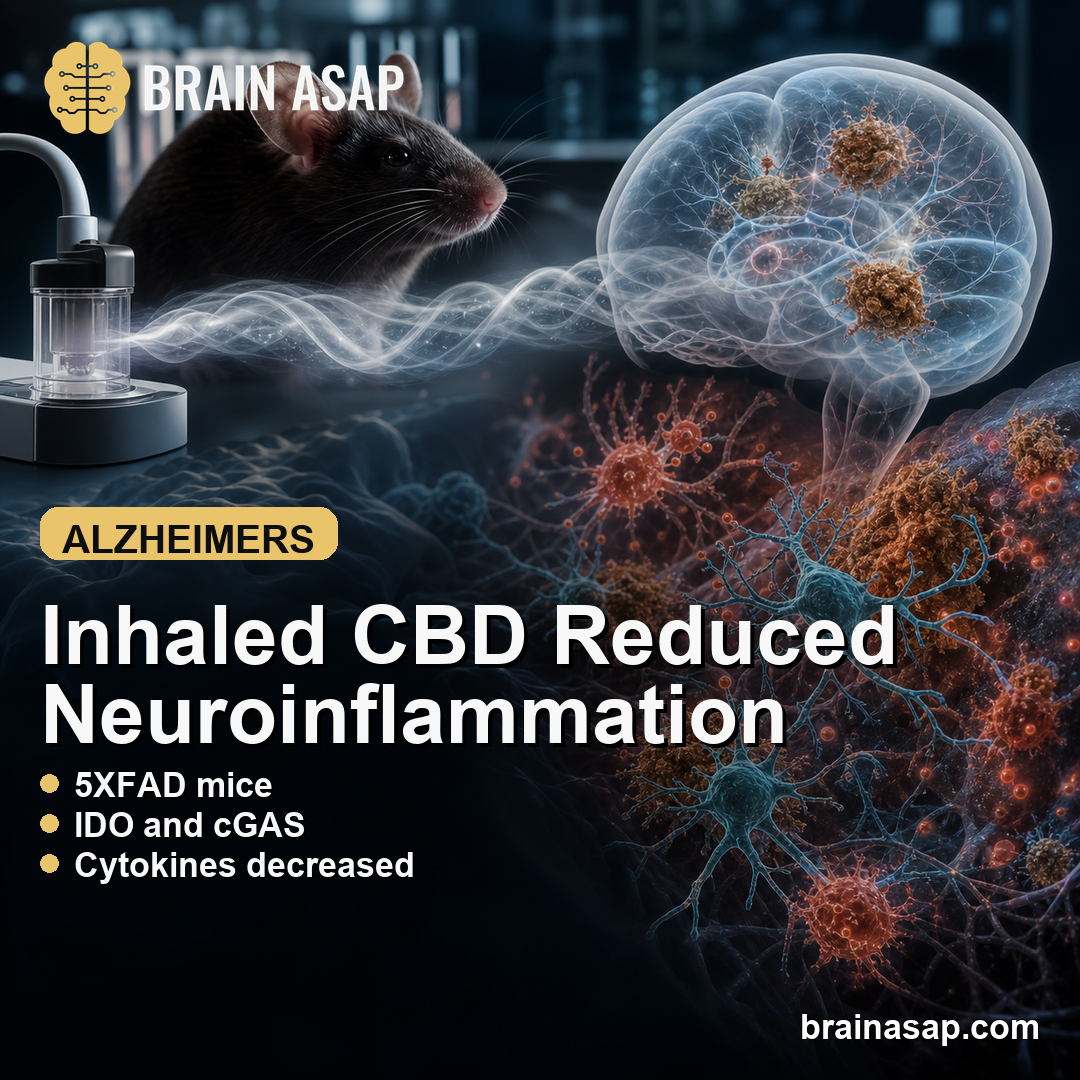
TL;DR: A 2025 mouse study in eNeuro reported that inhaled cannabidiol reduced IDO and cGAS pathway activity and lowered pro-inflammatory cytokines in male 5XFAD Alzheimer’s model mice.
Key Findings
- 5XFAD model: The study used male 5XFAD transgenic mice, a common amyloid-heavy Alzheimer’s disease model.
- Inhaled CBD: Cannabidiol was administered by inhalation rather than by oral dosing or injection.
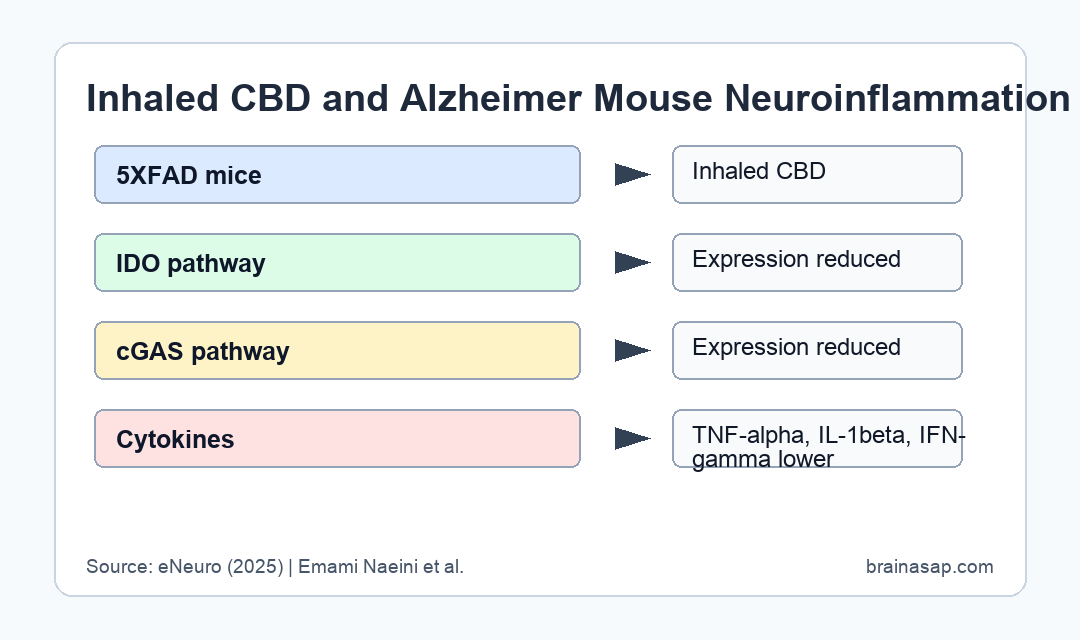
- IDO pathway: CBD treatment significantly reduced indoleamine 2,3-dioxygenase expression in the model.
- cGAS pathway: CBD also reduced cyclic GMP-AMP synthase expression, another immune-signaling pathway tied to neuroinflammation.
- Cytokine reduction: Pro-inflammatory cytokines including TNF-alpha, IL-1beta, and IFN-gamma decreased after CBD treatment.
Source: eNeuro (2025) | Emami Naeini et al.
Cannabidiol, or CBD, is often discussed in broad anti-inflammatory language. This study narrowed the question to two immune-metabolic pathways in an Alzheimer’s mouse model.
The result supports a mechanistic idea: CBD may affect neuroinflammation through IDO and cGAS signaling. It does not show that CBD treats Alzheimer’s disease in people.
Inhaled CBD Was Tested in Male 5XFAD Alzheimer's Model Mice
The researchers used the 5XFAD mouse model, a transgenic model that develops amyloid-related Alzheimer’s-like pathology. The study focused on male mice and delivered CBD by inhalation.
The route is important because inhaled delivery differs from the oral oils, capsules, and gummies many consumers associate with CBD. Dose, exposure, formulation, and model context all affect interpretation.
- Animal model: 5XFAD mice are useful for amyloid and inflammatory mechanisms but do not reproduce the full human disease.
- Intervention: CBD was administered as an inhalant formulation.
- Readouts: The team measured IDO, cGAS, cytokines, flow-cytometry markers, immunofluorescence, gene expression, and bioinformatics interactions.
The authors used an autoinflammatory model of Alzheimer’s disease, in which chronic immune dysfunction contributes to neuronal damage and disease progression.
CBD Reduced IDO and cGAS Immune-Signaling Pathways
The first pathway was IDO, short for indoleamine 2,3-dioxygenase. IDO is involved in tryptophan metabolism and immune regulation, and it can influence inflammatory signaling.
The second pathway was cGAS, short for cyclic GMP-AMP synthase. cGAS is part of innate immune sensing and can contribute to inflammatory responses when activated.
- IDO result: CBD treatment significantly reduced IDO expression in the 5XFAD model.
- cGAS result: CBD treatment also significantly reduced cGAS expression.
- Pathway meaning: Both pathways sit near immune-metabolic control points rather than amyloid plaque removal alone.
The more specific result is that inhaled CBD reduced IDO and cGAS expression, rather than merely producing a broad anti-inflammatory signal.
TNF-Alpha, IL-1beta, and IFN-Gamma Decreased After CBD
CBD treatment correlated with lower pro-inflammatory cytokines, including TNF-alpha, IL-1beta, and IFN-gamma. These cytokines are common inflammatory readouts in neuroimmune studies.
Researchers also used STRING-based bioinformatics to identify possible CBD-target interactions. Prioritized targets included AKT1, TRPV1, and GPR55, each tied to inflammatory signaling, nociception, immune activation, or cell survival.
- AKT1: A signaling protein involved in inflammatory regulation and cell-survival pathways.
- TRPV1: A receptor involved in nociception and neuroinflammatory signaling.
- GPR55: A receptor linked to immune-cell activation and cannabinoid-related biology.
- Cytokine direction: The main inflammatory cytokine markers moved downward after CBD treatment.
Bioinformatics can suggest plausible interactions, but it does not replace direct causal testing of every target. The strongest claims remain the measured IDO, cGAS, and cytokine changes in the mouse experiment.
The Result Supports Mechanism, Not Human CBD Treatment Claims
The study is relevant because Alzheimer’s drug development is increasingly interested in neuroinflammation, not only amyloid and tau. Still, a male mouse-model result is far from clinical proof.
The 5XFAD model is amyloid-heavy, genetically driven, and faster moving than typical human Alzheimer’s disease. A pathway change in that model cannot establish dosing, safety, cognitive benefit, or disease modification in patients.
- Supported claim: Inhaled CBD modulated IDO, cGAS, and inflammatory cytokine readouts in a 5XFAD mouse model.
- Unsupported claim: These mouse data do not show that CBD prevents, slows, or treats Alzheimer’s disease in people.
- Next evidence needed: Replication, dose-response work, female-mouse data, behavioral outcomes, and human clinical testing would be needed for translation.
The results support a specific immune-pathway hypothesis worth further study, but the evidence remains preclinical.
IDO and cGAS Give CBD a More Specific Alzheimer's Hypothesis
One reason this study is more useful than generic CBD commentary is that it names measurable immune pathways. IDO connects inflammation to tryptophan metabolism, while cGAS links cellular danger sensing to innate immune activation.
If those pathways remain overactive in Alzheimer’s disease, lowering them could theoretically reduce inflammatory pressure around neurons. The reductions in cytokine signaling in these mice are consistent with that hypothesis but do not establish it in humans.
- Specific mechanism: The study focused on immune-metabolic signaling rather than broad claims about cannabis or wellness.
- Relevant disease frame: Neuroinflammation is a serious Alzheimer’s research target, especially as amyloid-only strategies remain incomplete.
- Key uncertainty: It remains unclear whether lowering these pathways improves memory, preserves synapses, or changes disease course in people.
The conservative interpretation is that inhaled CBD changed neuroimmune markers in a mouse model. Any human recommendation would require a different evidence base.
Another boundary is the delivery route. Inhaled CBD may produce a different exposure pattern than oral CBD, and the study did not compare consumer products, purified oral formulations, or prescription cannabinoid medicines.
The mouse model also narrows the conclusion. A 5XFAD experiment can test amyloid-linked neuroinflammation quickly.
Human Alzheimer’s disease usually includes mixed amyloid, tau, vascular, immune, and aging biology over many years. That broader disease setting needs separate clinical testing.
Citation: DOI: 10.1523/ENEURO.0114-25.2025. Emami Naeini et al. Rethinking Alzheimer’s: Harnessing cannabidiol to modulate IDO and cGAS pathways for neuroinflammation control. eNeuro. 2025.
Study Design: Preclinical mouse-model study with flow cytometry, immunofluorescence, gene expression, cytokine assays, and bioinformatics.
Sample/Model: Male 5XFAD transgenic Alzheimer’s model mice treated with inhaled CBD.
Key Statistic: CBD reduced IDO and cGAS expression and lowered TNF-alpha, IL-1beta, and IFN-gamma inflammatory markers.
Caveat: The study does not establish human Alzheimer’s treatment efficacy or consumer CBD dosing guidance.