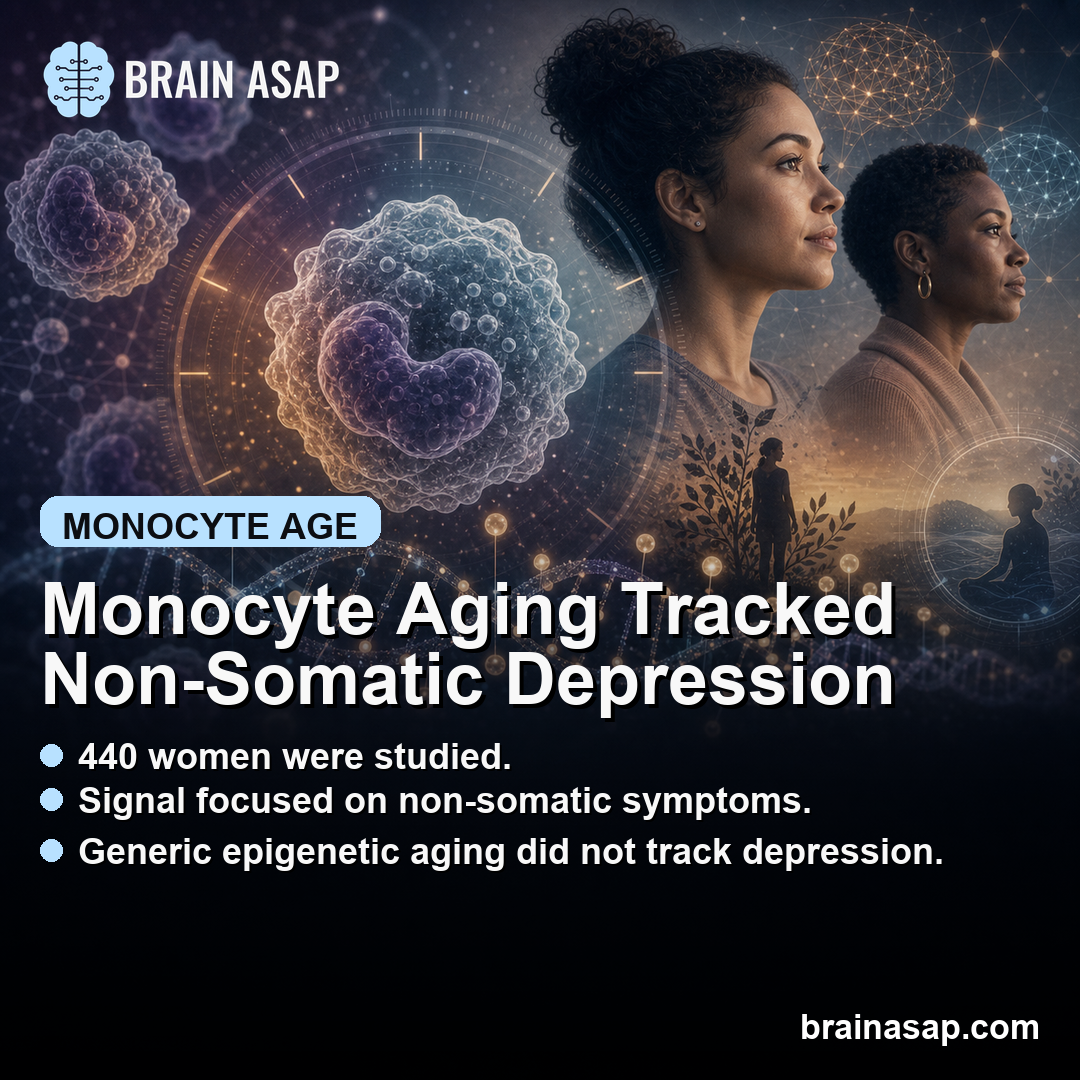
TL;DR: A 2026 study in The Journals of Gerontology, Series A: Biological Sciences and Medical Sciences measured a monocyte-specific DNA methylation clock (MonoDNAmAge) in 440 women with and without HIV, and found that accelerated monocyte epigenetic aging was specifically linked to non-somatic depressive symptoms (anhedonia, hopelessness, cognitive impacts) but not to broader depression severity, supporting the search for biological markers of distinct depression subtypes.
Key Findings
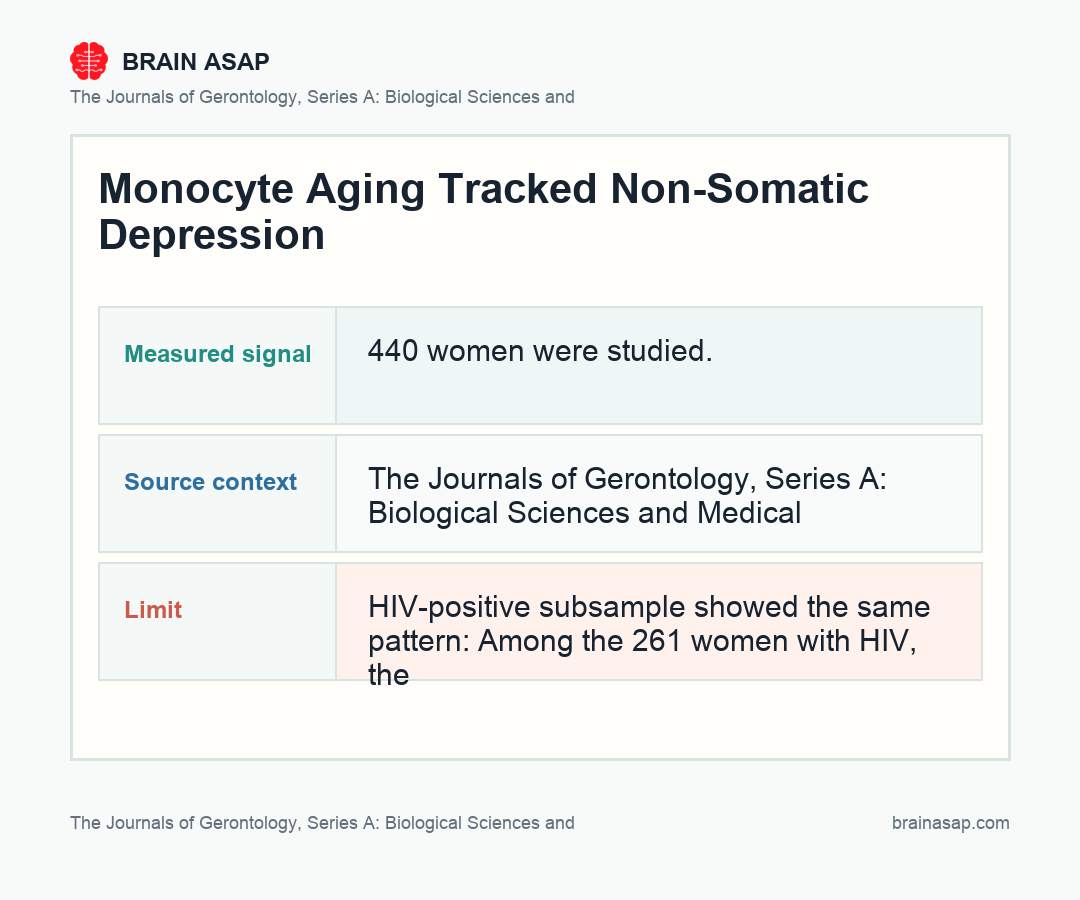
- Monocyte epigenetic age tracked non-somatic depressive symptoms: In the full sample of 440 women, monocyte epigenetic age acceleration (EAAMono) was associated with non-somatic depressive symptoms (β = 0.125, p = 0.018), specifically anhedonia (β = 0.354, p = 0.007), after adjusting for HIV status, race, and ethnicity.
- The signal was specific to monocyte aging, not general aging: A separate generic biological-aging measure (HorvathDNAmAge) was not associated with depression severity or symptom domains. The link is to monocyte-specific aging, not to overall epigenetic aging.
- HIV-positive subsample showed the same pattern: Among the 261 women with HIV, the EAAMono-to-non-somatic-depression association persisted (β = 0.112, p = 0.085) — trending in the same direction with a smaller sub-sample.
- Sample design: 440 participants from the Women’s Interagency HIV Study; 261 women with HIV (mean age 43.7 years; 38% Black; 48% Hispanic) and 179 women without HIV (mean age 39.5 years; 31% Black; 49% Hispanic).
- Implication for biological markers of depression: Depression today is diagnosed by patient self-report; there is no objective laboratory test. A biomarker that picks up specifically the non-somatic symptom domain would help untangle the heterogeneity of depression diagnoses.
- Why monocytes: Monocytes are key innate immune cells, and accelerated aging of these cells fits a chronic-inflammation model of depression that has been especially relevant in immune-affected populations such as women living with HIV.
Source: The Journals of Gerontology, Series A: Biological Sciences and Medical Sciences (2026) | Perez et al.
Depression affects roughly 1 in 5 adults in the United States, but is still diagnosed entirely by patient-reported symptoms.
The lack of an objective biological marker is part of why depression is hard to detect early and hard to subtype clinically — two patients with the same diagnosis may have very different underlying biology and very different symptoms.
This study tested whether a specific epigenetic-aging measure could pick up the biology of one of those subtypes.
Why Monocyte Epigenetic Aging Was the Target
The methodological premise rests on three connected ideas. The goal was framed directly:
Researchers analyzed data from a long-term study of women living with and without HIV. Sample details:
- Participants: 440 women.
- Women with HIV: 261; mean chronological age 43.7 (SD 8.9) years; 38% Black; 48% Hispanic.
- Women without HIV: 179; mean chronological age 39.5 (SD 10.0) years; 31% Black; 49% Hispanic.
- Outcome measure: Center for Epidemiologic Studies Depression Scale (CES-D), a depression-symptom questionnaire.
- Biomarker measures: HorvathDNAmAge (general epigenetic-aging clock) and MonoDNAmAge (monocyte-specific epigenetic-aging clock), both orthogonalized with chronological age.
Comparing a generic epigenetic-aging clock against a monocyte-specific one let the team test whether the depression signal lived in immune-cell aging specifically rather than in epigenetic aging more broadly.
Monocyte Aging Predicted Non-Somatic Depression, Not Somatic
Major finding: in the overall 440-woman sample, monocyte epigenetic age acceleration (EAAMono) was associated with the non-somatic depressive symptom domain.
The relevant numbers, all adjusted for HIV status, race, and ethnicity:
- EAAMono → non-somatic symptoms: β = 0.125, p = 0.018 in the full sample.
- EAAMono → anhedonia specifically: β = 0.354, p = 0.007 in the full sample.
- EAAMono → non-somatic symptoms in the HIV-positive subsample: β = 0.112, p = 0.085 — same direction, smaller sample, doesn’t quite clear conventional significance.
- EAAHorvath → depression severity or domains: No significant association.
The asymmetry between the two clocks is what makes the result mechanistically interesting. If general aging biology drove depression, the Horvath clock should also have shown a relationship. It didn’t. The signal lives specifically in monocyte aging.
Why Anhedonia Specifically
The anhedonia signal (β = 0.354, p = 0.007) is the strongest specific association in the analysis.
Anhedonia is the inability to feel pleasure or to retain interest in previously enjoyed activities. Clinically and biologically, it is one of the most important depression symptoms because:
- It tracks treatment resistance: Patients with prominent anhedonia tend to respond less well to standard SSRIs.
- It maps to a specific reward-circuit biology: Anhedonia is linked to dopamine signaling and reward-circuit dysfunction in ways the broader depression label is not.
- It is a transdiagnostic feature: Anhedonia appears across depression, schizophrenia, and trauma-related conditions, which makes a biomarker that picks it up potentially useful beyond depression alone.
Finding that monocyte epigenetic aging tracks anhedonia in particular suggests the inflammation-monocyte pathway may relate more directly to reward-circuit symptoms than to vegetative/somatic features.
Cross-Sectional Design, Women-Only Sample, and CES-D Screening Are Real Limits
- Cross-sectional design: The associations are measured at a single time point. Whether monocyte aging precedes the symptoms, follows them, or moves with them in real time cannot be determined here.
- Causality is not addressed: The β coefficients describe correlation strength. Whether accelerated monocyte aging causally drives non-somatic depression, or whether both share an upstream cause (chronic stress, inflammation), is not testable from this design.
- Sample is women only: The cohort came from the Women’s Interagency HIV Study. Whether the same monocyte-aging-to-anhedonia link holds in men or in non-HIV-affected populations needs separate testing.
- HIV-positive subsample finding was at p = 0.085: The pattern persisted in the HIV-positive subsample but did not clear conventional significance, likely reflecting reduced statistical power. Replication in a larger HIV-positive cohort is needed.
- CES-D is a screening instrument, not a diagnostic: Depression severity and symptom-domain breakdown were measured by self-report on the Center for Epidemiologic Studies Depression Scale rather than a structured clinical interview.
Symptom-Domain Biomarkers Beat Severity-Score Biomarkers in This Comparison
The work points toward a specific direction for depression-biomarker research:
- Symptom-domain biomarkers may work better than overall-severity biomarkers: The monocyte-aging signal showed up against non-somatic symptoms specifically, not against the global depression score. Future biomarker work may need to be subtype-specific from the start.
- Immune-cell aging is a candidate target: The fact that monocyte-specific aging tracked depression while general epigenetic aging did not argues for measuring the immune-cell window directly when looking for inflammation-linked depression biology.
- Anhedonia-specific biology is testable: A biomarker tied to anhedonia could help identify patients more likely to need anhedonia-targeted treatment rather than standard antidepressant prescriptions.
- HIV-affected populations need targeted attention: Women living with HIV face elevated depression risk through chronic inflammation, social stigma, and economic stress. A monocyte-aging biomarker may be especially useful for this population’s clinical care, where consistent treatment engagement is essential for both mental health and HIV outcomes.
Citation: DOI: 10.1093/gerona/glag083. Perez NB et al. Monocyte Epigenetic Age Acceleration is Linked to Non-Somatic Depressive Symptoms in Women with and Without HIV. The Journals of Gerontology, Series A: Biological Sciences and Medical Sciences. 2026.
Study Design: Cross-sectional analysis of DNA methylation clocks (Horvath general and monocyte-specific) and CES-D depression symptoms; multiple linear regression adjusted for HIV status, race, and ethnicity.
Sample Size: 440 women from the Women’s Interagency HIV Study (261 with HIV, 179 without). Mean age 43.7 (HIV+) and 39.5 (HIV-).
Key Statistic: EAAMono associated with non-somatic depressive symptoms (β = 0.125, p = 0.018) and with anhedonia specifically (β = 0.354, p = 0.007); pattern persisted in HIV+ subsample (β = 0.112, p = 0.085). EAAHorvath not associated with depression severity or symptom domains.
Caveat: Cross-sectional design cannot establish causality or temporal direction; women-only sample drawn from an HIV-cohort study; HIV+ subsample finding fell short of conventional significance; depression measured by self-report screening instrument rather than structured clinical interview.