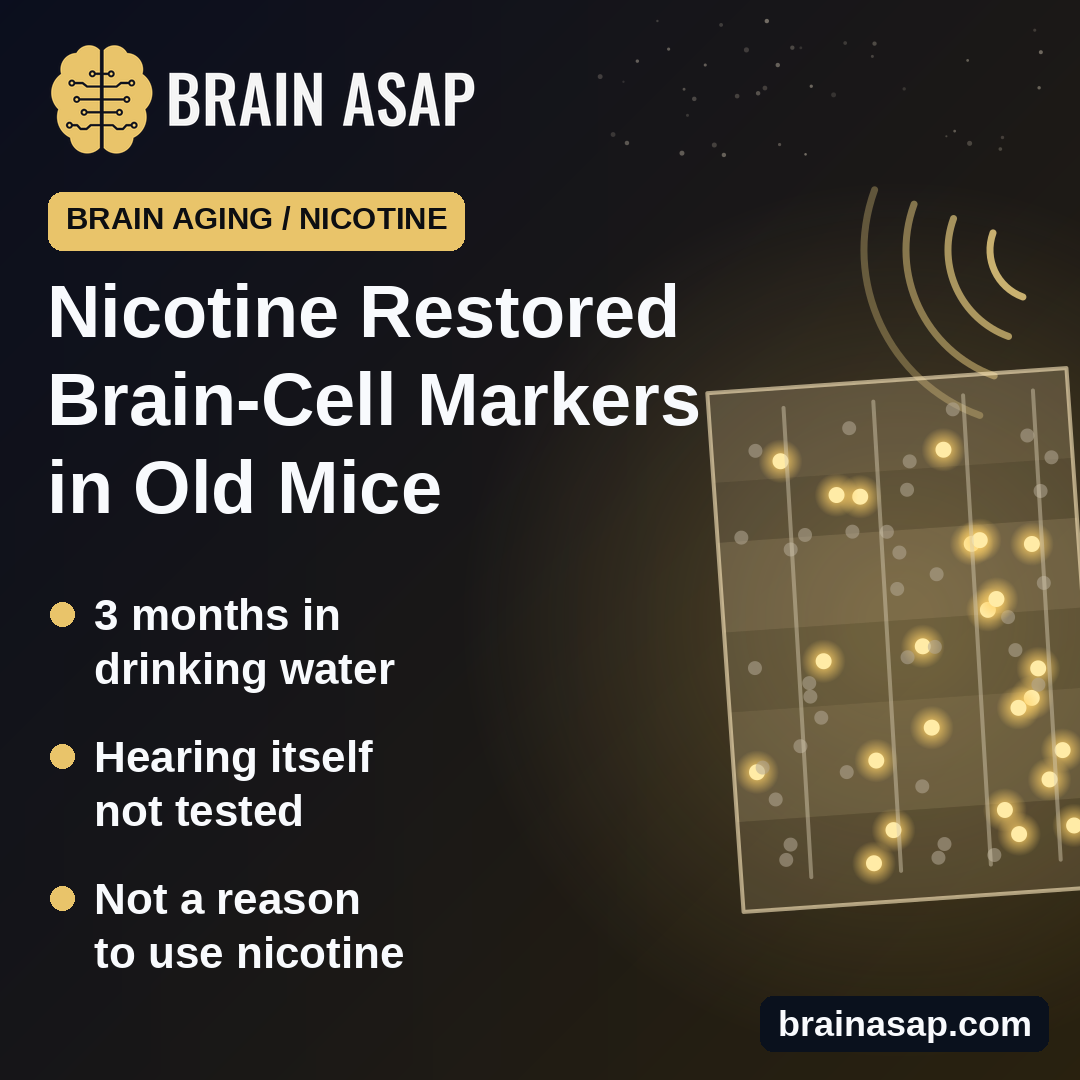
TL;DR: Old mice given nicotine in their drinking water for 3 months had more cells carrying two key markers of brake-like neurons in the hearing part of the brain, reaching young-adult levels. The study did not test hearing, and it is no reason for anyone to take up nicotine.
Key Findings
- Markers fell with age: Counts of three types of inhibitory neurons dropped, mostly by 12 months.
- Nicotine reversed two: PV and VIP cell counts rose to near young-adult levels at 12, 18 and 24 months.
- Partial for a third: SOM cells rose only at 12 months.
- Likely more protein, not new cells: PV brightness rose 22% within the normal range.
- Hearing not tested: Only brain tissue was examined.
Source: Frontiers in Aging Neuroscience (2026) | Intskirveli et al.
Many older adults can hear speech but struggle to follow it, especially in a noisy room. Hearing aids make sounds louder, but part of the problem sits in the brain, where sound gets sorted and sharpened.
That sharpening depends on inhibitory neurons, the brain’s brakes. A team at the University of California, Irvine, asked whether nicotine, which acts on receptors these cells carry, could counter their decline in aging mice.
The Brain’s Brakes Fade With Age
Inhibitory neurons in the cortex fall mainly into three types, each named for a protein they carry: parvalbumin (PV), somatostatin (SOM) and vasoactive intestinal peptide (VIP). A fourth, rarer group carries a nicotine receptor called alpha-2.
The researchers counted these cells in the hearing area of the cortex in 65 mice, from young adults at 2 months to old age at 24 months. Mice of this strain typically live about 2 years.
- SOM cells: Strong, steady decline with age
- PV and VIP cells: Declined, mostly by 12 months
- Alpha-2 cells: No change in number
- Cortex thickness: 13% thinner by 12 months, then stable
Three Months of Nicotine Water
Starting at 9, 15 or 21 months of age, mice were split into two groups for 3 months:
- Nicotine group: Nicotine in drinking water, sweetened with saccharin to mask the taste
- Comparison group: Saccharin water only
Blood tests in a few treated mice showed steady levels of cotinine, a breakdown product of nicotine. Both groups kept their weight.
Two Markers Climbed Back to Young-Adult Levels
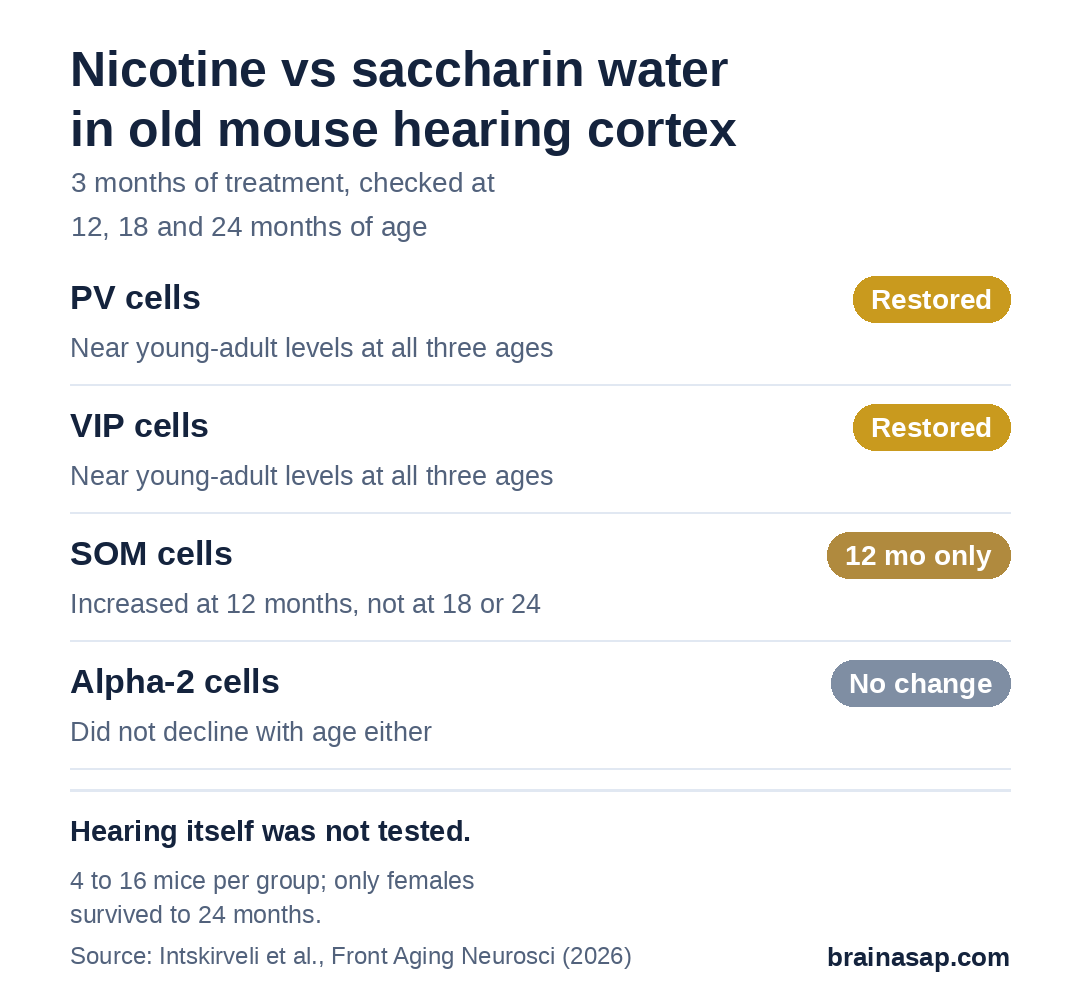
Because the boost appeared even when nicotine started after much of the decline, the authors describe it as reversal rather than prevention.
Brighter Cells, Not New Ones
Do more counted cells mean new neurons? Probably not. When the team measured how brightly PV cells glowed in 12-month-old mice, nicotine shifted the whole range upward, with a 22% higher median, but never above the brightest cells in untreated mice.
That pattern suggests existing neurons that had dimmed below the counting threshold started making more of their marker protein again. A similar shift has been seen after sound training in older animals.
Mouse Tissue, Not Better Hearing
- No hearing tests: The study counted cells; it did not measure hearing or sound processing
- Markers, not function: More marker protein does not prove stronger braking
- Small groups: 4 to 16 mice per age and treatment
- Females only at 24 months: Male mice of this strain did not live that long
- Counting not formally blinded: Images were unlabeled, and a blinded recount at 12 months matched
- One strain: Age effects vary between mouse and rat strains
- Nicotine is addictive: Smoking and vaping carry well-known harms
Next: Does It Change What Old Mice Hear?
The authors’ earlier work found that nicotine can sharpen how hearing neurons tune to different pitches. The natural next step is to test whether 3 months of nicotine improves sound processing in old mice, and whether safer drugs aimed at the same receptors could do the same.
Citation: DOI: 10.3389/fnagi.2026.1876409. Intskirveli I, Lazar R, Hidalgo D, Metherate R. Chronic nicotine reverses age-related decline of interneuron markers in mouse auditory cortex. Front Aging Neurosci. 2026;18:1876409.
Study Design: Controlled experiment in Chrna2-EGFP transgenic FVB mice, nicotine vs saccharin-only water for 3 months at three ages.
Sample Size: 65 mice aged 2 to 24 months.
Key Statistic: Nicotine increased PV (p < 0.0001) and VIP (p < 0.0001) cell counts across 12 to 24 months; PV fluorescence median up 22%.
Caveat: Mouse tissue markers only; no hearing tests; small groups; females only at 24 months.