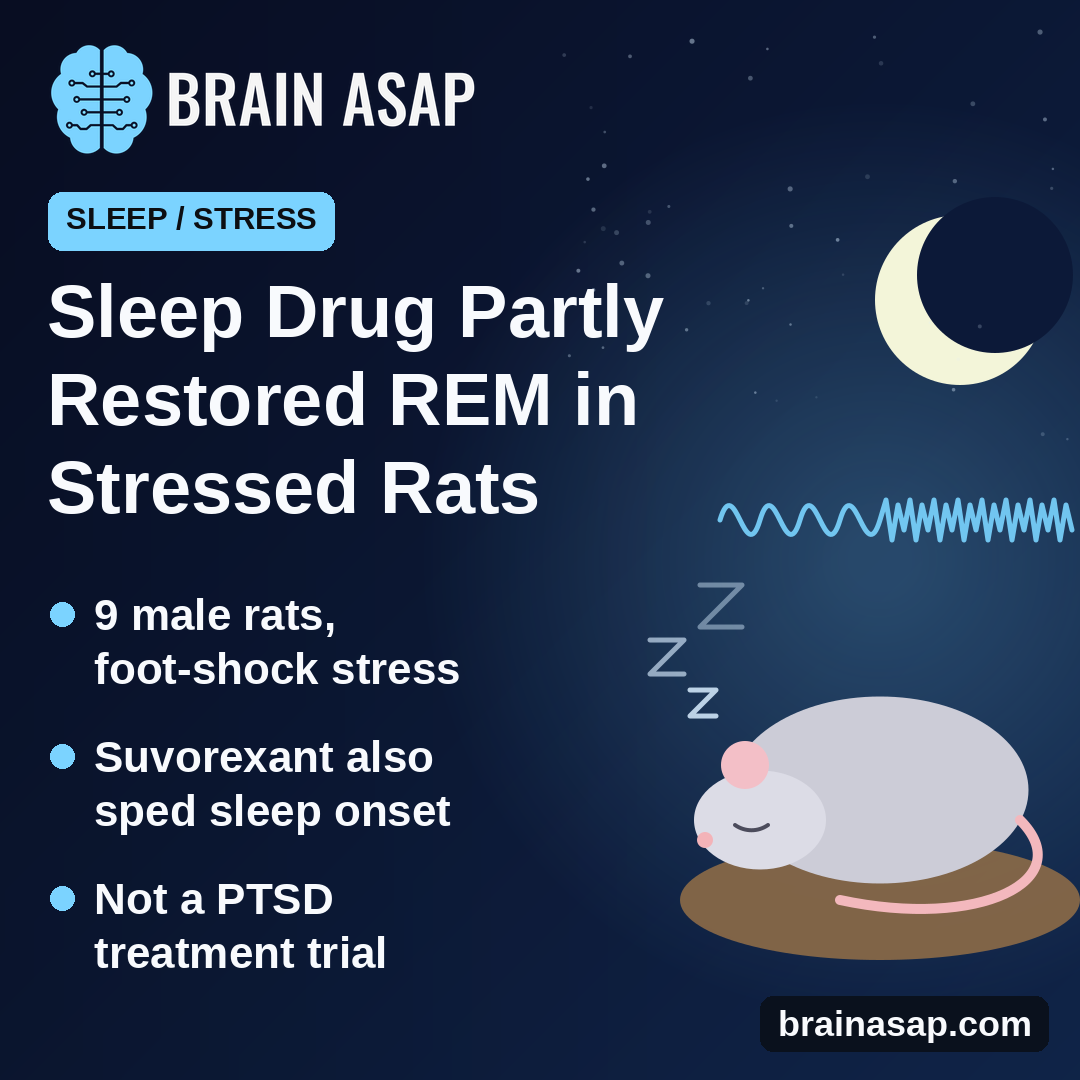
TL;DR: In rats stressed with mild foot shocks, REM sleep, the dream stage, dropped. The insomnia drug suvorexant and two related experimental drugs partly brought it back, and suvorexant also helped the rats fall asleep faster, but this was a small study in 9 male rats.
Key Findings
- Stress cut REM sleep: The share of time in REM fell after foot-shock stress.
- Total wake time unchanged: Stress reshuffled sleep stages rather than shortening sleep.
- All three drugs helped REM: Each partly restored REM after stress.
- Suvorexant sped sleep onset: The only drug that significantly shortened time to fall asleep after stress.
- Tiny study: 10 male rats entered, 9 analyzed, one dose per drug.
Source: Frontiers in Neuroscience (2026) | Lilly et al.
Up to 9 in 10 people with PTSD report insomnia, and many have nightmares. The usual sleeping pills carry risks of dependence, grogginess and misuse that are especially worrying in this group.
Researchers at UT Health San Antonio and the South Texas Veterans Health Care System tested a different kind of sleep drug in rats after a stressful experience.
Blocking the Brain’s Wake-Up Signal
Orexin is a brain chemical that keeps us awake and alert. It also rises with stress. It acts through two receptors, called OX1 and OX2.
Suvorexant, sold for insomnia, blocks both. The team compared it with two lab-only drugs:
- Suvorexant: Blocks both orexin receptors
- SB334867: Mostly blocks OX1
- EMPA: Blocks OX2 only
How the Rats Were Stressed and Recorded
Ten adult male rats wore small wireless sensors that recorded brain waves and neck-muscle activity, letting the team sort each moment into wake, non-REM sleep or REM sleep over 24 hours. One rat was later dropped for a technical failure.
- Week 1, before stress: A 24-hour recording after an inactive injection, then one after each drug
- Stress session: 15 brief, mild foot shocks over 90 minutes that the rats could not escape
- After stress: The same series of recordings, one per day
Each rat served as its own comparison, and all drugs were given at one dose.
Stress Took Away Dream Sleep
After the shocks, rats on the inactive injection spent a smaller share of time in REM sleep. Non-REM sleep took up a slightly larger share, though that rise was not quite significant. Total time awake did not change, and the rats took somewhat longer to fall asleep.
In other words, stress reshuffled sleep rather than cutting it.
Suvorexant Did the Most After Stress
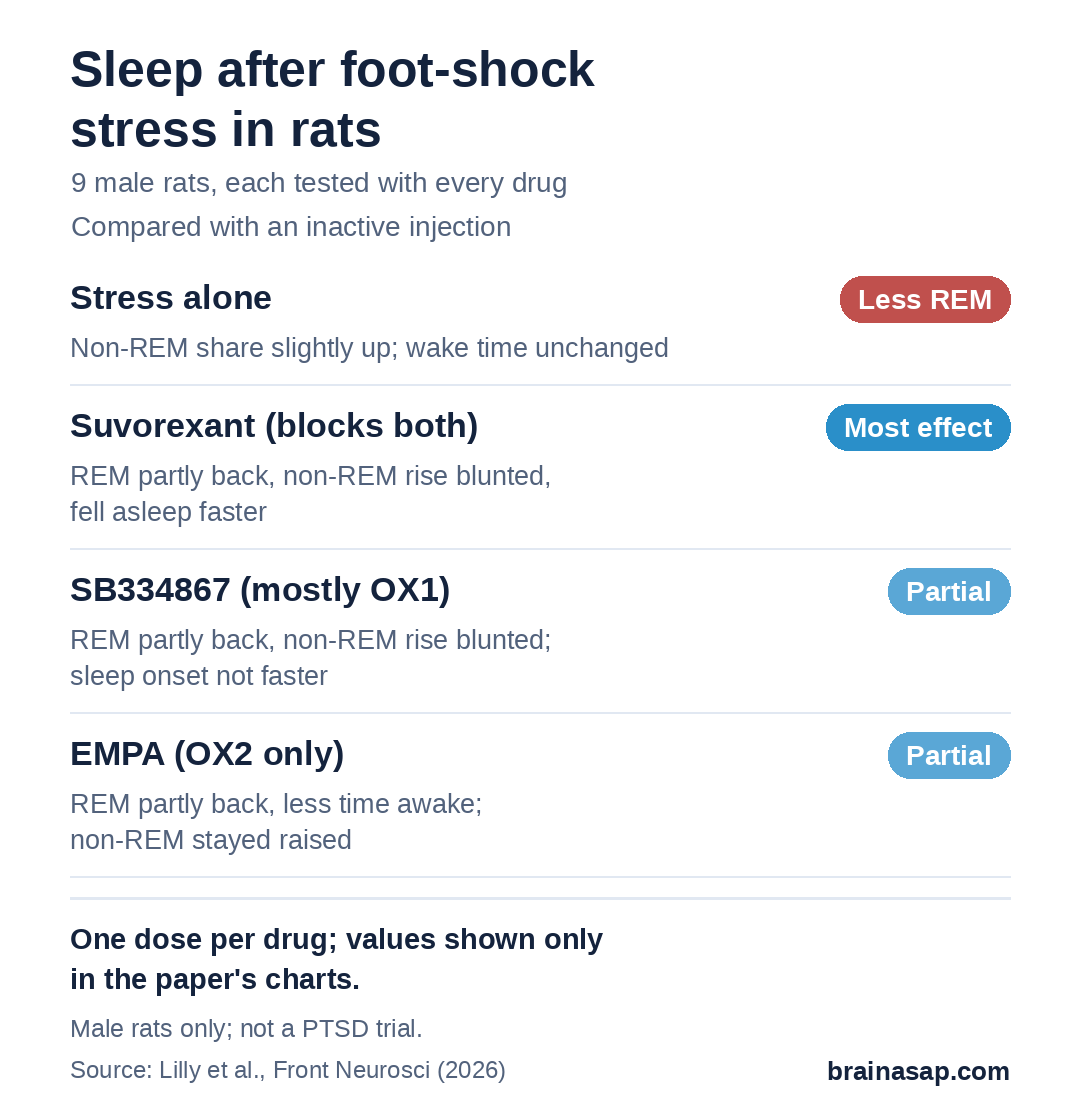
All three drugs partly brought back REM sleep after stress. The rise in non-REM sleep was blunted with suvorexant and SB334867 but not with EMPA.
Only suvorexant significantly shortened the time it took to fall asleep after stress. Only EMPA cut total time awake after stress; the study did not measure activity, so it cannot say whether that reflects sedation.
A Small Rat Study, Not a PTSD Trial
- Few animals: 9 rats analyzed; a couple of recordings dropped for technical problems
- Males only: Women are more likely to have PTSD and sleep problems
- One dose per drug: EMPA in particular may need higher doses to reach the brain
- Fixed order after stress: The inactive injection always came first, so some of the stress effect may have worn off by later drug days
- Not blinded: The person cleaning the recordings knew the condition
- Coarse sleep stages: Non-REM was not split into light and deep sleep
- No nightmares or behavior measured: Only sleep timing and stages
An earlier human trial of suvorexant for trauma-related insomnia found that people improved on both the drug and placebo, making a drug effect hard to see.
Larger Trials in People With PTSD Are Needed
The results add to the case that orexin blockers could help sleep after stress without simply knocking people out. The next step is a properly powered trial in people with PTSD that measures REM sleep, nightmares and daytime function, ideally in women as well as men.
Citation: DOI: 10.3389/fnins.2026.1898419. Lilly K, Perez SM, Lodge DJ. Orexin receptor antagonists attenuate acute stress-induced disruptions in sleep states. Front Neurosci. 2026;20:1898419.
Study Design: Within-subject experiment in adult male rats with EEG/EMG sleep recordings before and after inescapable foot-shock stress.
Sample Size: 10 rats entered, 9 analyzed.
Key Statistic: Stress reduced REM (p < 0.001); after stress all three antagonists increased REM vs vehicle (p < 0.001); suvorexant cut sleep-onset latency (p < 0.001).
Caveat: Small male-only rat study; one dose per drug; fixed vehicle-first order after stress; not a clinical PTSD result.