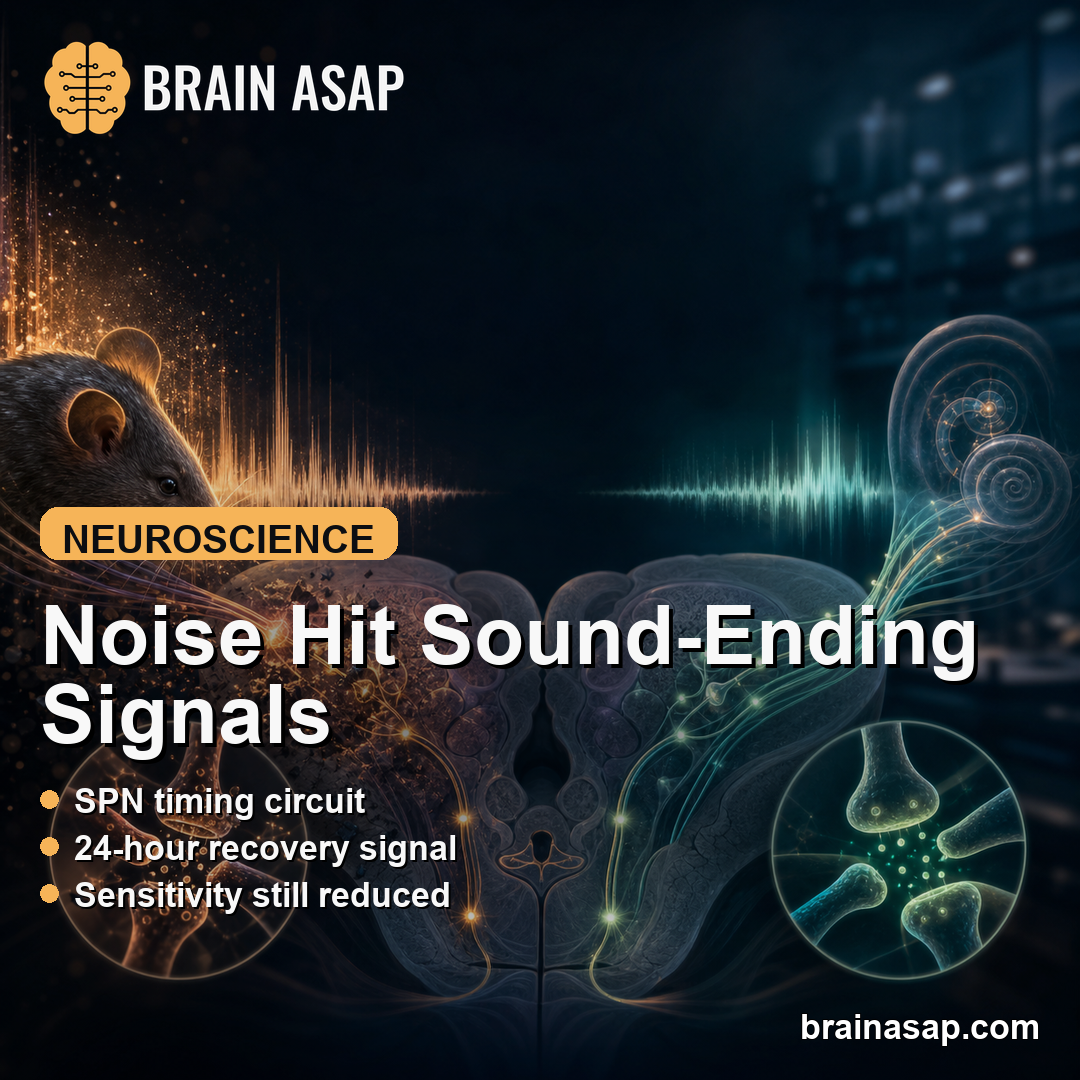
TL;DR: A 2026 mouse study in The Journal of Physiology found that damaging noise temporarily disrupted sound-offset responses in a brainstem hearing circuit, but those timing responses partly recovered within 24 hours through rapid circuit adaptation.
Key Findings
- Sound-offset responses mark when sound ends: researchers studied neurons in the superior paraolivary nucleus (SPN), a brainstem region involved in detecting sound termination and brief gaps.
- Noise exposure disrupted the timing response: immediately after damaging noise, SPN neurons lost much of their ability to respond to the end of a sound.
- Recovery began quickly: within 24 hours, SPN neurons became more excitable and received stronger inhibitory synaptic input.
- The adaptation helped louder sounds first: offset responses to louder sounds recovered earlier, while sensitivity to quieter sounds remained reduced.
- Hearing damage was not reversed: the study points to rapid brainstem compensation for timing, not full restoration of inner-ear sensitivity.
Source context: This BrainASAP draft is based on the underlying paper record and captured source file, not the Neuroscience News discovery page.
Hearing is not only about detecting when a sound begins. The brain also needs to know when a sound stops, because pauses and endings help define speech rhythm, sound duration, and the boundaries between auditory events.
The new study focused on sound-offset responses, the neural activity that marks the end of a sound. Researchers used mice to examine how this timing response changes after damaging noise exposure.
Noise Exposure Disrupted a Brainstem Sound-Offset Circuit
The circuit of interest sits in the superior paraolivary nucleus (SPN), a small brainstem region involved in auditory timing. In normal hearing, SPN neurons respond precisely when a sound ends.
That response depends on two interacting features. Sound-driven inhibitory input shapes when the neuron can fire, and the neuron’s own electrical properties help convert the end of inhibition into a sharp offset pulse.
- Auditory input: the inner ear and lower auditory pathway deliver information about the sound.
- Inhibitory timing: synaptic input helps define the pause or end point.
- Intrinsic excitability: SPN neurons use their own membrane properties to produce the offset response.
After damaging noise exposure, this system did not behave normally. Immediately after the exposure, SPN neurons lost their ability to respond clearly when sounds ended.
SPN Neurons Began Recovering Within 24 Hours
Recovery happened quickly in the circuit response. Within 24 hours, researchers saw early recovery in the offset pathway even though hearing sensitivity was still impaired.
SPN neurons became more excitable, meaning they were more ready to fire. At the same time, they received stronger inhibitory input, reflected by more active inhibitory synaptic connections.
Those two changes sound opposite, but they can work together in an offset circuit. Stronger inhibition during the sound and higher excitability after inhibition ends can help the neuron fire at the moment the sound stops.
- Immediately after noise: offset responses were reduced or lost.
- During early recovery: SPN neurons increased excitability and inhibitory synaptic drive.
- After compensation: offset responses to louder sounds started to return.
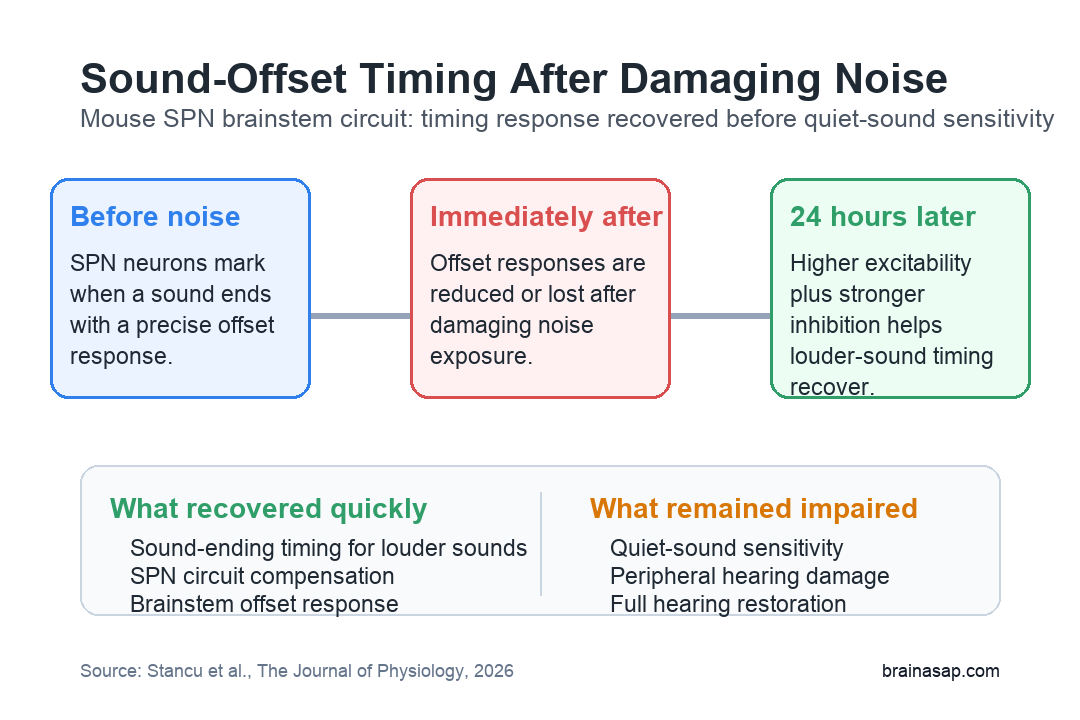
Timing Recovered Before Quiet-Sound Sensitivity
The study makes an important distinction. A recovered offset response is not the same thing as restored hearing sensitivity.
The captured source file describes early restoration for louder sounds. Sensitivity to quieter sounds remained diminished, which means the auditory system still carried the effect of noise injury.
This timing-sensitivity split is important because different parts of hearing can fail and recover on different timelines. A person or animal might process the rhythm of a loud sound better while still struggling with quiet inputs.
- Timing function: detecting the end of a sound or a brief pause.
- Sensitivity function: detecting quieter sounds at lower intensity.
- Compensation limit: the brainstem can adjust circuit timing without fully repairing the peripheral injury.
Practical interpretation: the result supports a compensation model. The brainstem auditory circuit can reorganize quickly to preserve one timing function after noise damage, but that compensation leaves the original hearing loss unresolved.
Patch-Clamp and In Vivo Recordings Traced the Circuit Change
Researchers combined several methods to examine the SPN after noise exposure. The captured source names patch-clamp recordings, immunohistochemistry, and in vivo electrophysiology.
Patch-clamp recordings measure electrical behavior in individual neurons. Immunohistochemistry helps mark cellular or synaptic features. In vivo electrophysiology records activity in living animals, closer to the operating auditory circuit.
Together, those methods let researchers ask whether recovery was only a behavioral observation or whether the circuit itself had changed.
- Cell-level evidence: SPN neurons became more excitable after the noise exposure.
- Synaptic evidence: inhibitory connections increased in number or activity.
- System-level evidence: sound-offset responses returned for louder sounds during early recovery.
The method mix strengthens the result because the adaptation appeared at more than one level of the auditory pathway.
The Result Points to Rapid Auditory Resilience, Not Full Repair
The auditory brainstem is not a passive receiver of damaged input. It can adjust quickly when the inner-ear drive is weakened by noise.
Still, the finding should not be read as a reason to dismiss noise injury. The same source file notes that quiet-sound sensitivity remained reduced, and the experiment was done in a mouse model rather than in people exposed to everyday urban noise.
The study is most relevant for understanding how timing information survives sensory injury. Speech and communication depend on brief silences, pauses, and endings, so a fast offset-recovery mechanism could help preserve some auditory structure even when sensitivity is worse.
Clinical boundary: the research does not identify a treatment for noise-induced hearing loss. It identifies a circuit-level compensation process that may help future work separate recoverable timing functions from harder-to-repair sensory damage.
Citation: DOI: 10.1113/jp289987. Study authors et al. Noise-induced reduction and early recovery of superior paraolivary nucleus sound-offset responses. The Journal of Physiology. 2026.
Study Design: Mouse auditory-neuroscience experiment using noise exposure, brainstem recordings, and circuit-level analysis.
Sample/Model: Mouse model focused on superior paraolivary nucleus neurons after damaging noise exposure.
Key Statistic: The captured source reports early recovery of sound-offset responses within 24 hours, especially for louder sounds.
Caveat: The captured source file does not provide sample size or full exposure parameters, and the result describes brainstem compensation rather than complete recovery from hearing damage.