Dirty Air, Fragile Brain: PM2.5’s Direct Link to Alzheimer’s
TL;DR: A massive study of 27.8 million Medicare beneficiaries found that exposure to fine air pollution (PM2.5) increases Alzheimer’s risk by 8.5% per unit increase—and this effect operates largely through direct brain damage, not through common health conditions like stroke or depression.
The conventional thinking about air pollution and dementia involves a detour through the cardiovascular system. Dirty air damages the heart and blood vessels, which then cascades into cognitive decline. But a groundbreaking analysis of nearly 28 million older Americans suggests the brain isn’t waiting for permission from the circulatory system to deteriorate. PM2.5—the microscopic particles that penetrate deep into lungs and bloodstream—appears to assault cognitive tissue directly.
Key Findings
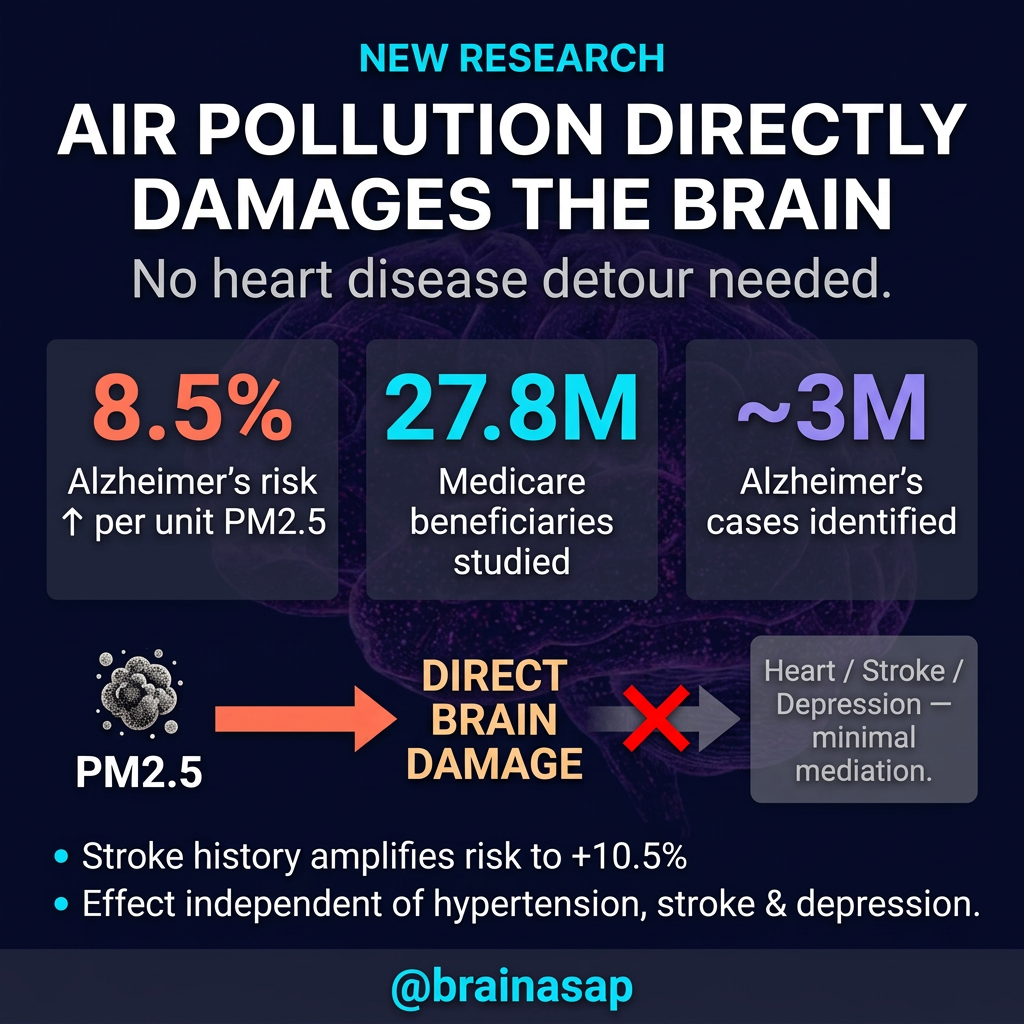
- 8.5% risk increase per unit: Each interquartile range increase in PM2.5 exposure (3.8 μg/m³) raised Alzheimer’s risk by 8.5% (hazard ratio 1.085, 95% CI: 1.078–1.091) in the overall population.
- Stroke amplifies vulnerability: Individuals with a history of stroke showed 10.5% elevated risk per unit PM2.5 increase, suggesting vascular damage primes the brain for pollution-related neurodegeneration.
- Direct pathway dominates: Comorbidities explained only minimal mediation—hypertension mediated 1.6%, stroke 4.2%, and depression 2.1% of the PM2.5–Alzheimer’s association, indicating pollution acts independently of these conditions.
- Massive national cohort: Study tracked 27.8 million Medicare beneficiaries aged 65+ from 2000–2018, identifying ~3.0 million incident Alzheimer’s cases with high statistical power across stratified analyses.
- Independent of comorbidities: All three comorbidities (hypertension, stroke, depression) were individually linked to elevated AD risk, yet comorbidities did NOT serve as mediating pathways for the pollution effect.
- Five-year exposure window matters: The risk association used 5-year moving averages prior to AD onset, capturing the relevant exposure period without conflating early preclinical disease with pollution burden.
Source: PLOS Medicine (2026) | Deng et al.
A Population-Scale Reckoning with Air Quality and Brain Health
Alzheimer’s disease affects over 5 million Americans, but prevention has remained elusive. The disease’s gradual, decades-long pathology—involving amyloid accumulation, tau tangles, and neuroinflammation—makes it hard to pinpoint causal culprits from traditional clinical trials. Population studies offer a different window: tracking millions of older adults, measuring their environmental exposures retrospectively, and asking whether polluted air correlates with dementia diagnosis.
This study did exactly that, leveraging Medicare claims data from the Centers for Medicare & Medicaid Services. The researchers used high-resolution satellite and ground-based air quality models to estimate daily PM2.5 concentrations at each beneficiary’s ZIP code, then linked those exposures to Alzheimer’s diagnoses recorded in claims.
Why Comorbidities Didn’t Explain the Link
The surprise here is what the data didn’t show. Hypertension, stroke, and depression are all established risk factors for Alzheimer’s disease. And the study confirmed they all remain strongly associated with dementia in this population. Yet when the researchers tested whether these comorbidities mediated the pollution effect—that is, whether dirty air causes hypertension, which then causes dementia—the math didn’t add up.
Hypertension mediated only 1.6% of the pollution–dementia link. Stroke, despite being the strongest modifier (elevating risk from 8.8% to 10.5%), explained just 4.2% of the effect. Depression accounted for 2.1%. This means roughly 93% of the association between PM2.5 and Alzheimer’s happened through channels other than these common conditions.
The finding inverts a popular hypothesis. It suggests that rather than air pollution triggering Alzheimer’s by damaging the heart and vessels—which then cause cognitive decline—pollution may directly injure the aging brain through neuroinflammation, oxidative stress, and amyloid pathway disruption.
The Stroke Vulnerability Subgroup: A Clue to Mechanism
One exception stood out. Participants with a history of stroke experienced a noticeably stronger association between PM2.5 and Alzheimer’s risk. The hazard ratio climbed from 1.088 (overall) to 1.105 in stroke survivors—a modest but statistically significant interaction.
This suggests a synergistic mechanism. Stroke damages cerebral blood vessels, impairs vascular integrity, and can disrupt the blood-brain barrier—the gatekeeper that normally shields the brain from harmful molecules. Pollution particles, toxic gases, and inflammatory mediators circulating in the bloodstream may exploit a compromised barrier more readily in stroke survivors.
Additionally, stroke-related injury can trigger chronic neuroinflammation and impair glymphatic clearance (the brain’s waste-disposal system). A brain already running a slow-motion inflammatory fire—and struggling to clear metabolic waste—may be exceptionally vulnerable to the additional oxidative insult of air pollution.
Methods That Tracked Real-World Exposure
The study’s statistical architecture deserves attention. Researchers didn’t simply ask “Do people exposed to more PM2.5 develop more dementia?” Instead, they constructed a carefully timed causal pathway: PM2.5 exposure → comorbidities → Alzheimer’s disease.
They required comorbidities to develop after baseline exposure began but before Alzheimer’s diagnosis. This temporal ordering—exposure first, then comorbidity, then dementia—mirrors biological causality. Participants entered the study after a 5-year “clean period” (free of the comorbidities of interest), ensuring a true incident cohort of newly diagnosed Alzheimer’s cases.
Exposure was estimated as 5-year moving averages of PM2.5 concentrations, capturing the relevant window without assuming that very recent pollution is what matters most. The team used Cox proportional hazards models stratified by age, sex, race, and Medicaid eligibility, then adjusted for dozens of covariates—socioeconomic status indicators, population density, smoking prevalence, body mass index, and healthcare capacity indicators—to minimize residual confounding.
[Insert image: causal pathway diagram showing PM2.5 → Alzheimer’s with minimal mediation through hypertension, stroke, and depression]
What the Effect Size Really Means
An 8.5% increase in risk per 3.8 μg/m³ elevation in PM2.5 sounds modest in isolation. But scale it up. The interquartile range of PM2.5 in this study was 3.8 μg/m³. Comparing someone in a clean air region (say, 5 μg/m³) to someone in a polluted region (say, 15 μg/m³) means roughly a 20% relative increase in Alzheimer’s risk attributable to air quality alone.
For a disease affecting millions of older Americans, a 20% population-attributable risk is substantial. And this study is just one among a growing ensemble of evidence. Prior national cohort studies reported similar effect sizes, with some meta-analyses finding hazard ratios ranging from 1.20 to 5.31 per 10 μg/m³ increase in PM2.5. The consistency across studies using different populations and methods lends credibility to the causal interpretation.
Limitations and the Residual Unknowns
No study is perfect, and this one faced real constraints. Air quality was estimated at the ZIP code level, not at individual residential addresses—a source of noise that could bias estimates toward the null (underestimating true effects). The analysis captured only 5-year average exposure immediately before Alzheimer’s diagnosis; if critical windows of vulnerability occur decades earlier, this study might miss them.
Disease diagnosis relied on Medicare claims, which could introduce misclassification if some Alzheimer’s cases went undiagnosed or were mislabeled as other dementias. However, prior validation work has shown that Medicare algorithms for dementia diagnosis have good specificity (95%) and moderate sensitivity (64%), suggesting the bias is likely nondifferential and would shift estimates toward the null rather than artificially inflate them.
The study could not account for indoor air pollution sources (cooking, heating, occupational exposure) or individual-level behavioral risk factors measured only at the area level, such as smoking rates. These unmeasured confounders could introduce residual bias, though the authors’ adjustment for dozens of ecological covariates and sensitivity analyses suggest any remaining distortion is likely modest.
Implications for Aging Populations and Public Health
If air pollution directly damages aging brains rather than working through cardiovascular intermediaries, the intervention landscape shifts. Reducing systemic inflammation or preventing stroke might offer partial protection, but the dominant strategy would be direct air quality improvement.
For individuals with cerebrovascular disease or stroke history, the data suggest heightened vulnerability. Targeted monitoring, cognitive screening, and aggressive environmental control (air filtration, relocation counseling in severely polluted areas, policy advocacy) might offer disproportionate benefit in this subgroup.
Broader policy implications are equally stark. If air pollution contributes to roughly one in twelve Alzheimer’s cases nationwide, improving air quality could prevent thousands of dementia diagnoses annually. This reframes air quality from an environmental concern to a neurological and gerontological imperative. Older adults represent the population most exposed (they spend more time indoors and outdoors in their own communities) and most vulnerable (aging brains have reduced compensatory capacity).
The Bigger Picture: Why Direct Brain Damage Makes Sense
The finding that pollution acts largely independently of comorbidities aligns with emerging mechanistic research. PM2.5 particles—especially those in the ultrafine range (< 0.1 μm)—can translocate from the lung into the bloodstream, cross the blood-brain barrier, and deposit directly in brain tissue. Once there, they trigger oxidative stress, activate microglia (brain immune cells), and promote neuroinflammation.
Studies in animals and postmortem human brains have documented PM2.5 particles in the hippocampus and prefrontal cortex, regions critical for memory and cognition. These particles are associated with increased levels of tau phosphorylation and amyloid-beta accumulation—the pathological hallmarks of Alzheimer’s disease. Such neuropathological findings suggest the brain isn’t just a passive casualty of systemic vascular damage; it’s under direct chemical siege.
This study demonstrates that the risk is real, population-scale, and substantially independent of the usual suspects (heart disease, stroke, depression). For millions of older Americans breathing polluted air, cognitive health may hinge not just on managing established cardiovascular risk factors, but on the simple fact of where they live and how clean the air they breathe is.
Citation: Deng Y, Liu Y, Hao H, Xu K, Zhu Q, Li H, Ma T, Steenland K. The role of comorbidities in the associations between air pollution and Alzheimer’s disease: A national cohort study in the American Medicare population. PLOS Medicine. 2026;23(2):e1004912. DOI: 10.1371/journal.pmed.1004912
Authors’ affiliations: Gangarosa Department of Environmental Health, Rollins School of Public Health, Emory University, Atlanta, Georgia, United States of America.