Your Brain Gets Louder as You Sleep — So Why Does Sleep Feel Deeper? The Answer Is Dreams.
TL;DR: Vivid, immersive dreaming makes sleep feel just as deep as complete unconsciousness—both rate identically—while the dim awareness of merely existing feels the shallowest, revealing that sleep depth depends on what’s happening in your mind, not just your brain’s electrical silence.
There’s a paradox buried in every night of sleep you’ve ever had. As the hours pass, your brain gets progressively noisier—high-frequency electrical activity increases, slow-wave power fades, and by traditional metrics, sleep is getting shallower.
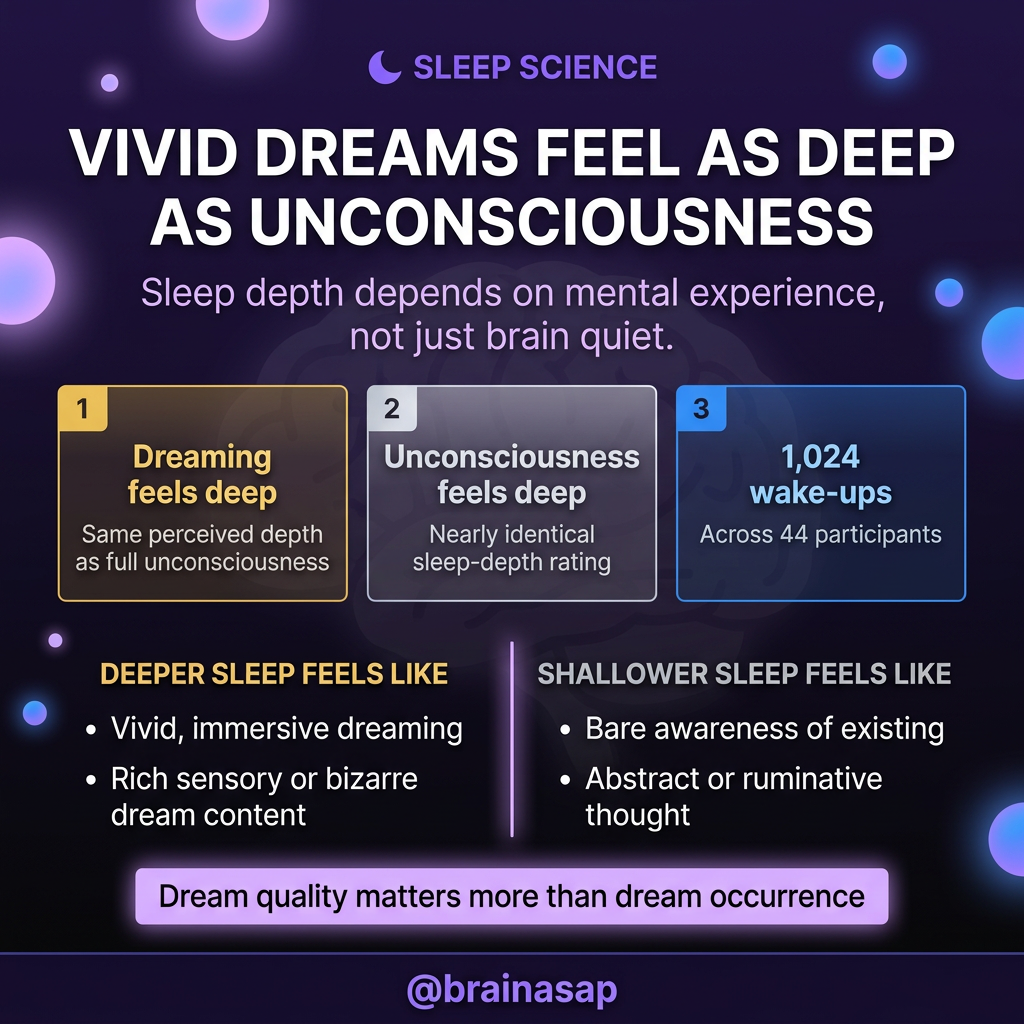
Yet ask someone how deeply they slept at 2 AM versus 5 AM, and they’ll tell you the later hours felt deeper and more restful. A team in Italy woke 44 people up 1,024 times to figure out why.
The answer upends one of the oldest assumptions in sleep science.
Key Findings
- Dreaming equals unconsciousness for perceived depth: Vivid, immersive dreaming produced perceived sleep depth ratings (β = 0.552) virtually identical to complete unconsciousness (β = 0.593) — the two highest-rated states. The shallowest perceived sleep came not from light sleep, but from a dim awareness of merely existing without dreaming (β = −0.195).
- Dreaming breaks the brain-sleep link: Dreaming decoupled brain activity from sleep perception: when participants were dreaming, the normal relationship between high-frequency cortical activation and feeling lightly asleep weakened significantly (interaction β = 0.380–0.467 at occipital electrodes, p < 0.05).
- Dream quality matters more than dream occurrence: The quality of dreaming mattered more than whether it happened. Perceptually immersive dreams (vivid, sensory, bizarre) predicted deep sleep (β = 0.277, p < 0.00001); abstract, ruminative thought predicted shallow sleep (β = −0.195, p = 0.00004). This held even for dreams participants couldn't remember.
- Dreams drive the nightlong paradox: Across the night, physiological sleep pressure (delta power) declined linearly — yet perceived sleep depth rose (β = 0.127, p < 0.00001). Dream immersiveness increased in parallel (β = 0.103, p < 0.0001), fully accounting for the paradox.
- Perceived depth and grogginess disconnect: Perceived depth and post-awakening sleepiness turned out to be separate phenomena. Dreamers reported deep sleep but woke alert; the truly unconscious reported deep sleep but woke groggy — suggesting dreams facilitate a smoother transition back to wakefulness.
This study analyzed 44 healthy adults (mean age 26.4, 21 female) across 196 overnight sessions using an exceptionally dense measurement setup:
- EEG system: 256-electrode high-density array — one of the densest brain-recording configurations available
- Sleep stage: Serial awakening protocol targeting NREM Stage 2 sleep exclusively
- Sample size: 196 total overnight sessions pooled across participants
Source: PLoS Biology (2026) | Michalak, Marzoli, Pietrogiacomi et al.
Waking People Up 1,024 Times to Measure What Sleep Feels Like From the Inside
The basic design was elegant. Each participant spent four nights wired into a 256-electrode EEG cap. Researchers watched the EEG in real time, waited for the participant to reach N2 sleep—roughly half of all sleep time—and then triggered an alarm. Within 30 seconds, the groggy participant answered: What were you experiencing? How deeply were you sleeping? How sleepy do you feel?
From 1,024 awakenings across all participants, researchers classified reports into four categories (shown below):
- Vivid dream with recall: 42.2% of awakenings — the person was somewhere, doing something, seeing things
- Dream without recall: 36% — “I was dreaming but I can’t tell you what about”
- Sense of presence: 11.5% — a dim feeling of existing, no dream content
- Complete unconsciousness: 12% — nothing at all
Then: how does each state map onto the feeling of deep sleep?
The U-Shaped Curve That Broke the Model
The textbook prediction is simple: unconsciousness should feel deepest, vivid dreaming lightest, and the sense of presence in between. That’s not what happened.
Perceived sleep depth followed a U-shaped curve. At one peak: complete unconsciousness. At the other peak, statistically identical: vivid, immersive dreaming—both felt profoundly deep.
At the bottom: the sense of presence—that half-awareness of merely existing. It felt worse than either being fully unconscious or fully dreaming.
This makes no sense under the standard model. But it makes perfect sense if sleep depth has two pathways: being profoundly unconscious or being profoundly absorbed in an internally generated world (immersive dreaming).
What feels shallow is neither—it’s the no-man’s-land of half-awareness.
[Insert image: U-shaped curve showing perceived sleep depth across unconsciousness, vivid dreaming (both high), sense of presence, and abstract thought (low)]
How Dreaming Overrides What the Brain Is Actually Doing
Here’s where the EEG data gets interesting: higher gamma power predicted lighter sleep, and more delta power predicted deeper sleep.
But when researchers split the data by whether participants had been dreaming, the relationship fractured. In dreaming epochs—even highly cortically activated ones—that relationship weakened dramatically.
Your brain can fire at frequencies that normally signal “practically awake,” but if you’re immersed in a vivid dream, the subjective experience of deep sleep persists.
Dreaming acts as a perceptual buffer that decouples brain activity from sleep perception.
The type of dream mattered enormously. Researchers extracted two distinct dream dimensions:
- Perceptual immersion: how vivid, sensorially rich, and absorbing the dream was (β = 0.277, p < 0.00001) — powerfully predicted deep sleep
- Reflective thought: abstract, conceptual, ruminative mentation (β = −0.195, p = 0.00004) — predicted shallow sleep
A dream of swimming through a vivid underwater world makes you feel deeply asleep. Half-dreaming about tomorrow’s to-do list makes you feel like you barely slept.
This distinction held even for dreams participants couldn’t remember.
The Night-Long Paradox: Why 5 AM Feels Deeper Than 1 AM
Delta power—the hallmark of deep sleep—declined linearly through the night. By every physiological metric, sleep was becoming lighter.
Yet perceived sleep depth kept rising. The explanation was dream quality—perceptual immersion increased progressively as the night advanced.
As the brain’s electrical signature drifted toward wakefulness, dreams became richer and more vivid, and these immersive dreams propped up the feeling of deep sleep from the inside.
Dreams function as an internal scaffold—a perceptual cocoon that keeps you feeling asleep even as your neurophysiology drifts toward morning.
What This Means for Insomnia, Sleep Quality, and the 40 Million Who Wake Up Feeling Unrested
The clinical implications are significant. Consider sleep-state misperception — a condition where patients are objectively asleep by EEG but report feeling awake.
These patients tend to have more thought-like, less perceptual dream content. Without immersive dreaming to buffer cortical activation, the normal electrical noise of sleep registers as wakefulness.
Their brain is asleep, but their experience of sleep tells them otherwise.
This reframes sleep quality. For decades, sleep medicine has defined good sleep by narrow EEG markers—slow waves, sleep spindles, few arousals.
This study argues that an equally important dimension has been invisible: the phenomenological quality of conscious experiences during sleep. Two nights with identical EEG could feel dramatically different depending on whether dreaming involved immersive vivid worlds or ruminative half-awareness.
If the relationship is causal, several therapeutic approaches could improve perceived sleep quality without changing EEG variables:
- Imagery rehearsal therapy: Structured visualization during waking hours to enhance dream vividness
- Cognitive pre-sleep techniques: Mental preparation to promote immersive dream states
- Pharmacological modulation: Targeted drugs to enhance dream vividness or narrative coherence
Freud called dreams the guardians of sleep. This study suggests he was right—not because dreams prevent awakenings, but because immersive dreaming sustains the internal perception of deep sleep, holding the feeling of rest intact as the brain drifts toward morning.
Citation: Michalak A, Marzoli D, Pietrogiacomi F, Bergamo D, Elce V, Pedreschi B, Mosca G, Navari A, Emdin M, Ricciardi E, Handjaras G, Bernardi G. (2026) Immersive NREM2 dreaming preserves subjective sleep depth against declining sleep pressure. PLoS Biology, 24(3): e3003683. DOI: 10.1371/journal.pbio.3003683
Authors’ affiliations: MoMiLab Research Unit, IMT School for Advanced Studies Lucca, Italy; Department of Biomedical, Metabolic, and Neural Sciences, University of Modena and Reggio Emilia; Department of General Psychology, University of Padova; Fondazione Toscana Gabriele Monasterio, Pisa; Health Science Interdisciplinary Center, Scuola Superiore Sant’Anna, Pisa.
Funding: ERC Starting Grant #948891; Italian Ministry of University and Research (Departments of Excellence 2023–2027). Data and analysis code deposited at Zenodo.