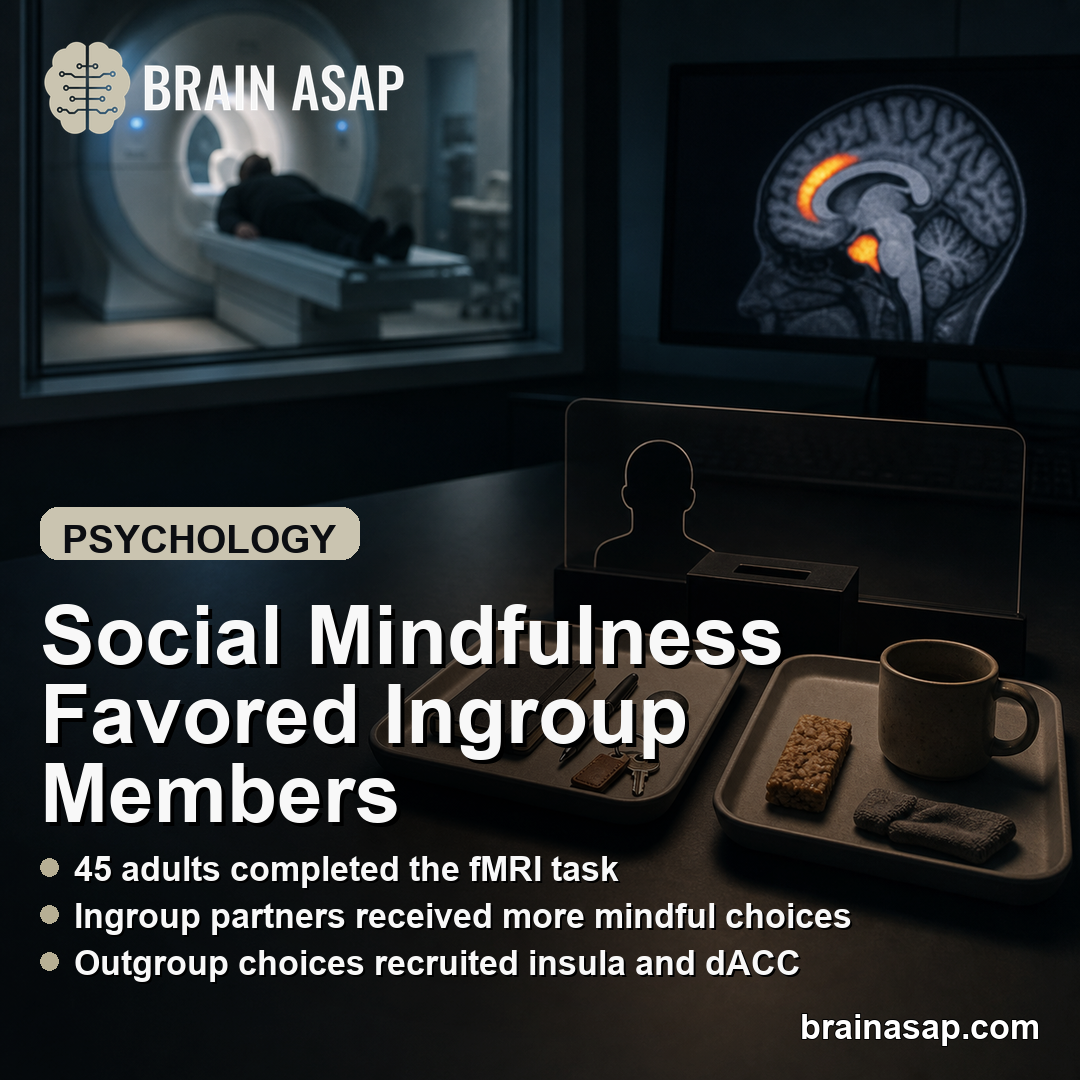
TL;DR: A 2026 study in Cognitive, Affective, & Behavioral Neuroscience used functional MRI (fMRI) to show that adults made more socially mindful choices for political ingroup members than for outgroup or unclassified partners.
Key Findings
- The fMRI task tested group-identity cues: 45 adults with strong pro- or anti-refugee stances made choices for ingroup, outgroup, or unclassified partners.
- Ingroup partners received more social mindfulness: socially mindful choices averaged 19.36 for ingroup partners versus 17.18 for outgroup partners.
- The ingroup-unclassified gap was larger: ingroup choices also exceeded unclassified-partner choices (19.36 vs 16.31; p < .001).
- General social mindfulness engaged social-decision regions: unclassified-partner trials activated right temporoparietal junction, dorsal medial prefrontal cortex, dorsolateral prefrontal cortex, middle temporal gyrus, and orbitofrontal cortex.
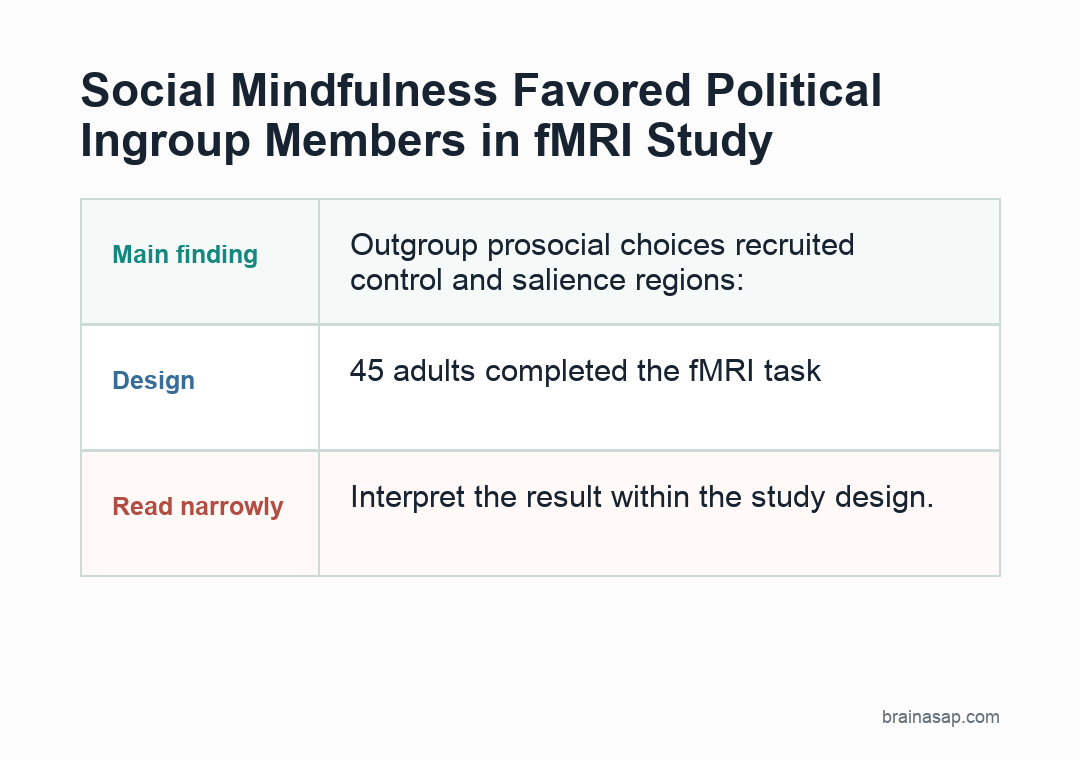
- Outgroup prosocial choices recruited control and salience regions: outgroup-versus-ingroup choices increased right anterior insula activity, while outgroup-versus-unclassified choices increased dorsal anterior cingulate cortex activity.
Source: Cognitive, Affective, & Behavioral Neuroscience (2026) | Overhaus et al.
Social mindfulness is a low-cost form of prosocial behavior. In this task, it means choosing an item that leaves another person with a real option instead of taking the only unique item for yourself.
The study tested whether that small courtesy changes when the other person belongs to a political ingroup or outgroup. Participants completed the Social Mindfulness, or SoMi, paradigm during functional MRI (fMRI), a brain-imaging method that measures blood-oxygen-related activity during a task.
Political Group Identity Changed Social Mindfulness Choices
The behavioral result was clear. Participants made more socially mindful choices when the partner shared their refugee-policy stance than when the partner held the opposing stance.
The effect appeared in a task where preserving another person’s options required only a small choice shift.
Average socially mindful choices were 19.36 for ingroup partners and 17.18 for outgroup partners. The paired comparison was significant, with p = .010.
Ingroup partners also received more socially mindful choices than unclassified partners: 19.36 vs 16.31, with p < .001. Outgroup and unclassified partners did not significantly differ.
- Ingroup partner: someone who shared the participant’s pro- or anti-refugee position.
- Outgroup partner: someone with the opposing position.
- Unclassified partner: someone whose position was not shown.
SoMi Choices Preserved Options Rather Than Giving Money
The SoMi paradigm is intentionally simple. Participants see sets of objects where one choice preserves another person’s options and another choice removes that option.
This design differs from costly donation or punishment games. The participant can act prosocially with little effort, so the task captures a subtle bias in everyday consideration rather than a large material sacrifice.
That low-cost design is important. Even when the behavioral stakes were small and hypothetical, group identity still shaped whether people left another person with more choice.
Participants Also Liked and Identified With Ingroup Partners More
The manipulation checks confirmed that the political grouping worked. Participants liked ingroup partners more than outgroup partners, with average ratings of 4.96 vs 3.67, and they also felt more connected to ingroup partners.
Similarity ratings showed the same direction. Participants rated themselves as more similar to ingroup partners than outgroup partners, and unclassified partners looked closer to ingroup partners than to outgroup partners.
Those checks matter because the SoMi behavior depended on an actual social distinction. The task separated shared-position partners from opposing-position partners before the choice trials were interpreted.
General Social Mindfulness Activated Mentalizing and Decision Regions
When the partner was unclassified, socially mindful choices activated regions often involved in thinking about other people’s perspectives and selecting actions. These included the right temporoparietal junction and dorsal medial prefrontal cortex.
Activity also involved dorsolateral prefrontal cortex, middle temporal gyrus, and orbitofrontal cortex. In plain terms, the socially mindful choice appeared to combine mentalizing, decision control, and reward-related processing.
- rTPJ: often linked to representing another person’s perspective.
- dorsal mPFC: involved in social inference and self-other processing.
- dlPFC and dACC: commonly tied to cognitive control during difficult choices.
Outgroup Prosocial Choices Recruited Insula and dACC
The group-identity imaging result was more selective than the behavior result. The researchers did not find broad neural differences when comparing ingroup socially mindful choices against outgroup or unclassified choices.
Instead, outgroup prosocial choices stood out. Socially mindful decisions for outgroup partners, compared with ingroup partners, increased activity in the right anterior insula, a region often linked to salience and emotionally relevant social information.
Outgroup choices also increased dorsal anterior cingulate cortex (dACC) activity compared with unclassified-partner choices. The authors interpreted this as possible evidence of greater cognitive control when prosocial norms conflict with self-interest or group bias.
Subtle Prosocial Bias Does Not Equal Fixed Prejudice
The study does not say people were unwilling to help outgroup members. Participants still made socially mindful choices for outgroup partners.
The difference was that they did so less often than for ingroup partners, and those choices appeared to require different neural processing.
Several limits matter:
- Small fMRI sample: the study included 45 adults.
- One political issue: group identity was based on pro- versus anti-refugee stances.
- Hypothetical choices: participants knew they and partners would not actually receive the objects.
- Cross-sectional design: the study cannot show whether changing group identity cues would change the brain response.
Practical takeaway: low-cost prosocial behavior can still be biased by group identity. The imaging result suggests outgroup prosocial choices may draw more on salience and control systems even when the outward behavior looks similar.
Citation: DOI: 10.3758/s13415-026-01425-1. Overhaus et al. Mindful minds: How group identity shapes brain and behavior in social decision-making. Cognitive, Affective, & Behavioral Neuroscience. 2026.
Study Design: fMRI study using the Social Mindfulness paradigm with political ingroup, outgroup, and unclassified interaction partners.
Sample Size: 45 adults with strong pro- or anti-refugee stances.
Key Statistic: Socially mindful choices were higher for ingroup partners than outgroup partners (19.36 vs 17.18; p = .010) and unclassified partners (19.36 vs 16.31; p < .001).
Caveat: The task used hypothetical object choices and one political grouping, so the results should not be generalized to every intergroup decision.