TL;DR: A 2026 exploratory study in Translational Psychiatry found blood DNA methylation changes after 25 mg psilocybin in detoxified alcohol use disorder patients, including findings near TLE4 and RASGRP4, but the small trial did not establish a definitive AUD biomarker.
Key Findings
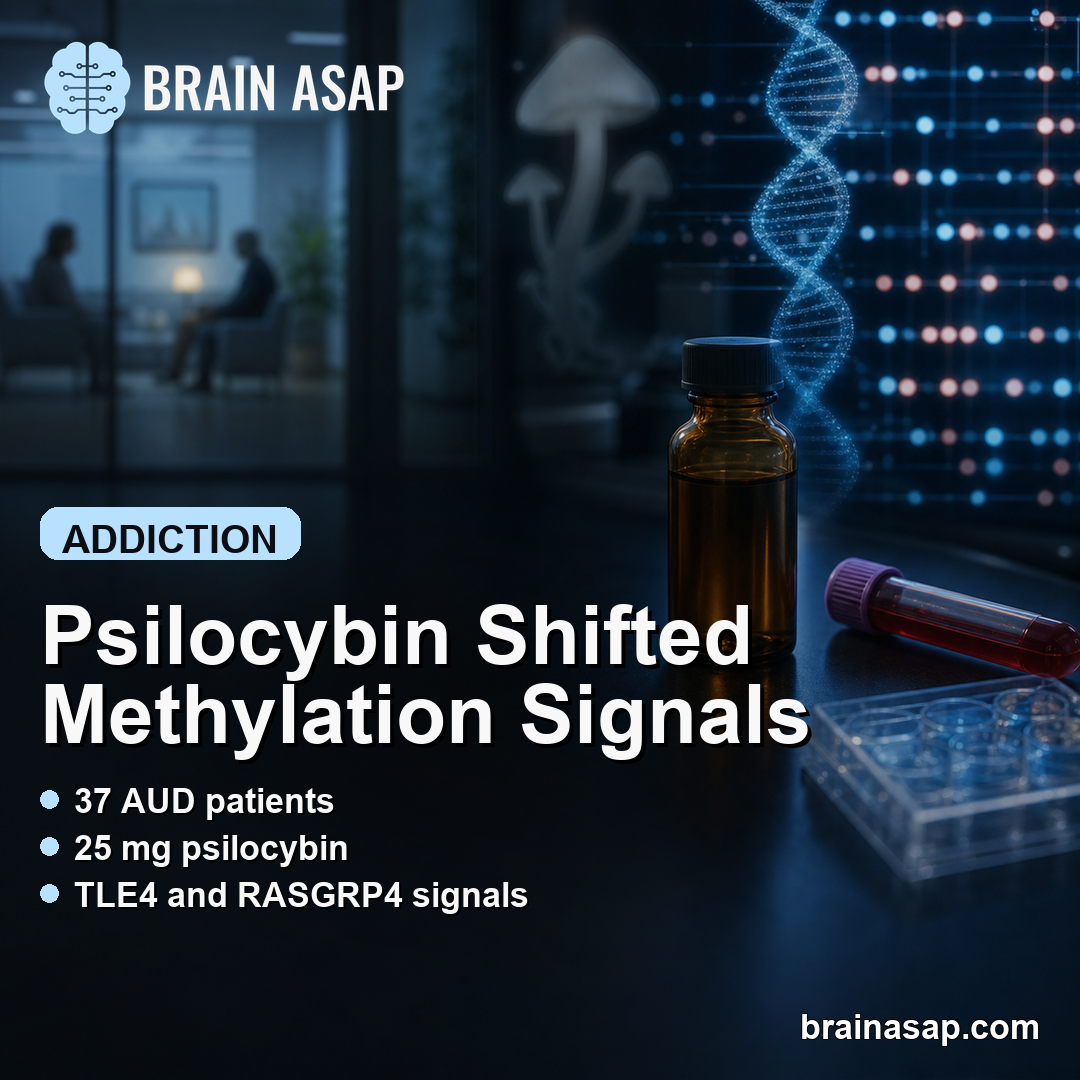
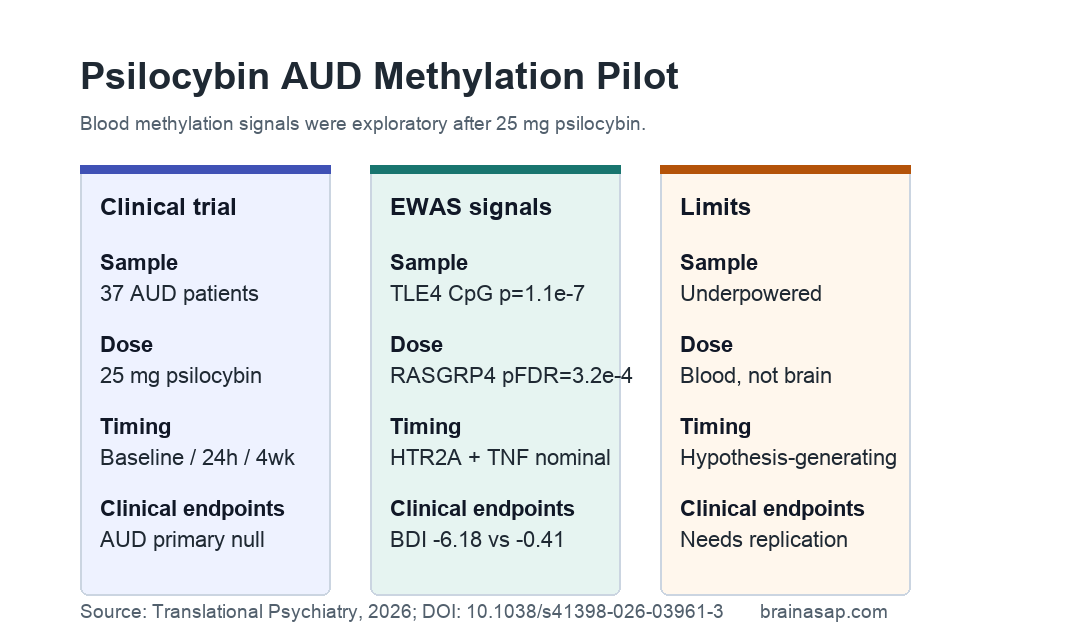
- 37 AUD patients: The methylation analysis used a randomized, double-blind psilocybin trial completed by 37 detoxified alcohol use disorder patients.
- 25 mg psilocybin: The treatment group received 25 mg oral psilocybin, while the placebo group received mannitol within a psychotherapeutic study framework.
- AUD endpoints missed: Mean alcohol use and time to relapse did not significantly differ after psilocybin, so the methylation results are not a validated AUD treatment biomarker.
- TLE4 CpG signal: The EWAS identified one CpG site in TLE4 associated with psilocybin treatment, p = 1.1e-7.
- RASGRP4 region: Differentially methylated region screening found altered methylation in RASGRP4, pFDR = 3.2e-4.
Source: Translational Psychiatry (2026) | Urban et al.
DNA methylation is an epigenetic chemical mark that can influence gene regulation without changing the DNA sequence. This study asked whether psilocybin treatment in alcohol use disorder (AUD) left measurable methylation patterns in blood.
The work is best read as a first-pass molecular screen. It connects psilocybin exposure with candidate blood methylation changes, but it does not prove that those changes caused clinical benefit.
Psilocybin Was Tested in Detoxified Alcohol Use Disorder Patients
The methylation paper used samples from a randomized, placebo-controlled, double-blind trial conducted at the Psychiatric University Hospital in Zurich. Participants had DSM-5 alcohol use disorder and were detoxified from alcohol 6 weeks before enrollment.
The trial was completed by 37 participants: 13 women and 24 men, with ages ranging from 21 to 58 years. The treatment arm received 25 mg oral psilocybin, while the placebo arm received mannitol.
- Baseline sample: Blood was collected 2 weeks before dosing.
- Early post-dose sample: Blood was collected 24 hours after psilocybin or placebo.
- Follow-up sample: Blood was collected around 4 weeks after dosing.
- Clinical scores: Researchers also tracked alcohol outcomes plus Beck Depression Inventory and Beck Hopelessness Scale scores.
The planned sample size was 60, but the trial did not reach that target because of COVID-19 delays. Three completers declined blood sampling, and 3 additional participants dropped out before the final blood draw.
Primary Alcohol Outcomes Did Not Separate Psilocybin From Placebo
The clinical trial’s primary outcomes were mean alcohol use after dosing and time to relapse, defined as at least 1 standard unit of alcohol per day. Those primary outcomes did not significantly differ between groups.
Mean time to relapse was 11.24 days after placebo and 17.77 days after psilocybin, p = 0.095. Mean daily alcohol intake was 1.39 units after placebo and 0.84 units after psilocybin, p = 0.331.
- Relapse timing: The psilocybin group had a longer mean time to relapse, but the difference did not reach statistical significance.
- Daily alcohol use: The psilocybin group had lower mean daily alcohol intake, but the difference was not significant.
- Depression score: Beck Depression Inventory change was -6.18 after psilocybin versus -0.41 after placebo, p = 0.017.
- Hopelessness score: Beck Hopelessness Scale change was -1.59 after psilocybin versus +0.65 after placebo, p = 0.017.
Because the alcohol outcomes were not positive, the methylation analysis cannot be framed as a confirmed AUD-response biomarker. The stronger clinical link in this dataset was to secondary depression and hopelessness measures.
TLE4 and RASGRP4 Were the Main Methylation Signals
The epigenome-wide association study (EWAS) tested blood DNA methylation across many CpG sites, where a cytosine and guanine sit next to each other in DNA. One CpG site annotated to TLE4 was associated with psilocybin treatment, p = 1.1e-7.
TLE4 is a transcriptional co-regulator involved in developmental and immune-related processes. The paper discusses TLE4 cautiously because the finding is a candidate molecular clue, not a demonstrated mechanism.
Differentially methylated region analysis found a region covering RASGRP4, pFDR = 3.2e-4. RASGRP4 is involved in mast-cell development and immune-response regulation, which fits the paper’s broader interest in immunomodulatory effects.
- TLE4: One CpG site in the TLE4 gene body was highlighted in the EWAS.
- RASGRP4: A differentially methylated region implicated immune-response biology.
- HTR2A and TNF: Candidate-gene testing found promoter-associated methylation changes at nominal p < 0.05.
HTR2A is especially relevant because it encodes the serotonin 2A receptor, a core receptor target in psilocybin’s acute psychedelic effects. TNF is relevant to inflammatory signaling.
Network Modules Linked Methylation With Mood and Drinking Measures
The analysis also used weighted gene co-methylation network analysis, a method that groups methylation sites into modules that vary together. It identified 34 co-methylation modules.
Some modules related to psilocybin treatment, depression-score change, hopelessness-score change, mean alcohol intake, or duration of abstinence. Gene ontology analysis linked those modules with neuroplasticity and immune functions.
- Hopelessness module: A pink module related to group and hopelessness-score change.
- Depression module: A light-green module related to Beck Depression Inventory change.
- Alcohol-use module: A light-cyan module related to mean alcohol intake during follow-up.
- Abstinence module: A green module related to duration of abstinence.
The study did not find significant methylation mediation effects for depression or hopelessness outcomes. In other words, the methylation data did not prove an intermediate causal step between psilocybin and symptom change.
The Findings Are Hypothesis-Generating, Not Clinical Tests
The limitations are central to the story. The trial was underpowered for conservative EWAS thresholds, most findings did not survive strict multiple-comparison correction, and effect sizes were generally small.
The tissue source is another limitation. Blood is practical for biomarker discovery, but blood methylation does not automatically represent methylation in brain tissue.
The paper’s blood-brain concordance discussion showed that CpG correlations can differ across cortical regions.
The study gives researchers candidate epigenetic targets to test in larger psilocybin AUD trials. It does not show that a blood methylation test can predict who will respond to psilocybin.
It also does not establish psilocybin as an AUD treatment from this dataset alone.
Citation: DOI: 10.1038/s41398-026-03961-3. Urban et al. Epigenome-wide association study of psilocybin-induced methylome changes in alcohol use disorder. Translational Psychiatry. 2026;16:283.
Study Design: Exploratory methylome-wide analysis using blood samples from a randomized, double-blind psilocybin trial in alcohol use disorder.
Sample Size: 37 detoxified alcohol use disorder patients completed the parent trial.
Key Statistic: One TLE4 CpG site was associated with psilocybin treatment, p = 1.1e-7; a RASGRP4 differentially methylated region had pFDR = 3.2e-4.
Caveat: Primary AUD endpoints were not significantly improved, and blood methylation results are exploratory rather than validated clinical biomarkers.