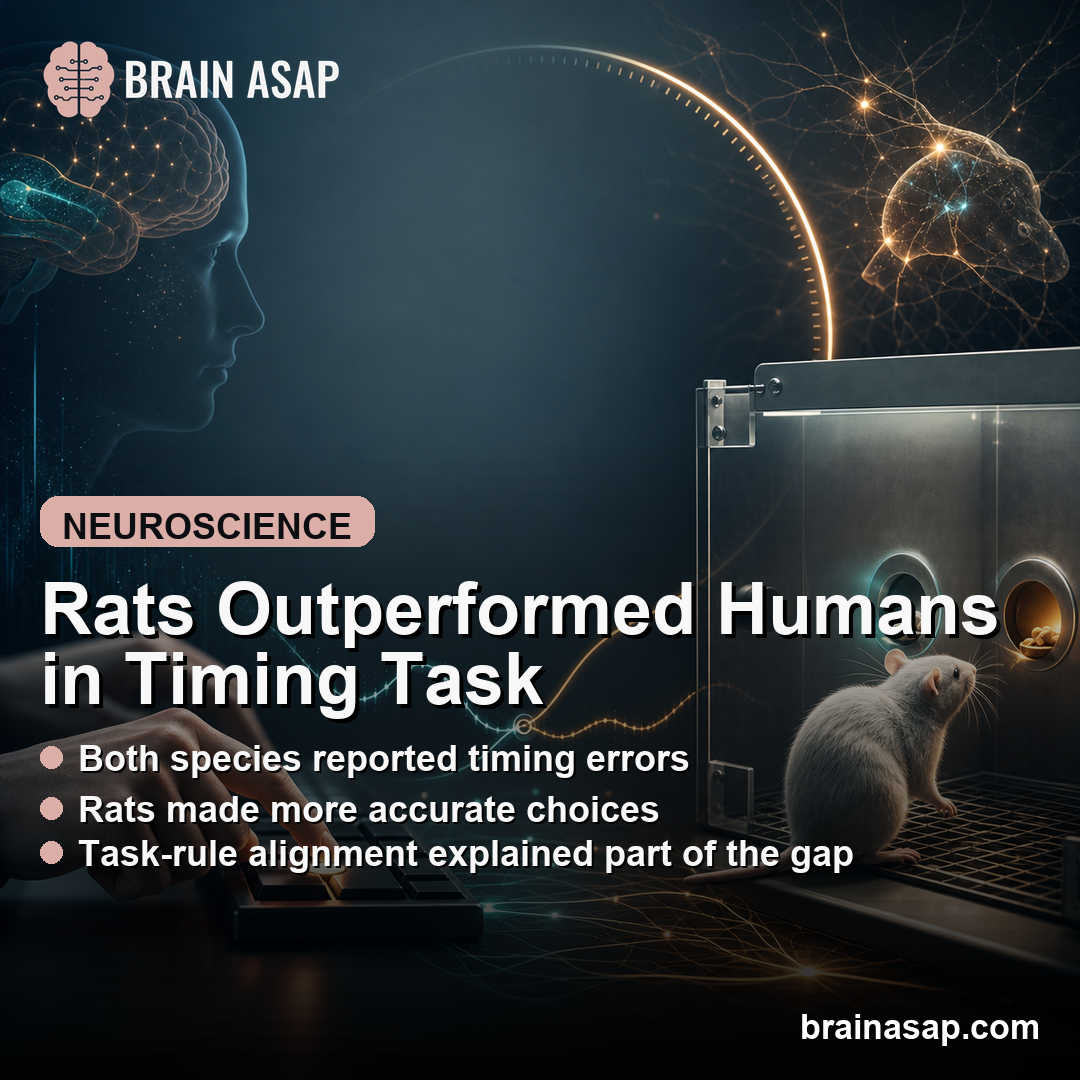
TL;DR: A 2026 iScience study found that both humans and rats could report their own timing errors in a 2-second task, but rats made more accurate error-based choices than humans.
Key Findings
- Matched timing task: Researchers compared 34 adults with 16 male Sprague-Dawley rats in a similar 2-second time-production task.
- Both species monitored errors: Humans and rats chose above chance when asked whether their own produced interval had a small or large error.
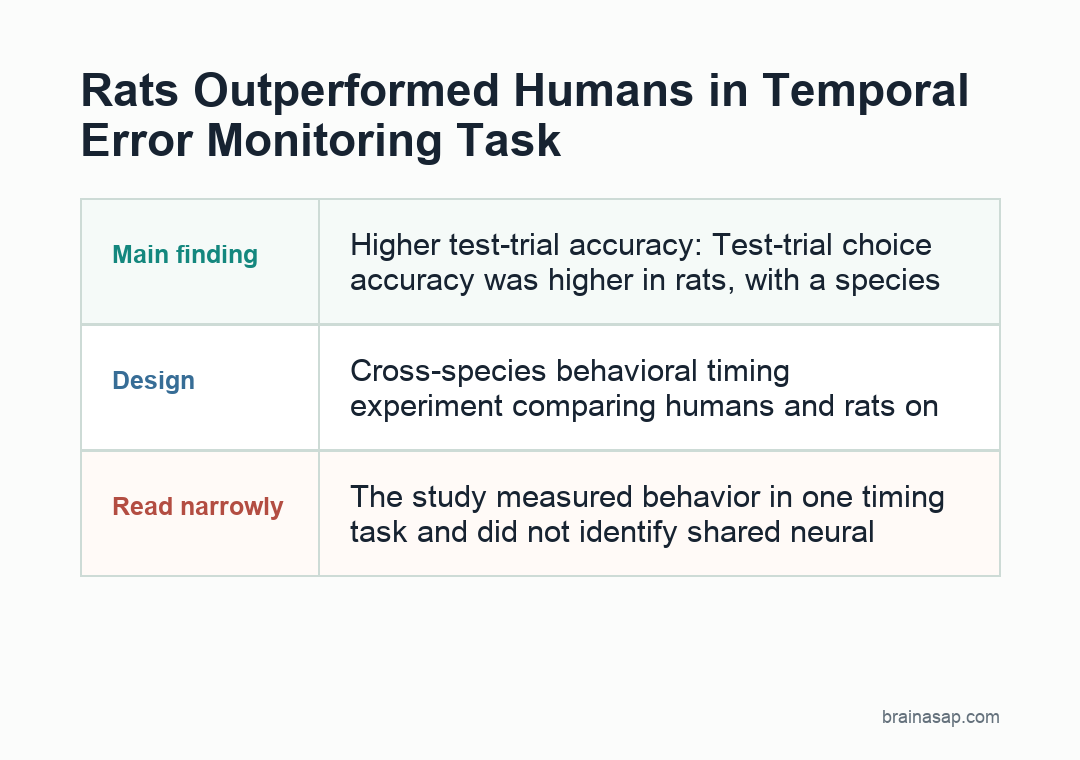
- Higher test-trial accuracy: Test-trial choice accuracy was higher in rats, with a species effect of beta = 0.09.
- Task-rule alignment mattered: Better alignment between timing thresholds predicted higher choice accuracy across both species.
- Behavioral comparison only: The study did not identify shared neural circuits or prove that rats and humans used the same metacognitive mechanism.
Source: iScience (2026) | Bilgin et al.
Temporal error monitoring means tracking whether a self-generated action was close to a target time. In this study, the action was simple: produce a 2-second interval, then choose whether the timing error was small or large.
The finding is not that rats are generally more self-aware than humans. The narrower result is that rats performed better in this carefully matched timing-and-reward task.
Animal studies of metacognition face a translation problem. If a rat and a person behave differently, researchers have to ask whether the difference reflects cognition, training history, task design, motor demands, or reward learning.
The researchers narrowed that gap by testing rats and humans under a shared behavioral framework. The goal was to compare how each species used its own timing error to guide a later choice.
Humans and Rats Produced a 2-Second Interval
The researchers trained both species to produce a minimum target interval of 2 seconds. Humans used a keyboard task with reward cards on a screen.
Rats used an operant box with a lever or press-and-hold action and two reward ports.
After each timing response, the task linked the size of the timing error to a reward location. A small timing error and a large timing error pointed to different reward options.
The design included several controls so the comparison was not just a human computer game against an animal box task.
- Motor routine: Both species had press and hold versions of the task.
- Human instructions: Some human groups received explicit instructions, while others received reduced instructions to better resemble the animal learning setup.
- Reward rule: The choice rule depended on each subject’s timing-error distribution rather than on a fixed raw duration alone.
Rats produced intervals closer to the target than humans and showed better precision. The study reported stronger rat timing accuracy and precision, while both species still followed Weber-like timing variability, meaning timing variability increased with the produced duration in a similar lawful way.
Test-Trial Choices Measured Temporal Error Monitoring
The core test came after training. On test trials, both reward options were available, so the subject had to choose the option matching the size of its own timing error.
If choices were random, accuracy would sit near chance. Instead, both groups performed above chance, which means both species used information about their own just-produced interval.
Humans showed above-chance test-trial accuracy with a 95% confidence interval of 0.517 to 0.574. Rats showed a higher above-chance range, with a 95% confidence interval of 0.645 to 0.668.
Researchers also modeled how strongly the current timing response predicted the small-error choice. The relationship was much steeper in rats than in humans.
- Rats: Current-trial timing strongly predicted the small-error choice, with beta = -0.99.
- Humans: Current-trial timing also predicted the small-error choice, but more weakly, with beta = -0.13.
- Species contrast: The rat-human difference in current-trial reliance was large, with beta = -0.86.
Rats were more tightly guided by the timing response they had just made. Humans appeared to rely more on information carried over from previous trials.
Task-Rule Alignment Predicted Better Error Reports
The study then asked why accuracy differed. One answer involved how well each subject’s internal choice behavior lined up with the task’s reward threshold.
The researchers used theta values to describe three task variables: the assigned threshold based on prior timing distributions, the observed threshold from the current session, and the choice threshold inferred from behavior.
Readers do not need the Greek letter to understand the result. When these thresholds were closer together, choice accuracy was higher.
Across sessions, better alignment predicted better performance, with beta = -0.06 for the main theta-alignment model. Smaller threshold distance meant higher accuracy.
- Assigned threshold: The task rule set from earlier timing performance.
- Observed threshold: The reward-rule threshold calculated from the current session.
- Choice threshold: The threshold implied by the subject’s actual small-error and large-error choices.
After matching human and rat sessions on these task-rule variables, the rat-human accuracy gap disappeared at the session level. That does not erase the original species difference, but it shows that task representation explained part of it.
The shared pattern is important. It suggests that rats and humans both used structured timing-and-reward information, even if they did not rely on the same exact trial history.
Response Times Suggested Different Decision Strategies
Response time was used as a behavioral proxy for confidence and decision processing. Both species responded differently on choice trials than on no-choice training trials.
Humans showed a larger response-time difference between trial types than rats. The study reported a human test-trial response-time effect of beta = 0.78 and a rat effect of beta = 0.39.
Researchers interpreted that as evidence for different choice behavior, not as proof that one species had more confidence in the everyday sense.
- Current-trial use: Rats relied more on the timing response that had just happened.
- Previous-trial use: Humans appeared to integrate more information from earlier trials within the session.
- Confidence readout: Response times tracked confidence-like behavior more clearly in rats than in humans.
This distinction keeps the result from becoming too broad. The study supports a behavioral comparison of timing-error reports, not a simple hierarchy of animal and human metacognition.
The Study Builds a Cross-Species Timing Framework
The paper’s practical value is methodological. It gives researchers a way to compare temporal error monitoring across species while tracking task variables that could otherwise distort the comparison.
The limitations are direct. The rat group included 16 male rats, so sex differences in animals were not tested.
The human sample included 34 young adults, and sex was not formally analyzed as a study factor.
The task also compared behavior, not neural circuits. The researchers did not claim to identify the brain mechanisms that support temporal error monitoring in both species.
Within those boundaries, the behavioral finding is useful. Both rats and humans used their own timing errors to guide choices, and better task-rule representation improved accuracy in both species.
For comparative cognition, that is a cleaner starting point than asking whether an animal simply “knows” it made an error. The better question is which task variables let error monitoring show up in measurable behavior.
Citation: DOI: 10.1016/j.isci.2026.115531. Bilgin et al. Direct comparison of temporal error monitoring in humans and rats. iScience. 2026;29:115531.
Study Design: Cross-species behavioral timing experiment comparing humans and rats on a matched temporal error-monitoring task.
Sample Size: 34 human adults and 16 male Sprague-Dawley rats.
Key Statistic: Test-trial choice accuracy was above chance in humans and rats, with higher accuracy in rats and a species effect of beta = 0.09.
Caveat: The study measured behavior in one timing task and did not identify shared neural circuits or prove identical metacognitive mechanisms across species.