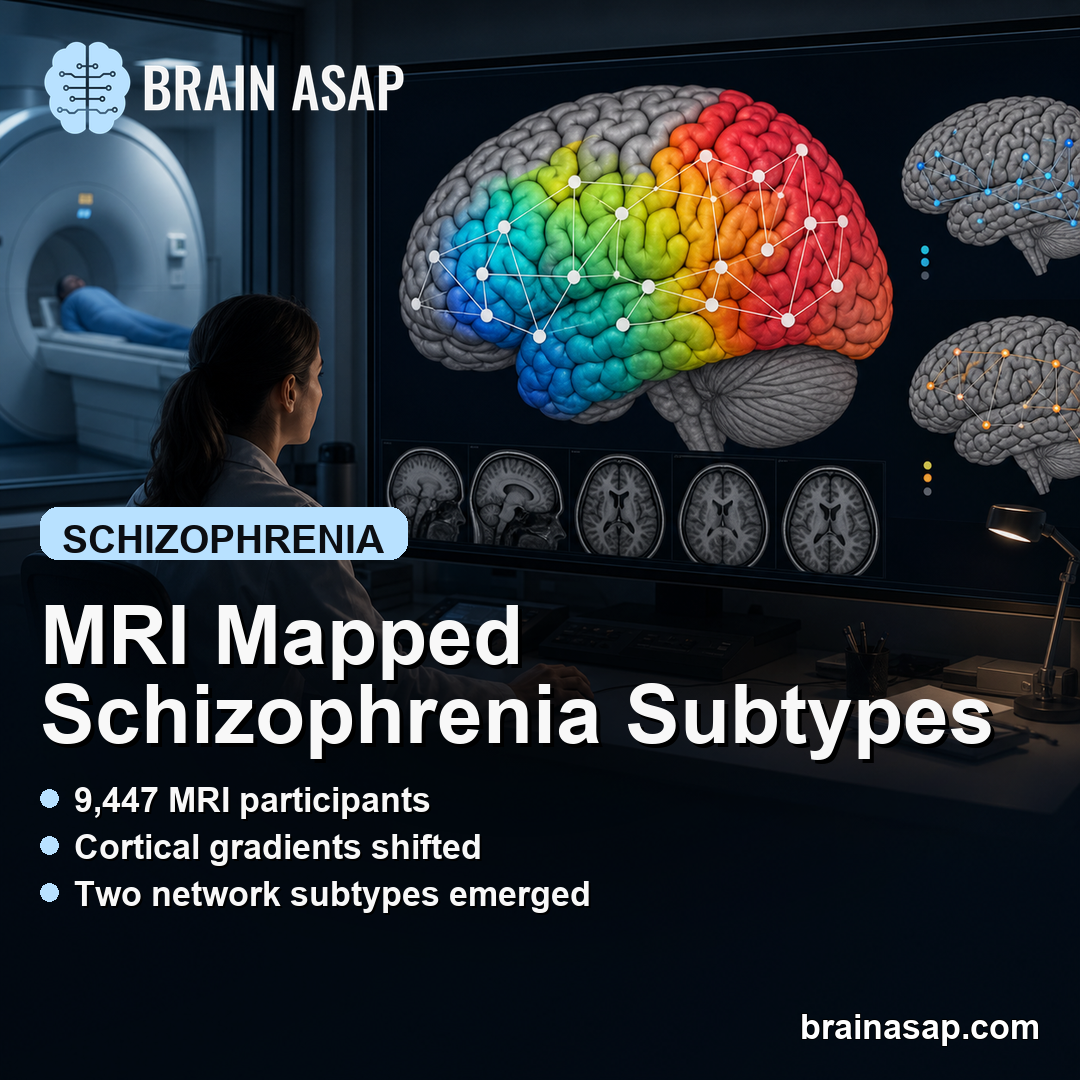
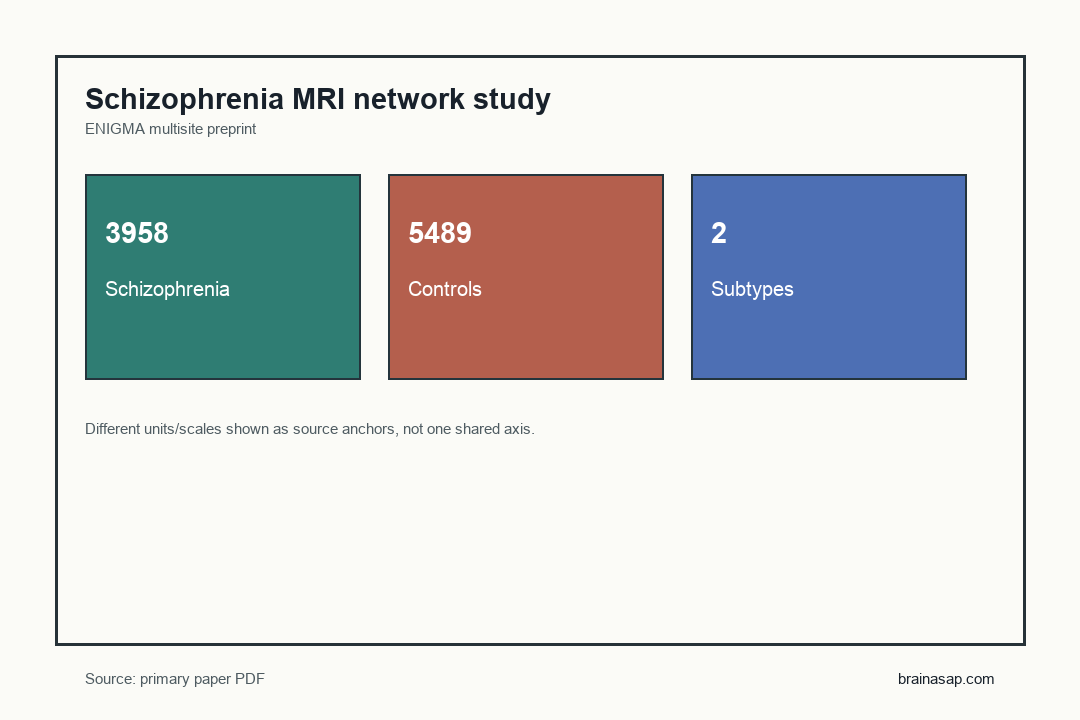
TL;DR: A 2026 preprint on medRxiv used multisite MRI data from 3,958 people with schizophrenia and 5,489 controls to map cortical network disruptions and identify two robust brain-structure subtypes.
Key Findings
- 9,447 MRI participants: The analysis included 3,958 individuals with schizophrenia and 5,489 neurotypical controls from 40 centers.
- Gradient alterations: Schizophrenia was linked with widespread cortical-gradient loading changes along inferior-superior and frontal-temporal axes.
- Hub topology changes: Small-world topology alterations localized to hubs including the insula and anterior cingulate cortex.
- Symptom-linked dimension: Brain-symptom analyses linked disorganization symptoms to topological alterations.
- Two subtypes: Clustering identified subtypes with anterior cingulate versus temporoparietal cortical-thickness differences.
Source: medRxiv (2026) | Wan et al.
Schizophrenia is often described as a brain network disorder, but that phrase can be too broad to guide interpretation. This preprint tried to make the network claim more concrete by studying cortical gradients and graph-theory topology in a very large MRI dataset.
A cortical gradient describes a smooth axis of brain organization, while small-world topology describes how efficiently a network balances local clustering with long-range integration. Together, they give two views of macroscale cortical organization.
ENIGMA MRI Data Covered 3,958 Schizophrenia Cases
The sample came from the international ENIGMA consortium Schizophrenia Working Group and included 3,958 people with schizophrenia and 5,489 controls. The participants came from 40 centers, which gives the analysis unusual scale for structural MRI work.
Diagnosis was confirmed at each center using ICD or DSM criteria. The schizophrenia group had a mean age of 35.0 years, and the control group had a mean age of 34.6 years.
- Case group: 3,958 individuals with schizophrenia or schizoaffective disorder.
- Control group: 5,489 neurotypical individuals.
- Multisite scope: Data came from 40 international centers, increasing scale but also adding site-level complexity.
The analysis used individualized cortical network similarity rather than relying only on regional thickness averages. That choice aimed to capture organization across the cortex, not just isolated spots of thinning.
That is a meaningful distinction for schizophrenia research because many prior MRI findings are region lists. A network-similarity approach asks whether the cortex’s broader organizational pattern is altered, which may better match a disorder with cognitive, perceptual, affective, and disorganization symptoms.
The analysis used cortical thickness similarity matrices, gradient decomposition, and small-world topology measures across different sparsity thresholds. Those technical choices were meant to test whether the pattern was organized and stable rather than dependent on one network setting.
Cortical Gradients Shifted Along Inferior-Superior and Frontal-Temporal Axes
People with schizophrenia showed widespread alterations in gradient loadings. The reported pattern followed inferior-superior and frontal-temporal axes, which means the differences were organized across large cortical dimensions rather than scattered randomly.
The pattern fits the idea that schizophrenia affects brain organization at network scale. It does not imply every patient has the same regional abnormality, but it suggests shared spatial principles beneath individual variation.
The gradient language can sound abstract, but the practical idea is straightforward. Cortical regions are not independent tiles; they sit along organized axes of structure and function, and schizophrenia-related differences may follow those axes.
- Gradient one: The analysis examined broad cortical organization using eigenvector decomposition of similarity patterns.
- Gradient two: A second major gradient captured another axis of cortical thickness covariance.
- Group contrast: The schizophrenia-control difference was evaluated across these organized axes.
Insula and Anterior Cingulate Hub Topology Was Altered
Small-world topology changes localized to key network hubs, including the insula and anterior cingulate cortex. These regions are often relevant to salience, cognitive control, interoception, and symptom organization, though this study focused on structural network architecture.
A latent brain-symptom dimension linked disorganization symptoms to topological alterations. Structural MRI differences are more useful when they connect to clinical variation.
Disorganization symptoms can include fragmented thought, speech, or behavior, depending on the clinical scale. Linking that dimension to topology does not create a diagnostic MRI test, but it gives the network result a symptom-relevant anchor.
- Insula hub: The insula appeared among regions with localized topology changes.
- Anterior cingulate: The anterior cingulate cortex was another hub involved in altered network topology.
- Disorganization link: Symptom association analyses connected disorganization to topology, not just to broad diagnosis.
Two Schizophrenia Subtypes Differed by Anterior Cingulate and Temporoparietal Patterns
Clustering cortical alterations identified two robust subtypes. One was characterized by divergent anterior cingulate thickness differences, while the other was characterized by temporoparietal thickness differences.
Both subtypes were present early in illness and remained stable across disease stages and age groups. That stability makes the subtype result more informative than a simple late-stage illness marker.
The subtype claim also argues against treating heterogeneity as noise. If the two profiles replicate, they could help explain why different schizophrenia cohorts show different regional thickness results even when the overall diagnosis is the same.
- Subtype S1: The first subtype emphasized anterior cingulate cortical-thickness differences.
- Subtype S2: The second subtype emphasized temporoparietal cortical-thickness differences.
- Stability claim: The subtypes appeared across illness stages and age groups in the analyzed sample.
The Finding Is Large-Scale but Still Preprint Evidence
The sample size and multisite design make this a substantial analysis, but the source is a preprint that had not been certified by peer review at the time of posting. MRI-derived subtypes also need external validation before they can guide care.
The research value is conceptual: schizophrenia-related cortical differences may be better understood as organized network changes with clinically relevant subtypes, rather than as one uniform brain-thickness deficit shared by every patient.
For now, the result belongs in the research lane. It can guide hypotheses about brain organization and heterogeneity, but it should not be used to label individual patients, choose medications, or predict outcome outside validated clinical studies.
Citation: DOI: 10.64898/2026.04.25.26351736. Wan et al. Individualized cortical gradient and network topology reveal symptom-linked disruptions and neurobiological subtypes in schizophrenia. medRxiv. 2026.
Study Design: Multisite structural MRI preprint using cortical-gradient, graph-theory, symptom-association, and clustering analyses.
Sample Size: 3,958 individuals with schizophrenia and 5,489 controls.
Key Statistic: Two robust cortical-thickness subtypes were identified after network-gradient and topology analysis.
Caveat: Preprint findings require peer review and independent clinical validation.