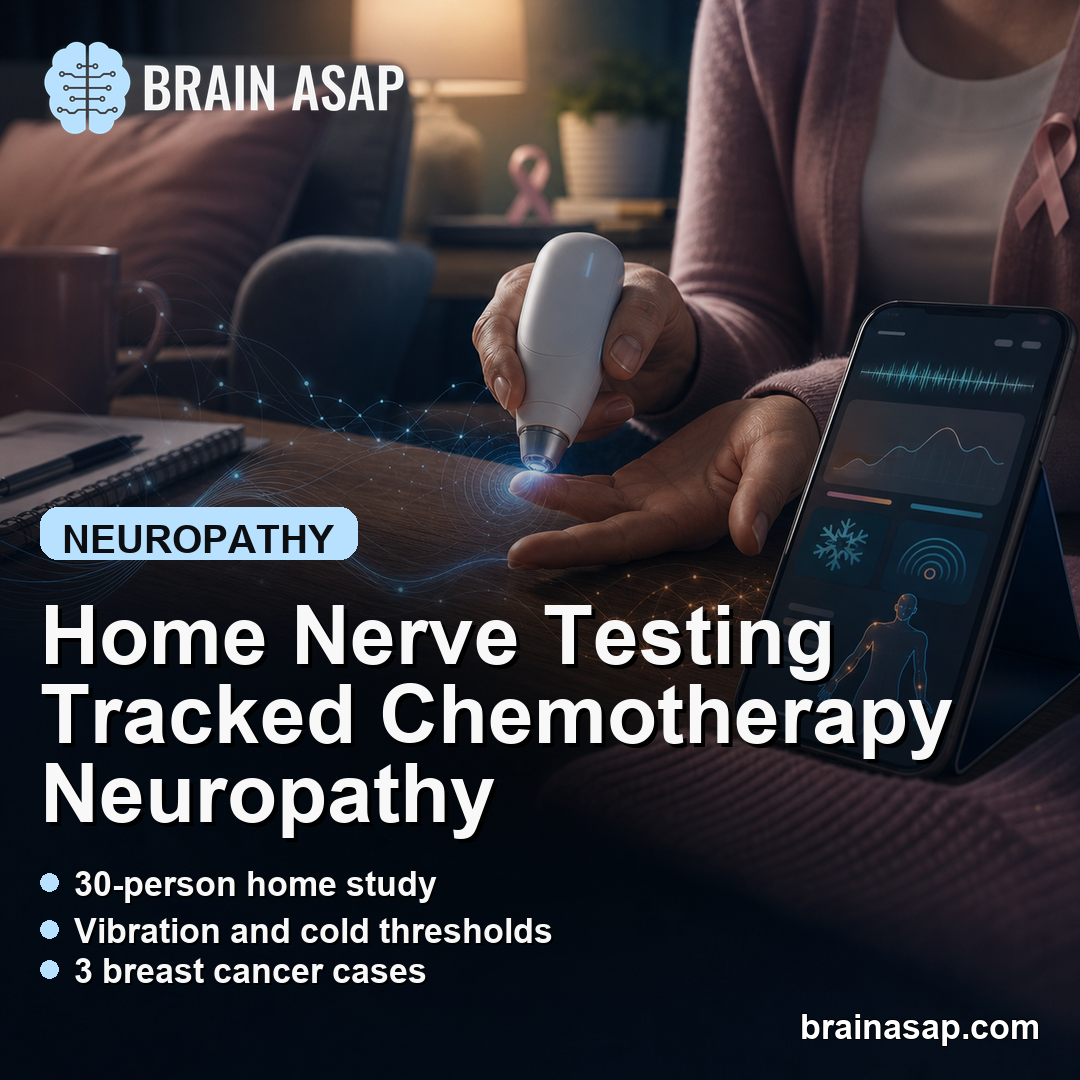
TL;DR: A 2026 preprint in medRxiv reported that SenseCheQ, a home quantitative sensory testing device, produced reliable vibration and temperature-threshold measurements in 30 healthy adults and tracked early sensory changes in 3 breast cancer patients receiving neurotoxic chemotherapy.
Key Findings
- 30-person home study: Healthy adults completed one familiarization session and three self-administered home sessions using SenseCheQ.
- Vibration reliability: Vibration detection thresholds differed by only 0.02 µm on average between two home sessions, with 23 of 30 participants within ±0.2 µm.
- Cold reliability: Cold detection thresholds differed by 0.10°C on average, and 26 of 30 participants were within ±0.5°C.
- Patient signal: In one breast cancer patient, vibration threshold more than doubled around the time tingling and numbness emerged and grade 1 sensory neuropathy was diagnosed.
- Preprint caveat: The patient evidence came from only 3 case studies, and the preprint had not been peer reviewed.
Source: medRxiv (2026) | Gausden et al.
Chemotherapy-induced peripheral neuropathy can leave patients with tingling, numbness, pain, or altered temperature sensation. Prevention is difficult because clinicians often learn about nerve injury after symptoms are already clear.
SenseCheQ was designed for a practical gap: repeatable, self-administered nerve-function testing that can happen at home during treatment. A home device could also collect measurements more often than clinic visits, which matters when symptoms fluctuate around infusion cycles.
SenseCheQ Measured Vibration Cold and Warm Detection at Home
SenseCheQ combines controlled sensory stimulation with a patient-facing interface. The device measures vibration detection threshold, cold detection threshold, and warm detection threshold.
Those thresholds are not interchangeable. Vibration detection can reflect large-fiber function, while cold and warm thresholds can add information about small-fiber sensory pathways.
- Vibration detection threshold: The device used a haptic actuator and calibration routine to measure when vibration was first detected.
- Cold detection threshold: A thermoelectric module measured the point at which cooling from a 32°C baseline was noticed.
- Warm detection threshold: The same thermal setup measured when warming from baseline was first noticed.
The preprint emphasized engineering details because home testing adds environmental and user-related noise. Skin-temperature control, haptic calibration, and a short protocol were meant to keep measurements stable outside a laboratory.
Thirty Healthy Adults Completed Repeated Home Sessions
The home reliability study enrolled 30 healthy adults, mostly University of Bristol staff. Participants first completed a familiarization session in a controlled clinic room, then used the device at home.
Each session took about 10 minutes. Home sessions were completed on separate days, with the first two home sessions used for test-retest reliability.
- Clinic familiarization: Participants learned the protocol and completed an initial device session.
- Home Session 1: The first unsupervised home measurement established a baseline for comparison.
- Home Session 2: A second home measurement, about 12 hours later, tested short-term repeatability.
- Home Session 3: A modified protocol tested whether skin-temperature clamping improved vibration measurement stability.
Vibration and Cold Thresholds Were the Most Stable Measures
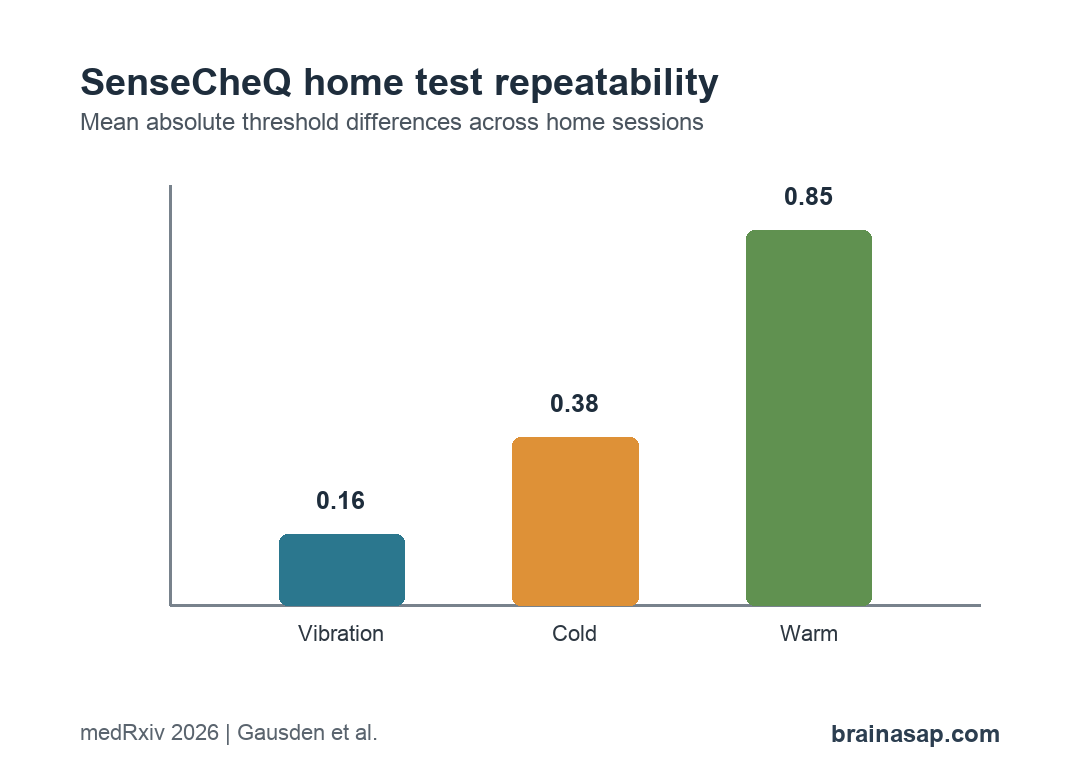
The strongest reliability numbers came from vibration and cold thresholds. Vibration detection thresholds were not significantly different between two home sessions, with a mean difference of 0.02 µm.
Cold detection thresholds also remained stable, with a mean session difference of 0.10°C. Spearman reliability for cold detection was 0.79, and the intraclass correlation was 0.69.
Warm detection was less stable than cold or vibration. The mean warm-threshold difference was 0.20°C, and the rank-order reliability was lower, with Spearman rho reported as 0.51.
The thermal and vibration results should be read together. Cold and vibration were more stable in this healthy-adult sample, but warm detection still added a small-fiber sensory measure that may be useful after protocol refinement.
Three Chemotherapy Cases Showed Early Nerve-Function Tracking
The patient portion was small but clinically relevant. 3 female breast cancer patients used SenseCheQ during chemotherapy, usually before infusion visits.
2 patients received paclitaxel, and 1 received docetaxel plus carboplatin. The device results were not shared with patients or clinical teams during testing.
- Patient 1: No chemotherapy-induced peripheral neuropathy symptoms were reported, and SenseCheQ did not show clear sensory-function change across six infusions over 18 weeks.
- Patient 2: Tingling and numbness emerged, grade 1 sensory neuropathy was diagnosed, and vibration threshold more than doubled around the same period.
- Patient 3: Vibration-threshold changes corresponded to episodes of finger paraesthesia after infusions, suggesting dose-linked fluctuation.
The comparison to formal quantitative sensory testing was encouraging. The home signals aligned with patient-reported symptoms and clinic-based sensory assessment, but the sample was far too small for diagnostic accuracy claims.
Home Neuropathy Monitoring Still Needs Larger Clinical Testing
The preprint frames SenseCheQ as a possible scalable biomarker platform for neuropathy detection. That claim depends on whether larger studies can show that repeated home testing predicts clinically meaningful nerve injury early enough to change treatment decisions.
Cost and usability were part of the device argument. The component cost was estimated at about £500 per unit, far below many commercial quantitative sensory testing systems.
- Strength: The healthy-adult home study showed repeatable measurements under unsupervised conditions.
- Strength: Patient case studies suggested that frequent home testing can capture changes missed by sparse clinic visits.
- Limit: Only three chemotherapy patients were described, and the work was a preprint rather than a peer-reviewed clinical validation study.
For chemotherapy care, the possible value is earlier detection of sensory changes before chronic neuropathy is established. The next test is whether SenseCheQ changes clinical decisions and outcomes, not only whether it produces stable threshold numbers.
Until then, the device is best understood as a promising measurement platform. It may help researchers study neuropathy trajectories before it becomes a routine tool for adjusting chemotherapy.
Citation: DOI: 10.64898/2026.04.15.26350779. Gausden et al. SenseCheQ: Home-based Nerve Function Self-Assessment using Autonomous Quantitative Sensory Testing. medRxiv. 2026.
Study Design: Device-engineering and feasibility preprint with healthy-adult home reliability testing and prospective patient case studies.
Sample Size: 30 healthy adults in the home reliability study and three breast cancer patients receiving neurotoxic chemotherapy.
Key Statistic: Vibration detection threshold differed by 0.02 µm on average between two home sessions, with 23 of 30 participants within ±0.2 µm.
Caveat: The patient evidence was limited to three case studies, and the preprint had not been peer reviewed.