TL;DR: A 2026 study in PNAS from Oregon Health & Science University and Anhui University used optogenetics in mice to map a specific serotonin-producing brain circuit that runs straight to the auditory system, showed that activating this circuit produced tinnitus-like behavior, and traced a likely mechanism for why some patients on SSRI antidepressants report worsened ringing in the ears.
Key Findings
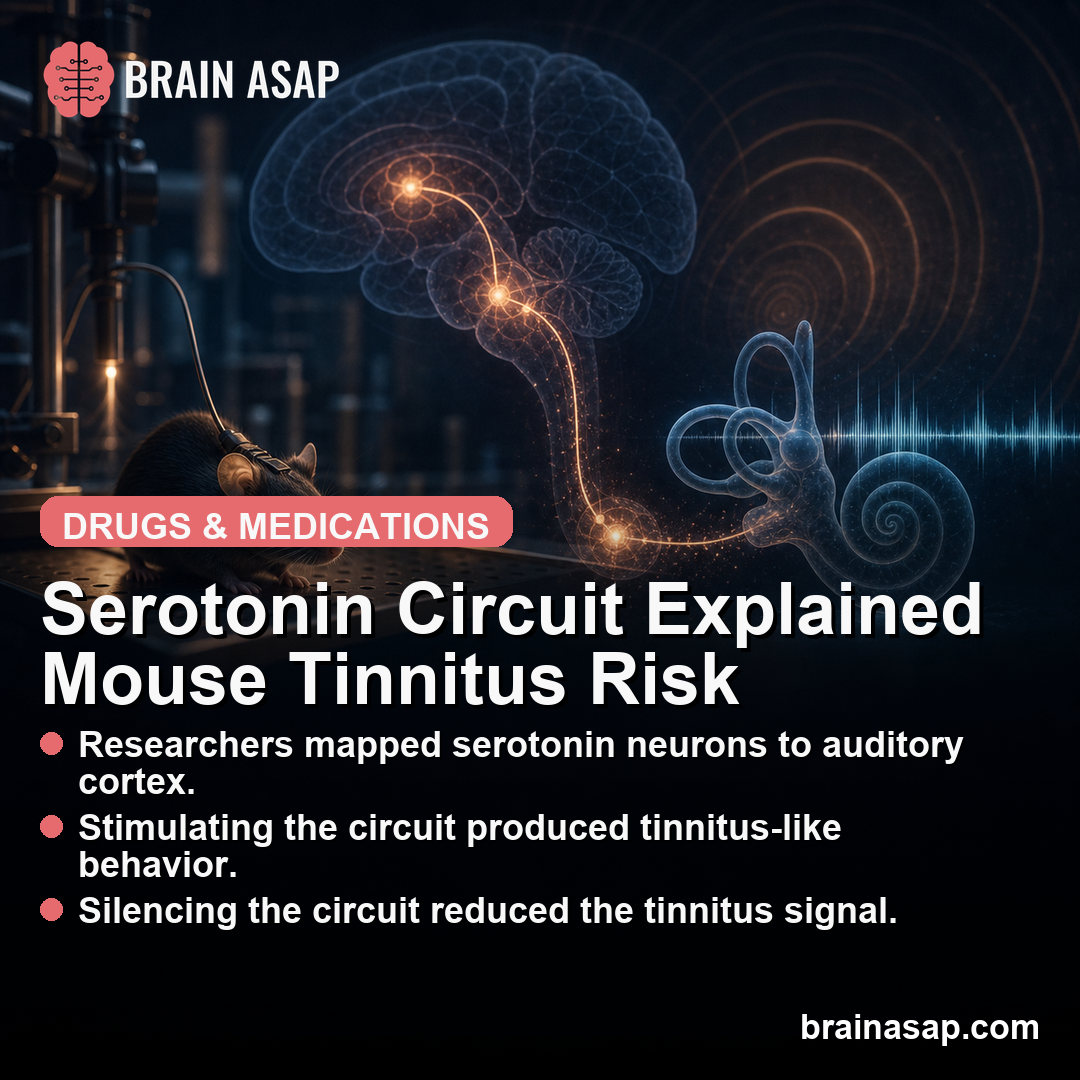
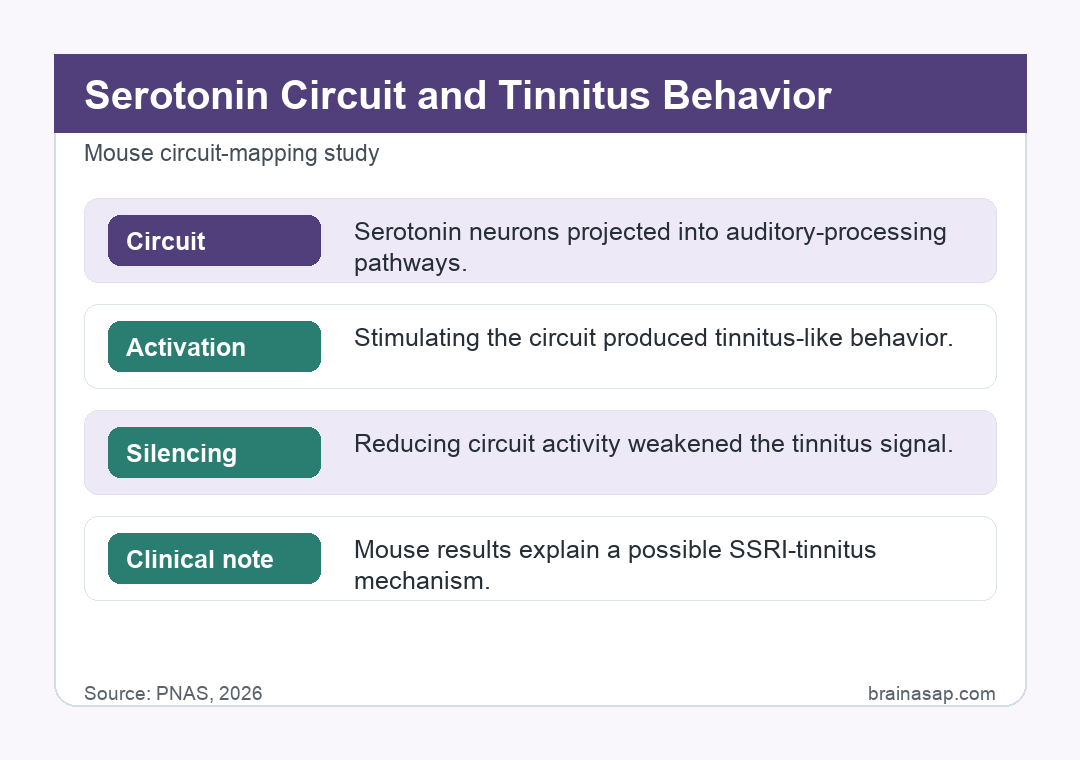
- Specific serotonergic circuit reaches the auditory system directly: Researchers mapped a defined brain circuit running from serotonin-producing neurons straight to the auditory region, with optogenetic stimulation triggering both serotonin release and auditory-region activation.
- Activating the circuit produced tinnitus-like behavior in mice: When the team stimulated the serotonergic neurons via fiber-optic light, mice showed behavioral signs consistent with what tinnitus would produce in humans, measured through a modified auditory startle paradigm.
- Switching the circuit off reduced tinnitus symptoms: Inactivating the same circuit significantly ameliorated the tinnitus-like behavior, supporting a causal role for this specific pathway.
- Mechanistic explanation for SSRI-tinnitus reports: SSRIs raise brain serotonin levels to treat depression and anxiety. The same elevation may reach the auditory circuit and worsen tinnitus — consistent with longstanding patient reports of medication-associated tinnitus flares.
- Tinnitus prevalence is up to 14% globally: Constant ringing or buzzing in the ears that creates continual irritation for some and severe anxiety for others — a common condition with limited targeted treatment options.
Source: Proceedings of the National Academy of Sciences (2026) | Tang, Trussell et al.
Tinnitus — constant ringing or buzzing in the ears — affects up to 14% of people globally. For some it is a mild irritation; for others it produces severe anxiety and sleep disruption.
Patients on SSRI antidepressants have reported for years that their tinnitus worsens after starting the medication, but the brain mechanism connecting elevated serotonin to auditory symptoms had not been mapped directly.
This OHSU/Anhui collaboration used optogenetics in mice to test a specific serotonergic circuit and showed that activating it produced tinnitus-like behavior — while turning it off reduced the symptom.
Optogenetic Mapping of a Serotonin-to-Auditory Circuit
The work was led by Laurence Trussell at OHSU School of Medicine and Zheng-Quan Tang, who started the project as a postdoctoral scholar in Trussell’s lab and is now at Anhui University.
The experimental approach:
- Optogenetics via fiber optics: Light delivered precisely into the brain to trigger electrical activity of specific serotonin-producing neurons on demand.
- Auditory-region recording: Activation of the targeted serotonergic neurons reliably stimulated activity in the auditory region of the mouse brain — mapping the direct functional connection.
- Behavioral readout: A modified auditory startle response paradigm to measure whether the mice behaved as if they were experiencing tinnitus.
- Off-switch test: The team also inactivated the same circuit and measured whether tinnitus-like behavior decreased.
The combination — map the circuit, activate it, observe tinnitus-like behavior, then turn it off and observe the symptom reduce — gives a tighter causal claim than correlational observation could produce.
Activating the Circuit Produced Tinnitus-Like Behavior; Turning It Off Reversed It
Activating the serotonergic neurons increased activity in the auditory region and made mice behave as if they were hearing tinnitus. Turning the same circuit off reduced the tinnitus-like behavior.
The bidirectional intervention — produce tinnitus by activating, reduce it by inactivating — is the kind of evidence that points beyond correlation toward a circuit-level mechanism.
SSRI Patient Reports Fit the Serotonin-Auditory Circuit
Selective serotonin reuptake inhibitors are widely prescribed for moderate-to-severe depression and anxiety. They work by raising serotonin levels in the brain.
The tinnitus implication:
- Patient reports have flagged the link for years: Some patients on SSRIs say their tinnitus flares up after starting the medication.
- The new circuit mechanism explains how: If raising brain serotonin reaches the specific auditory circuit identified here, the same drug action that helps mood symptoms could worsen ear ringing.
- Clinical validation: Trussell’s team frames this as evidence that clinicians should take patient reports of medication-associated tinnitus increases seriously rather than dismissing them.
The clinical recommendation is shared decision-making rather than abrupt medication changes. Patients with tinnitus should work with the prescribing clinician to balance psychiatric symptom relief against tinnitus worsening, and clinicians should take medication-associated tinnitus reports seriously.
Mouse-Model Evidence, Optogenetic Specificity, and Translation Stay Open
- Mouse-only evidence: Tinnitus is inferred behaviorally in mice through modified startle paradigms, not measured directly. The behavioral assay captures something tinnitus-like, but the human subjective experience is not the same data point.
- Optogenetic activation is artificial: The researchers used precise light triggering of specific neurons. SSRI-driven serotonin elevation in humans is more diffuse and slower; the circuit-level effect may not map one-to-one onto pharmacological elevation.
- Receptor subtype not isolated here: Serotonin acts through many receptor subtypes. Which subtype on which auditory cell mediates the tinnitus effect is the next mechanistic question, and it determines what kind of selective drug could avoid the side effect.
- SSRI patient population not directly studied: The work supports a plausible mechanism for SSRI-tinnitus reports but does not measure tinnitus changes in SSRI-treated humans.
- Tinnitus heterogeneity not addressed: Tinnitus has many causes (noise exposure, age-related hearing loss, ototoxic drugs). The serotonergic circuit may be one contributor among several.
Cell- or Region-Specific Serotonergic Drugs Are the Plausible Next Direction
The translational direction the team points toward:
- Selective serotonergic targeting: If serotonin can be elevated in mood-relevant brain regions while avoiding the auditory circuit, the antidepressant benefit may be separable from the tinnitus side effect.
- Receptor-subtype-specific drug development: Identifying which serotonin receptor on which auditory cell mediates the tinnitus signal would guide development of subtype-selective compounds.
- Patient counseling is already relevant: Even without new drugs, the work supports validating patient reports and adjusting regimens when SSRI-related tinnitus emerges.
- No unilateral medication stop: The clinical direction is shared decision-making with prescribing physicians, not unsupervised discontinuation of antidepressant treatment.
The longer-term drug-development idea is more selective serotonin targeting: preserve mood-relevant serotonin effects while avoiding the auditory circuit that may worsen tinnitus.
Citation: DOI: 10.1073/pnas.2509692123. Tang Z-Q, Trussell L et al. A discrete serotonergic circuit involved in the generation of tinnitus behavior. Proceedings of the National Academy of Sciences. 2026.
Study Design: Optogenetic activation and inactivation of a specific serotonin-producing brain circuit in mice; behavioral assessment of tinnitus-like effects via modified auditory startle response.
Sample/Model: Mouse model with fiber-optic optogenetic targeting of serotonergic neurons connecting to the auditory system.
Key Statistic: Optogenetic activation of the targeted serotonergic circuit produced tinnitus-like behavior; inactivation significantly reduced the symptoms — supporting a causal role for this specific circuit and a likely mechanism for SSRI-associated tinnitus reports.
Caveat: Mouse-only evidence with behaviorally inferred tinnitus; optogenetic activation is more targeted and faster than SSRI-driven serotonin elevation; receptor subtype not isolated; SSRI-treated human population not directly studied; tinnitus has many causes and the serotonergic circuit is likely one contributor among several.