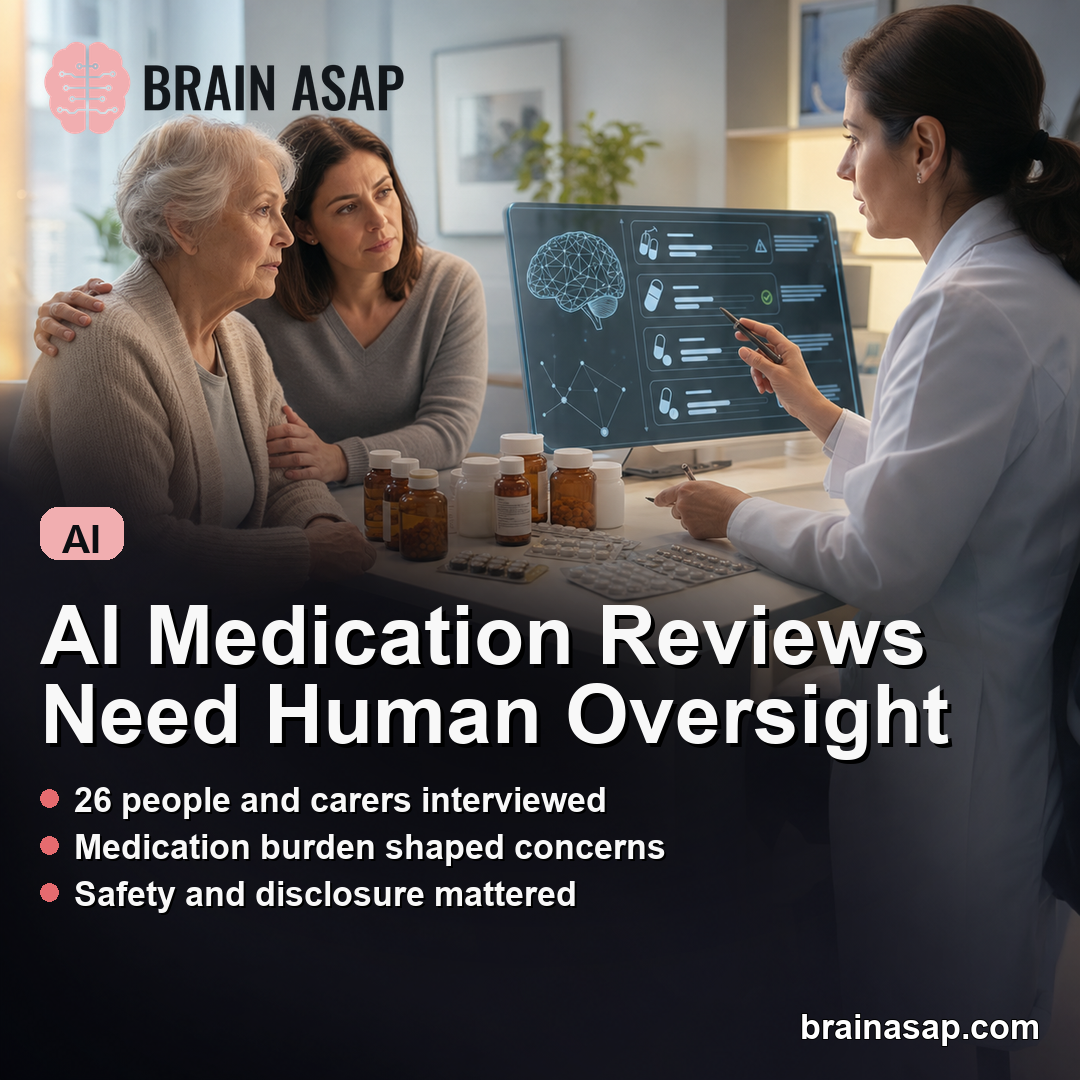
TL;DR: A 2026 preprint in medRxiv reported that people living with dementia (PLwD) and carers were generally open to artificial intelligence (AI) support in structured medication reviews, but only when AI remained validated, transparent, secure, and subordinate to human clinical judgement.
Key Findings
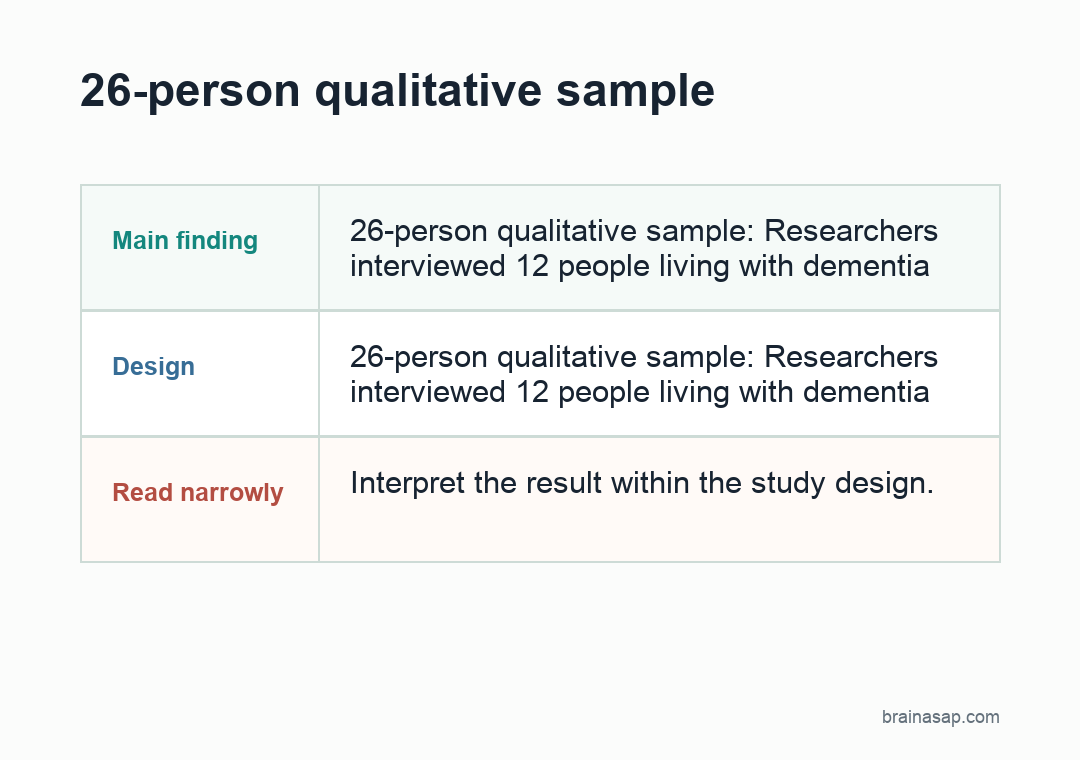
- 26-person qualitative sample: Researchers interviewed 12 people living with dementia and ran 2 focus groups with 14 carers.
- Two main themes: The analysis grouped findings into perceived pitfalls of structured medication reviews and attitudes toward AI use in those reviews.
- Five SMR pain points: Participants emphasized medication burden, rushed reviews, access problems, limited empathy, and a need for non-drug support signposting.
- Six AI conditions: AI acceptability depended on efficiency, safety, data security, disclosure preferences, the human touch, and co-design with dementia-affected people.
- Preprint boundary: The findings were not peer reviewed and measured attitudes, not whether AI-assisted medication reviews improve medication safety.
Source: medRxiv (2026) | Linder et al.
Structured medication reviews (SMRs) are meant to check whether a medication regimen is still safe, appropriate, and aligned with a patient’s needs. For people with dementia, that question is harder because memory changes, multiple conditions, and caregiver involvement can all shape day-to-day medicine use.
The study asked a narrow but practical question: would PLwD and carers accept AI help in this process? Participants described conditional support for AI assistance, not support for replacing clinicians who understand dementia, listen carefully, and can be held accountable.
AI Medication Review Support Was Acceptable Only With Human Oversight
The research team conducted semi-structured interviews with 12 PLwD and two focus groups with 14 carers. Interviews and focus groups were remote, using Microsoft Teams or telephone, and transcripts were analyzed with reflexive thematic analysis.
The design sets the claim boundary because the study was not testing an AI tool. It was collecting views from people who would be affected if AI systems were introduced into medication review workflows.
- Population: Participants included people with dementia and carers, not clinicians alone.
- Medication context: The topic was polypharmacy, defined in the paper as use of five or more medications.
- Care setting: The work focused on UK structured medication reviews in the National Health Service.
- Outcome type: The main evidence was qualitative themes, not clinical outcomes or prescribing changes.
Participants often saw AI as part of the future of health care. The positive case was practical: AI might reduce administrative burden, help clinicians manage complex medication lists, and make reviews more person centered if it freed clinicians to spend more time on the conversation.
Support was conditional. Participants wanted human oversight, clear accountability, strong validation, and protection against unsafe or inaccurate AI-generated recommendations.
Dementia Medication Burden Shaped Views of AI
The first theme was not about AI at all. It was about the lived difficulty of medication management in dementia, where a person may forget doses, struggle to recognize side effects, or depend on a carer to interpret changes in symptoms.
That background helps explain why participants did not want a purely technical medication check. They valued SMRs most when a clinician took time to understand the person, medication routine, side effects, and family context.
- Medication management: Dementia could make adherence and symptom interpretation harder over time.
- Personalized review: Participants disliked reviews that felt like a tick-box exercise.
- Access: Some participants found it difficult to arrange reviews with a preferred clinician.
- Empathy: Participants wanted more dementia awareness in medication conversations.
- Non-drug support: They wanted signposting to support groups and other non-pharmacological help when relevant.
Those details shape AI deployment. A medication-review algorithm that only flags drug interactions would miss several things participants considered central to a complete review.
Safety, Data Security, and Disclosure Were Main AI Concerns
The second theme covered attitudes toward AI in SMRs. Participants often described AI as inevitable or potentially helpful, especially in a resource-constrained health system, but they also raised specific boundaries.
- Safety concerns: Participants wanted AI recommendations to be tested, accurate, and checked by a professional.
- Data security: They worried about personal details leaving trusted healthcare settings or being exposed through breaches.
- Disclosure preferences: Some wanted to know when AI was used; others were more comfortable if the NHS had approved the system.
- Human touch: Trust, continuity, empathy, and a clinician’s understanding of the person remained central.
- Co-design: Participants wanted people affected by dementia involved in AI tool development.
The disclosure finding avoids a one-size-fits-all assumption. Transparency mattered, but participants differed in how much explanation they wanted and what kind of institutional approval would reassure them.
For dementia care, the human-touch concern is not decorative. Medication reviews may involve risk, family disagreement, communication barriers, and uncertainty about whether a symptom is a drug side effect or dementia progression.
Small Qualitative Preprint Cannot Prove AI Improves Medication Safety
The study’s strongest contribution is acceptability evidence. It shows that a small group of PLwD and carers could imagine AI being useful in SMRs, provided the tool was designed around clinician support rather than replacement.
It does not show that AI improves deprescribing, reduces adverse drug events, prevents falls, or saves clinician time in practice. Those claims would require implementation studies or trials that measure clinical and workflow outcomes.
- Sample size: The study included 26 participants, so subgroup claims should be cautious.
- Preprint status: The manuscript had not been peer reviewed at posting.
- AI literacy: Some participants said they did not know much about AI, which could affect how risks were discussed.
- Group-level analysis: Individual characteristics could not be tied directly to specific AI attitudes.
The practical takeaway is specific: if AI enters dementia medication reviews, the design target should be a safer, better-prepared clinician conversation. Participants did not ask for an autonomous AI reviewer; they asked for support that respects medication complexity, privacy, and lived experience.
Citation: DOI: 10.64898/2026.06.24.26356103. Linder et al. Attitudes of People Living with Dementia and their Carers towards the use of Generative Artificial Intelligence to inform Structured Medication Reviews. medRxiv. 2026.
Study Design: Qualitative preprint using semi-structured interviews and carer focus groups analyzed with reflexive thematic analysis.
Sample Size: 12 people living with dementia and 14 carers.
Key Statistic: Two main themes were constructed, with five SMR pain points and six AI acceptability subthemes.
Caveat: The study measured attitudes in a small preprint sample and did not test whether AI-assisted medication reviews improve clinical outcomes.