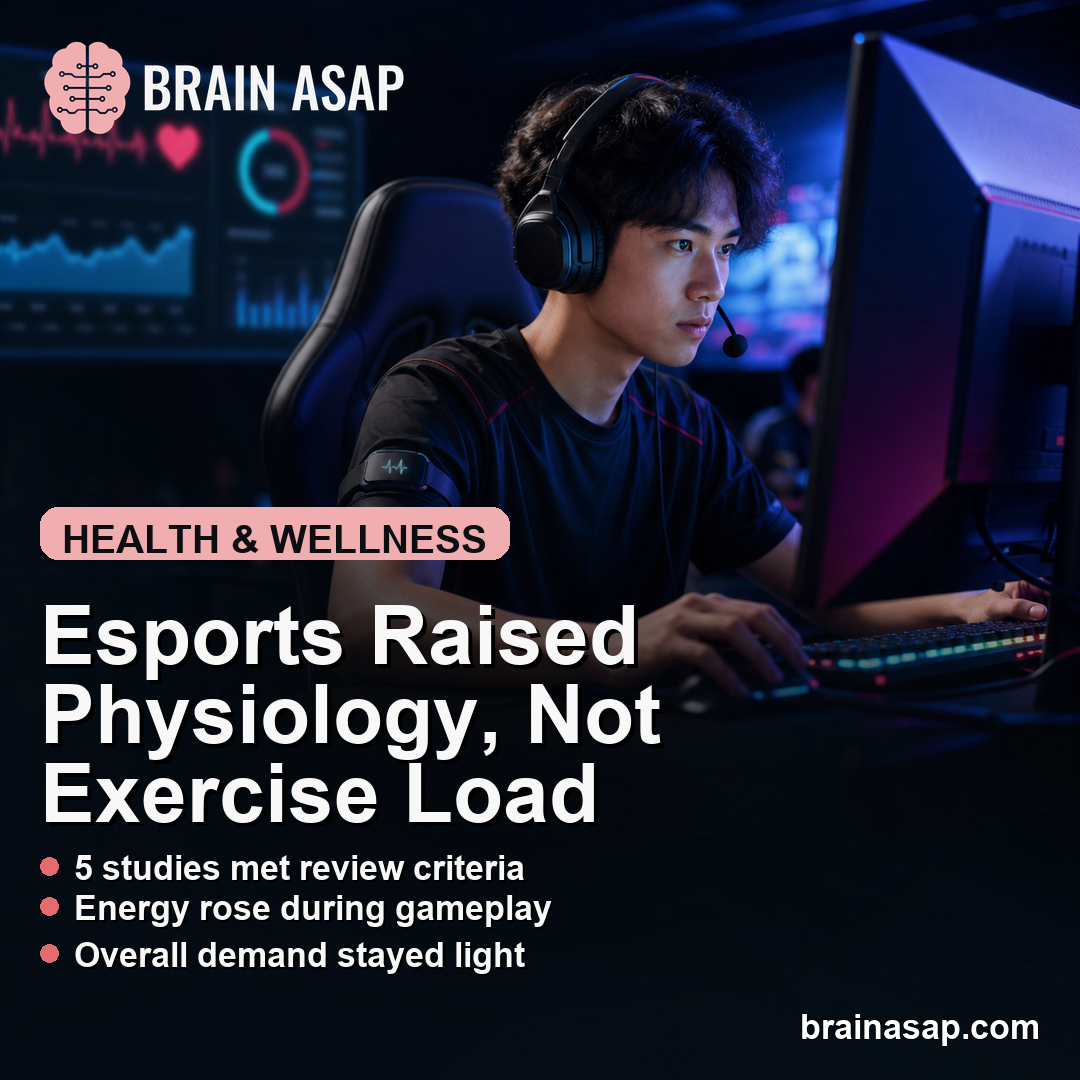
TL;DR: A 2026 systematic review in Sports Medicine – Open found that esports gameplay can raise heart rate, stress physiology, and energy expenditure, but the overall metabolic demand generally stayed in the light-activity range.
Key Findings
- 176 records screened: The review searched PubMed, Embase, SPORTDiscus, Web of Science, and Scopus before narrowing to 5 eligible studies.
- 5-study evidence base: Included studies covered multiplayer online battle arena games, first-person shooters, and sports simulations.
- 40% higher energy: One amateur-player study reported roughly 40% higher energy expenditure during competitive gameplay than during rest.
- 1.28 to 1.45 kcal/min: One expert-player study reported median energy expenditure rising from 1.28 kcal/min at rest to 1.45 kcal/min during play.
- Light-activity conclusion: The review concluded that esports can trigger sympathetic arousal while still producing relatively low total metabolic demand.
Source: Sports Medicine – Open (2026) | Kotas et al.
Energy expenditure (EE) is the amount of energy the body uses over time. In esports, the question is not whether gaming is physically demanding like running or cycling, but whether competitive play adds enough metabolic and stress load to matter during long sedentary sessions.
The review treated esports as organized competitive video gaming. Tournament play can combine sitting, rapid hand movements, cognitive load, and psycho-emotional stress.
Five Esports Energy-Expenditure Studies Met Review Criteria
The researchers screened 176 records and removed duplicates, non-English articles, wrong publication types, and studies that did not measure EE during esports sessions. Only 5 studies met the final criteria.
The included protocols were small and varied. Sample sizes ranged from a single-case study to groups of 11, 13, 27, and 30 participants.
- Game types: Studies included League of Legends, DOTA2, Paladins Champions, CS:GO, Overwatch, Rocket League, Valorant, and FIFA.
- Skill level: Most studies examined amateur players, while one included expert players.
- Comparators: Most compared gameplay with seated rest; one compared gaming with cycling at a heart-rate-matched workload.
- Measurements: Methods included indirect calorimetry, heart-rate monitoring, heart-rate variability, electrocardiography, blood markers, and cortisol.
This small base is why the review reads more like an evidence map than a settled answer. It shows what has been measured, but it also shows how little standardized physiology work exists for competitive gaming.
Competitive Gaming Raised Physiology More Than Total Calorie Burn
The main result was a split between arousal and energy cost. Esports sessions often raised heart rate and stress-related physiology, but total energy expenditure stayed low compared with traditional exercise.
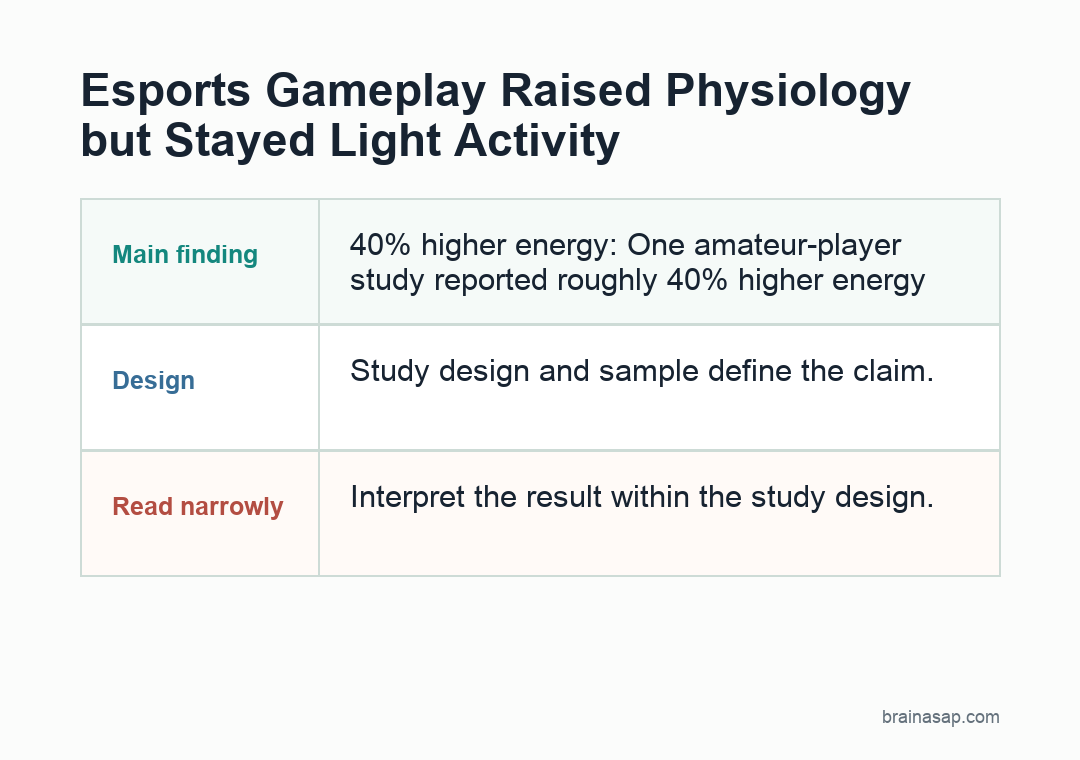
One amateur-player study reported roughly 40% higher EE during competitive gameplay than during rest, and that increase correlated with actions per minute. More in-game activity may raise energy use, even when the person remains seated.
In expert players, one study reported median EE rising from 1.28 kcal/min at rest to 1.45 kcal/min during competitive play. Oxygen consumption and carbon dioxide production also increased.
- Motor activity: Rapid hand and forearm movements can add local workload.
- Cognitive demand: Competitive decision-making can raise arousal even without large-muscle movement.
- Competitive pressure: Heart-rate and stress-marker changes may reflect psycho-emotional load more than calorie burn.
Other studies found smaller or negligible metabolic shifts. One 30-minute amateur esports intervention did not significantly alter metabolism or EE, and a single-case comparison found low EE despite elevated physiological stress.
Player Skill, Game Genre, and Measurement Method Limited Comparisons
The review could not cleanly rank game genres or match formats. Multiplayer online battle arena games, first-person shooters, and sports simulations appeared across the included studies, but protocols differed too much for a precise genre comparison.
Measurement differences also matter. Indirect calorimetry can estimate oxygen use and energy cost, but protocols varied in fasting controls, caffeine control, steady-state criteria, and whether devices interfered with gameplay.
The strongest studies controlled those pre-measurement details more carefully, while weaker protocols left more room for caffeine, recent activity, or short adaptation periods to affect the result. The direction of the finding is therefore easier to trust than any single calorie estimate.
- Sample limitations: Small non-random samples reduce generalizability.
- Protocol variation: Session length, game type, skill level, and comparator condition differed across studies.
- Stress confounding: Higher heart rate during play may reflect arousal rather than high metabolic workload.
- Tournament realism: Real competitive environments can restrict monitoring devices and differ from laboratory sessions.
That uncertainty is important for health interpretation. Esports may not burn many calories, but long sessions can still combine prolonged sitting, sympathetic activation, poor recovery, and musculoskeletal strain.
Esports Health Advice Should Not Treat Gameplay as Exercise
The strongest practical takeaway is that gameplay should not be counted as a meaningful substitute for physical activity. Competitive play can be stressful, but the metabolic demand generally resembles light activity.
For players and teams, the review supports compensatory physical activity rather than assuming competition itself covers movement needs. It also supports better measurement in future studies, especially in professional settings.
- For players: Break up long seated sessions and schedule separate aerobic and strength work.
- For teams: Monitor sleep, recovery, posture, and training load alongside game performance.
- For researchers: Use standardized calorimetry protocols and report game genre, skill level, match format, and stress markers together.
The review narrows the claim: esports can activate the body, but the total energy cost is usually low. The health issue is less about hidden exercise and more about how sedentary competition, cognitive stress, and long practice hours stack up over time.
Citation: DOI: 10.1186/s40798-026-01055-4. Kotas et al. Energy Expenditure of Esports Athletes During Gameplay: A Systematic Review. Sports Medicine – Open. 2026;12:91.
Study Design: PRISMA-guided systematic review registered in PROSPERO.
Sample Size: 5 included studies after screening 176 database records.
Key Statistic: One study reported about 40% higher EE during competitive gameplay, while another reported 1.28 to 1.45 kcal/min from rest to expert play.
Caveat: The evidence base was small, heterogeneous, and mostly amateur, so genre-specific and professional-player conclusions remain uncertain.