TL;DR: A 2026 study in Cognitive, Affective, & Behavioral Neuroscience found that visual working memory, the short-term holding of visual details, still showed a strong cardinal-versus-diagonal orientation bias under distraction, while transcranial direct current stimulation (tDCS), a weak noninvasive brain-stimulation method, did not improve task reports.
Key Findings
- Two stimulation experiments tested orientation memory: Researchers studied parietal tDCS in one experiment and occipital tDCS in a second experiment.
- Brain stimulation did not reliably improve reports: Across experiments, the tDCS main effect was not significant in the combined analysis.
- The oblique effect remained strong: Memory was more accurate for cardinal orientations than diagonal orientations, with a large angle effect.
- Distraction strengthened the bias: The angle-by-distraction interaction was significant, meaning distractors changed how strongly orientation angle affected memory.
- The result favored caution about simple cortex-switching models: The task did not show a clean shift from visual cortex to parietal protection during distraction.
Source: Cognitive, Affective, & Behavioral Neuroscience (2026) | Yoruk and Tamber-Rosenau
Visual working memory is the system that briefly holds visual information after it disappears. In everyday terms, it helps a person keep track of where something was, what angle it had, or what color it was after the original image is gone.
The new study tested a specific neural question: when people remember a line’s orientation, does the brain rely more on early visual cortex, more on posterior parietal cortex, or a flexible mix of both depending on distraction?
Researchers Tested Visual Memory With and Without Distraction
Researchers ran two related experiments using an orientation visual working-memory task. Participants viewed an oriented item, held it briefly in memory, and then reported the remembered orientation.
The key behavioral pattern was the oblique effect. People usually process vertical and horizontal orientations more precisely than diagonal orientations.
If remembered angles still show that bias, it suggests the memory trace may retain features of early visual processing.
The experiments varied three main factors:
- Stimulation site: One experiment targeted right posterior parietal cortex, while the other targeted occipital cortex.
- Stimulation condition: Participants received anodal tDCS or sham stimulation across sessions.
- Delay-period distraction: In some blocks, distractors appeared while the remembered orientation had to be maintained.
Transcranial direct current stimulation uses a low electrical current through scalp electrodes. In this study, researchers used 20 minutes of stimulation at 2.0 mA for the active condition, with sham sessions used as a control.
Parietal tDCS Did Not Produce the Predicted Boost
The first experiment tested whether parietal stimulation would help protect visual working memory from distraction. After exclusions, analyses included 35 participants.
The prediction was straightforward: if posterior parietal cortex helps preserve visual memory when distractors appear, then parietal tDCS should improve performance or reduce the oblique effect under distraction.
The predicted improvement did not appear clearly. The main effect of tDCS was inconclusive under the Bayesian stopping rule reported for the experiment, with BF = 0.839.
The broader discussion states that parietal stimulation showed no apparent enhancement of visual working memory.
The oblique effect, however, was visible. Participants still showed better memory for cardinal orientations than for diagonal orientations, which was not what a simple parietal-protection account would predict if distraction forced the system away from early visual coding.
Occipital tDCS Also Failed to Move the Main Result
The second experiment moved the active stimulation target to the occipital cortex, a visual-processing region. After exclusions, analyses included 33 participants.
Here, the logic ran in the other direction. If early visual cortex carries the remembered orientation, changing occipital excitability might alter precision, susceptibility to distraction, or the size of the oblique effect.
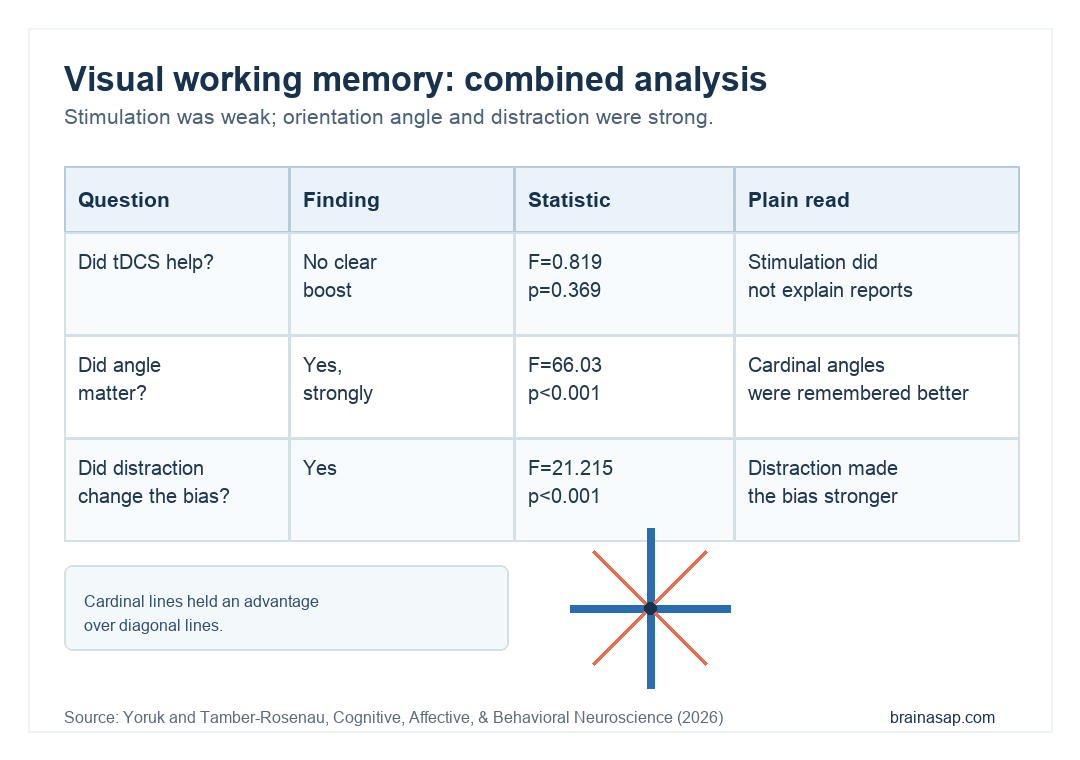
Again, stimulation did not drive the main behavioral story. In the combined analysis across both experiments, the tDCS main effect was not significant: F(1,66) = 0.819, p = 0.369, partial eta squared = 0.012, with BFinc = 0.547.
That does not prove tDCS can never affect visual working memory. It does mean this well-controlled design did not support the specific prediction that parietal or occipital anodal stimulation would cleanly improve orientation memory reports.
Distraction Made the Oblique Effect Stronger, Not Weaker
The strongest result was the orientation-angle effect. Across experiments, angle had a large association with performance: F(1,66) = 66.03, p < 0.001, partial eta squared = 0.5, with BFinc = 1.968 x 10^8.
The more surprising finding was how distraction changed that bias. Researchers expected distractors to push memory away from early visual cortex and therefore reduce the oblique effect.
Instead, the distractor-by-angle interaction was significant: F(1,66) = 21.215, p < 0.001, partial eta squared = 0.243, BFinc = 1021.671.
The simple angle effects were present in both conditions, but stronger with distraction:
- Distractor-present trials: The angle effect had t(67) = 8.181, p < 0.001, Cohen’s d = 0.992, BFinc = 7.931 x 10^8.
- Distractor-absent trials: The angle effect had t(67) = 4.546, p < 0.001, Cohen’s d = 0.551, BFinc = 800.231.
- Practical meaning: Diagonal orientations carried a bigger memory cost when distractors had appeared during the delay.
The main behavioral result is direct. Distraction did not erase the sensory-style orientation bias. It amplified it.
Distraction Complicated Visual Cortex and Parietal Models
A simple version of the distributed-network view would predict a clean handoff. Without distraction, early visual cortex would carry the fine-grained visual trace; with distraction, parietal regions would protect the remembered item from incoming visual input.
The study did not fit that simple handoff. The oblique effect remained and became stronger under distraction, while neither parietal nor occipital tDCS created the expected improvement.
Researchers offered two main interpretations:
- Continued sensory reliance: Visual working memory may still depend on early visual coding even when distractors are present.
- Strategy shift under distraction: Participants may use a performance-maximizing strategy that sacrifices fine-grained orientation detail.
- Null stimulation result: The absence of a tDCS benefit weakens a strong causal claim from this design, but it does not close the broader debate about visual and parietal memory representations.
The limitation is also clear. The sample came from a university community, and the task tested a narrow form of visual memory: brief orientation reports.
The results should not be stretched into a general claim about all working memory, all attention, or clinical brain stimulation.
The finding separates the task’s behavioral sensitivity from the stimulation result. The task was sensitive enough to detect a robust orientation-memory bias.
It did not show a matching behavioral benefit from anodal tDCS. For visual working-memory research, that combination is a real constraint on simple models of how the brain protects remembered visual detail.
Citation: DOI: 10.3758/s13415-026-01443-z. Yoruk and Tamber-Rosenau. The oblique effect in visual working memory is enhanced by distraction, regardless of tDCS manipulations. Cognitive, Affective, & Behavioral Neuroscience. 2026.
Study Design: Two within-subject visual working-memory experiments testing anodal versus sham tDCS, delay-period distraction, and cardinal versus diagonal orientation memory.
Sample Size: 68 analyzed participants across two experiments: 35 in the parietal tDCS experiment and 33 in the occipital tDCS experiment.
Key Statistic: Across experiments, the tDCS main effect was not significant, while the angle effect was large (F(1,66) = 66.03, p < 0.001) and the distractor-by-angle interaction was significant (F(1,66) = 21.215, p < 0.001).
Caveat: The task focused on short-term orientation memory in a university sample, so the result should not be generalized to all working-memory tasks or clinical stimulation uses.