TL;DR: A 2026 study in Journal of Sex Research found that in 571 German women, arousal to an aggressive written sexual narrative was better explained by sex drive, rape myth acceptance, and prior violent pornography exposure than by evolutionary life-history markers.
Key Findings
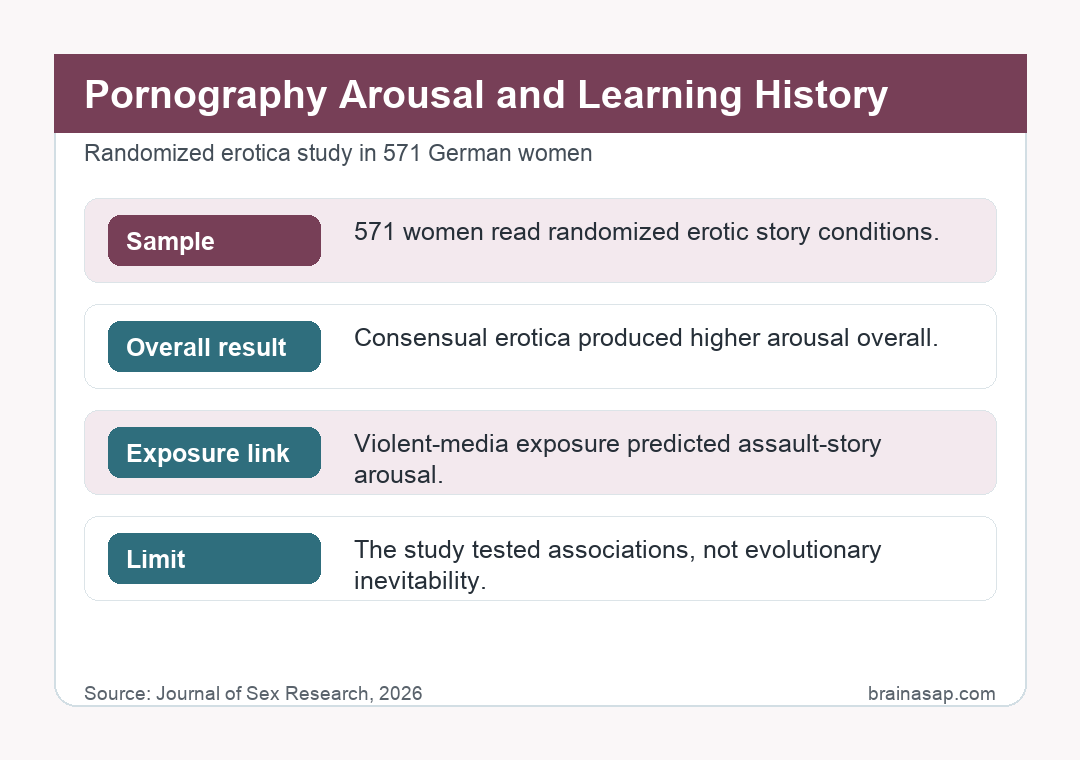
- 571 women were quota-sampled: The German sample was selected to reflect age and education distributions in the population.
- Consensual scenario aroused more overall: Across the sample, the consensual written pornography stimulus produced greater arousal than the nonconsensual assault narrative.
- Sex drive generalized: Higher sex drive predicted greater arousal to explicit material across conditions.
- Rape myth acceptance mattered: Higher acceptance of rape myths significantly predicted reported arousal patterns.
- Violent-media exposure was specific: Prior violent pornography use predicted higher arousal to the assault narrative, but not the consensual scenario.
Source: Journal of Sex Research (2026) | von Andrian-Werburg et al.
Sexual arousal can be psychologically uncomfortable to study because it does not map neatly onto values, consent, or endorsement.
This Journal of Sex Research experiment handled that distinction directly.
It measured subjective arousal to written scenarios and asked which predictors actually explained the response.
The Study Separated Arousal From Endorsement
The most important interpretive guardrail is that subjective arousal to a fictional stimulus is not moral approval, desire for real harm, or consent.
Study details:
- 571 women were quota-sampled: The German sample was selected to reflect age and education distributions in the population
- Consensual scenario aroused more overall: Across the sample, the consensual written pornography stimulus produced greater arousal than the nonconsensual assault narrative
- Sex drive generalized: Higher sex drive predicted greater arousal to explicit material across conditions
- Rape myth acceptance mattered: Higher acceptance of rape myths significantly predicted reported arousal patterns
The study also focused on psychological arousal rather than involuntary genital reflexes.
The distinction is important because nonconsensual sexual stimuli can produce complex responses.
A person’s body or mind can react to threat, taboo, tension, learned associations, or narrative intensity without endorsing the event depicted.
That distinction protects the interpretation in both directions.
The result should not be used to blame women for responses to fictional aggression, and it should not be used to pretend media exposure has no learning effects.
That separation lets the response be measured without turning it into a moral confession.
Arousal becomes a psychological outcome to explain: what cues were present, what meanings were attached to them, and what past exposure may have taught the participant to expect.
Consensual Erotica Was Still More Arousing Overall
Participants were randomly assigned to read either a consensual sexual scenario or a nonconsensual assault scenario. Overall, the consensual scenario elicited greater arousal.
That baseline result prevents the study from being misread as saying aggressive material was generally preferred.
The informative test was narrower: which traits predicted higher arousal among people exposed to the aggressive narrative?
Prior Violent Media Exposure Predicted the Specific Response
Women who had previously consumed violent pornography reported higher arousal when reading the assault narrative compared with women without that history.
The same prior exposure did not raise arousal in the consensual-stimulus group.
That finding points toward learning. Repeated exposure can link certain cues, tension states, and narrative structures with sexual arousal, making later responses more likely in similar contexts.
The finding does not require a claim that media overwrites desire in a simple way.
A learned association can be narrower: a repeated pairing between arousal, taboo, aggression cues, and narrative suspense may make the assault script more familiar or more sexually legible when it appears again.
- General arousal route: higher sex drive predicted stronger responses to explicit material overall.
- Specific exposure route: prior violent pornography use predicted arousal to the assault narrative.
- Belief route: rape myth acceptance may change how a nonconsensual scenario is interpreted.
- Unsupported route: fast life-history markers did not explain the arousal pattern.
If prior violent pornography exposure had simply marked higher overall sexual responsiveness, it should have predicted arousal to the consensual scenario too.
The reported pattern was narrower than that, which is why the exposure history points toward learned cue-response associations rather than global libido alone.
Rape Myth Acceptance Changed the Interpretive Frame
Rape myth acceptance also mattered. These are beliefs that excuse perpetrators, blame victims, or reinterpret assault as something less harmful or secretly desired.
Researchers suggest that such beliefs may change how a reader processes a nonconsensual narrative, potentially creating psychological distance from the victim or reframing the scenario as rough but consensual.
That is a media-psychology mechanism, not an evolutionary destiny.
This part of the finding is uncomfortable but important. Beliefs can shape what a stimulus appears to mean, and meaning changes arousal, disgust, fear, attention, and memory.
A person who interprets the same text as coercion may have a different response from someone who interprets it through scripts that minimize coercion.
The study is therefore about appraisal as much as exposure.
Prevention research would target those pathways differently from libido or inherited strategy.
The model implied by the data is cognitive and learned: cues are interpreted, interpretations carry emotional weight, and repeated scripts can become easier to process over time.
Fast Life-History Theory Did Not Explain the Data
The study tested whether biological-evolutionary markers, including age at first menstruation and life-history strategy measures, predicted arousal to aggressive material. They did not, aside from general sex drive.
That negative result is the point.
The data favored socialization, prior media exposure, and beliefs over the idea that a subset of women respond to aggressive pornography because of a fast reproductive strategy.
Evolutionary explanations can sound deeper than learning explanations even when the data do not support them. In this dataset, the more ordinary predictors did more work.
Researchers did not show that violent media exposure causes a fixed preference, and the study cannot reconstruct every participant’s developmental history.
It does show that measured exposure and beliefs explained more than the life-history variables researchers tested.
The life-history result should also keep the interpretation from drifting into biological fatalism.
Age at menarche and calculated life-history strategy did not carry the arousal pattern, so the data point back toward modifiable learning histories and belief systems.
Learning History Beat Fast Life-History Markers
Preferences for aggressive sexual fiction were better explained by learning history, broader sexual responsiveness, and social beliefs than by the tested evolutionary markers.
That should inform discussions of media psychology and consent culture without turning arousal into blame. It also keeps the result away from a simplistic “biology made this inevitable” frame.
The next study would need stronger exposure timing, longitudinal data, and measures that separate curiosity, disgust, fear, attention, taboo, sexual interest, and narrative transportation.
Self-reported arousal is helpful, but it is not the whole psychological response.
In this sample, prior violent pornography exposure predicted a specific arousal response to an aggressive written stimulus, while fast life-history markers did not.
A stronger design would also ask whether changes in media exposure predict later changes in appraisal, rape myth acceptance, or arousal to aggressive fiction.
That would move the field beyond cross-sectional exposure history and closer to a learning model with temporal order.
Such a design could test the mechanism directly.
If exposure comes first, then appraisal shifts, then arousal changes, the learning account becomes stronger; if arousal preference comes first and predicts later media choice, the causal sequence would be different.
Until then, the safest mechanism is associative and interpretive: repeated scripts can change what cues feel familiar, and beliefs can change what the same cue appears to mean.
Citation: DOI: 10.1080/00224499.2026.2642323. von et al. Why Do You Watch This Rough Stuff? Assessing Predictors of Female Pornography Preferences. Journal of Sex Research. 2026
Study Design: Randomized experimental psychology study using written consensual versus nonconsensual sexual stimuli and self-reported psychological arousal.
Sample/Model: 571 women living in Germany, quota-sampled by age and education.
Key Statistic: Prior violent pornography use predicted higher arousal to the nonconsensual stimulus, while fast life-history markers were not significant predictors aside from sex drive.
Caveat: Single-study evidence; interpret with the source design and sample.