Home DBS Recordings Tracked Depression Recovery Biomarkers

Home DBS Recordings Tracked Depression Recovery Biomarkers

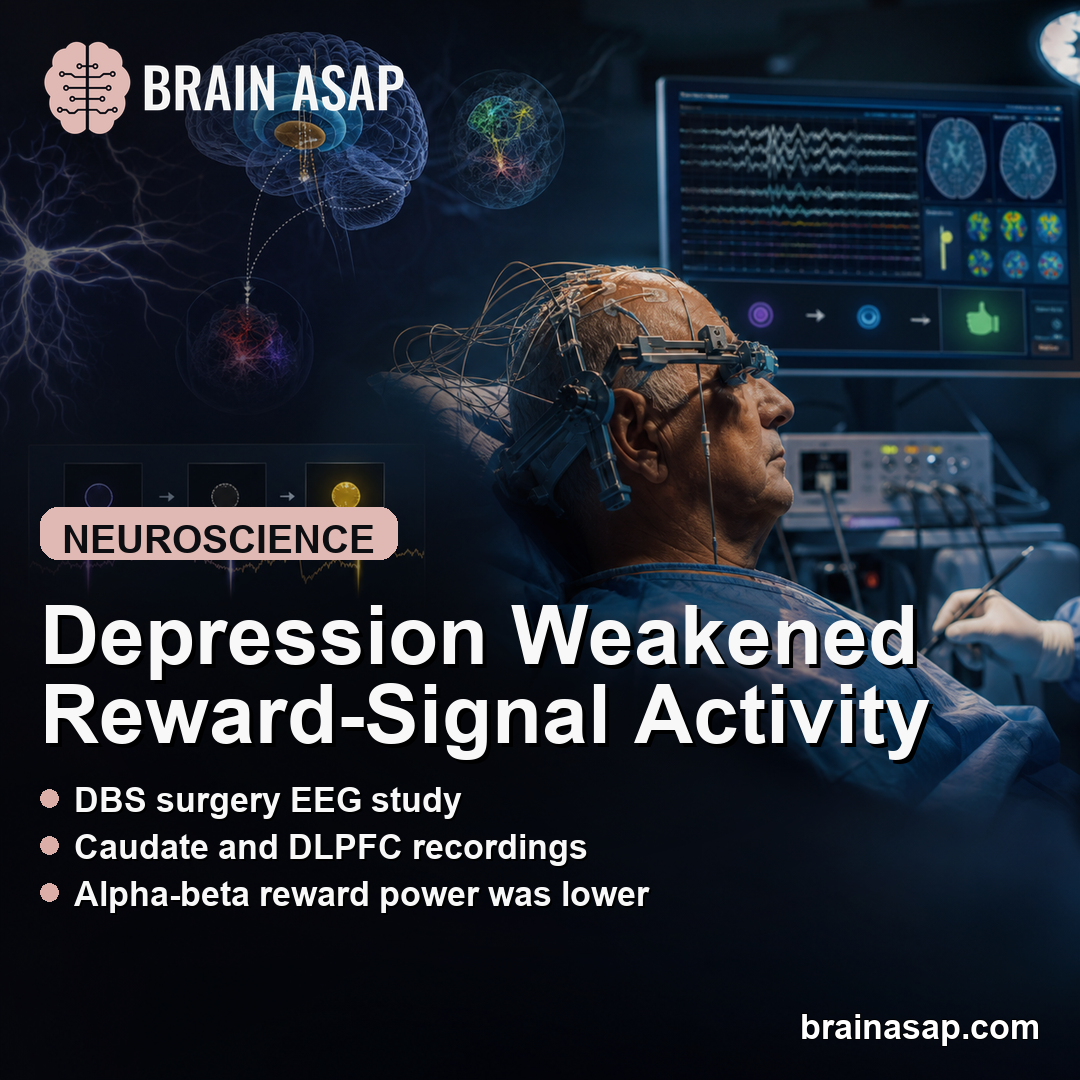
TL;DR: A 2026 preprint deep brain stimulation biomarker study in medRxiv found that home-recorded electrophysiology biomarkers tracked stable depression recovery during SCC DBS, while the biomarkers helped distinguish recovery from nonspecific symptom fluctuations and external distress. Key Findings Study type: a home-recording study using bidirectional deep brain stimulation devices to monitor electrophysiology during depression recovery. …

Read more

ECT Was Not Linked to Long-Term Dementia Harm in Adjusted Data

ECT Looks Safer in the Long Run Than Its Reputation

ECT Looks Safer in the Long Run Than Its Reputation TL;DR: A British Journal of Psychiatry review argues that modern population-level studies do not support a long-term increase in dementia or major cardiovascular risk after electroconvulsive therapy and instead point toward lower suicide mortality and all-cause mortality in the patients who receive it. Key Findings …

Read more

Focused Ultrasound Reprogrammed Microglia in Alzheimer’s Rats

How Focused Ultrasound Reprogrammed Microglia in Alzheimer's Rats

How Focused Ultrasound Reprogrammed Microglia in Alzheimer’s Rats TL;DR: In TgF344-AD rats, repeated low-intensity focused ultrasound triggered a short-lived inflammatory response, then left behind a more durable microglial metabolic shift in early disease without clearly improving Alzheimer’s pathology on its own. Key Findings 450 kPa across a 12 x 6 mm target: The team skull-corrected …

Read more

Low CSF Ethanolamine Linked to Major Depression, Levels Increase After ECT

Ethanolamine Could Be a Depression Biomarker and Treatment Target

Ethanolamine Looked Like a Depression Biomarker and Treatment Target TL;DR: In a 380-person cerebrospinal fluid dataset, patients with active major depression had lower ethanolamine levels than controls, those levels rose after electroconvulsive therapy, and parallel rat experiments suggested the molecule may be more than just a marker. Key Findings 380-person cerebrospinal fluid (CSF), the fluid …

Read more

DLPFC-sgACC EEG Connectivity Predicted rTMS Remission in Depression

Brain Circuit Signal Predicted rTMS Remission

DLPFC-sgACC Circuit Signal Predicted rTMS Remission TL;DR: Before starting rTMS, patients who later remitted from depression showed lower alpha-band connectivity flowing from the DLPFC to the subgenual cingulate — pointing toward a measurable EEG marker that could help select candidates before weeks of treatment are spent. Key Findings Remitters had lower pre-treatment DLPFC-to-sgACC alpha connectivity: …

Read more

Transcranial Direct Current Stimulation (tDCS) of Left Dorsolateral Prefrontal Cortex Seems Effective for Depression & Anxiety (2024 Review)

Transcranial direct current stimulation (tDCS) targeting the left dorsolateral prefrontal cortex (DLPFC) at 2-mA intensity effectively alleviates depressive symptoms and shows promise in reducing anxiety symptoms across various clinical conditions. Highlights: tDCS targeting the left DLPFC significantly reduces depressive symptoms, highlighting it as a transdiagnostic neural mechanism across diverse clinical conditions. The meta-analysis showed that …

Read more

rTMS of Left Dorsolateral Prefrontal Cortex (DL-PFC) May Treat Methamphetamine Addiction via Altering Cravings & Decision Making (2024 Study)

Repetitive transcranial magnetic stimulation (rTMS) on the left dorsolateral prefrontal cortex (dlPFC) improves decision-making and reduces cravings in individuals with methamphetamine use disorder (MUD). Highlights: Improved Decision-Making: rTMS treatment enhanced decision-making abilities in MUD patients, making their choices more rational and similar to healthy individuals. Craving Reduction: Participants experienced a significant decrease in cravings for …

Read more

TMS is Effective But Underutilized for Major Depression vs. Standard of Care (2024 Study)

Transcranial magnetic stimulation (TMS) is underutilized in treating major depressive disorder (MDD) despite showing significant clinical benefits, with barriers including insurance coverage and limited access. Highlights: Study Scope: Analyzed real-world data from a large, multi-site psychiatric practice to evaluate TMS utilization and outcomes compared to usual care (UC) for patients with MDD. Patient Cohorts: Among …

Read more

Transcranial Alternating Current Stimulation (TACS) for Depression: Effective Adjunct via Reducing Prefrontal Alpha Waves (2024 Trial)

Adding transcranial alternating current stimulation (tACS) to antidepressant treatment improves depression symptoms more effectively than using antidepressants alone. Highlights: Enhanced Efficacy: tACS combined with antidepressants significantly reduces depression symptoms compared to antidepressant treatment alone. Lasting Effects: The additional antidepressant benefits of tACS persist for at least 4 weeks after treatment ends. Brain Activity Changes: Patients …

Read more

rTMS Improves Blood Biomarkers (BDNF, GDNF, Thiol, S100B) in Depression (2024 Study)

Repetitive transcranial magnetic stimulation (rTMS) therapy improves key biochemical markers in major depressive disorder (MDD) patients, indicating its effectiveness as an antidepressant treatment. Highlights: Improved Antioxidant Levels: rTMS therapy significantly increased total antioxidant status (TAS), total thiol (TT), and native thiol (NT) levels in MDD patients compared to their levels before treatment. Reduced Oxidative Stress: …

Read more