TL;DR: A 2026 study in Political Psychology found that men ages 18 to 35 reported the highest levels of dominance-seeking moral grandstanding, a form of moral expression aimed at putting opponents down rather than only defending a belief.
Key Findings
- Dominance-seeking moral grandstanding was highest among men ages 18 to 35.
- Four-country survey: 8,420 adults were surveyed across Germany, France, Greece, and Hungary.
- Party pattern: The pattern was reported across party preferences, suggesting hostile moral display was not only a left-right issue.
- Prestige motive: Prestige-seeking grandstanding was more broadly distributed across age, gender, and political groups.
- Main caveat: The study was cross-sectional and survey-based, so it cannot prove that age, gender, or status pressure caused the behavior.
Source: Political Psychology (2026) | Jungkunz
Moral grandstanding means using public moral or political talk to raise one’s social standing. It is different from holding a strong moral belief, because the behavior is partly about audience, status, and social reward.
Sebastian Jungkunz tested whether this behavior followed predictable demographic patterns. The clearest split was not between left and right. It was between dominance-seeking moral display and prestige-seeking moral display.
Dominance-Seeking Grandstanding Means Shaming Opponents
The study separated two motives that can look similar in public debate. Both involve moral language, but they point toward different social goals:
- Prestige-seeking grandstanding: expressing moral views to look principled, admirable, or inspiring to one’s own group.
- Dominance-seeking grandstanding: using moral claims to denigrate opponents, shame them, or show superiority over people who disagree.
That distinction is important because online political conflict often treats every moralized statement as the same thing. The motive behind the statement may be the sharper measurement.
A person can make a sincere ethical argument without grandstanding. The behavior measured here is narrower: moral expression used as a competitive social display.
The Survey Included 8,420 Adults in Four Countries
Researchers analyzed 8,420 adults from Germany, France, Greece, and Hungary. Participants ranged from 18 to 69 years old and completed survey items on moral grandstanding motives, gender, age, education, and intended party support.
The moral grandstanding scale asked about statements that map onto prestige and dominance. A prestige item captured wanting to appear on the right side of moral or political history.
A dominance item captured wanting to show people who disagree that one is better than them.
The design let researchers compare several possible explanations at once:
- Age: whether younger adults reported stronger status-seeking moral display.
- Gender: whether men and women differed in prestige or dominance motives.
- Party preference: whether the pattern tracked left-right affiliation.
- Political extremity: whether more radical views predicted stronger grandstanding than moderate views.
Young Men Reported the Highest Dominance Motive
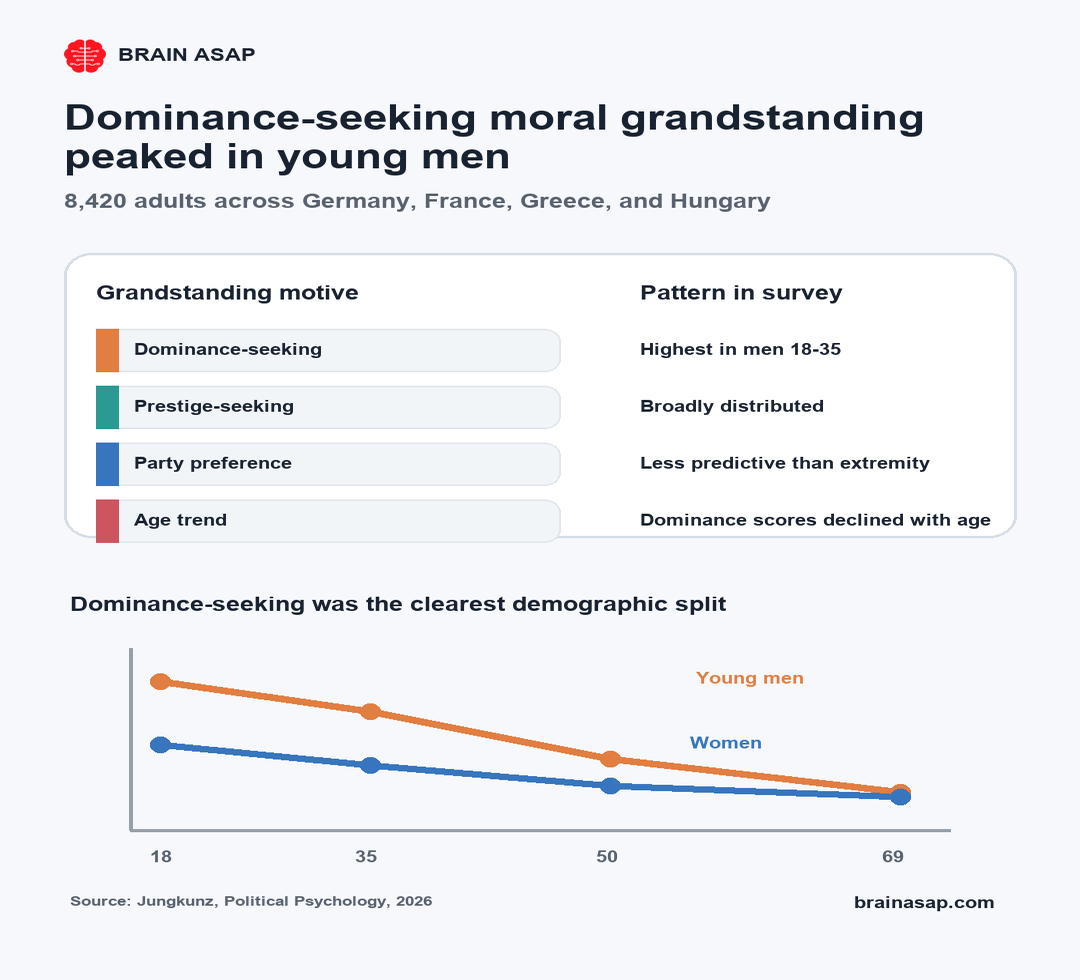
The strongest demographic result involved men ages 18 to 35. They reported the highest levels of dominance-seeking moral grandstanding, meaning they were more likely to endorse using moral and political expression to put down opponents.
The gender gap was especially wide among the youngest respondents. The report described a typical 18-year-old man as scoring about one point higher on the dominance scale than a woman of the same age.
Dominance-seeking scores declined with age, and the gender gap narrowed in older groups. Among the oldest respondents, men and women looked much more similar on the dominance measure.
The finding is not a claim that young men are uniquely political, uniquely moral, or uniquely hostile. It shows that this particular status-oriented form of moral expression clustered most clearly in that group.
Party Preference Was Not the Main Divider
One notable result is what did not explain the pattern. Basic party preference mattered less than many readers might expect. Young men reported elevated dominance-seeking grandstanding across different political camps.
Political extremity was more predictive. People with more radical views on either end of the ideological spectrum were more likely to report moral grandstanding than moderates.
That creates three separate takeaways:
- Hostile moral display is not only partisan: the same dominance motive can appear in different ideological groups.
- Extremity still matters: stronger ideological radicalism was linked with more grandstanding.
- Demographics shaped expression: age and gender changed how moral status competition showed up.
Prestige-seeking grandstanding followed a different pattern. Wanting to appear admirable or inspiring was spread more broadly across age, gender, and political affiliation.
Status Pressure May Shape Online Outrage
The study fits a practical observation about digital politics. Public argument often rewards the person who sounds most certain, most morally charged, or most willing to humiliate an opponent.
For younger adults, especially younger men, those rewards may overlap with status competition. The paper describes dominance-seeking moral grandstanding as one possible route for publicly proving strength, certainty, or social rank.
That interpretation is plausible, but it should stay bounded. The study measured self-reported motives in an online survey.
It did not observe live behavior, track social-media posts, or prove that masculine status pressure caused the pattern.
The narrower implication is direct: when political speech becomes a stage for status, content moderation or fact-checking alone may not address the motive behind the performance.
The Main Limit Is Causality
The study was cross-sectional, meaning all measurements were collected at one time. That design can identify associations, but it cannot prove developmental change or cause and effect.
Online survey panels may also overrepresent people who are active in digital settings, where antagonistic moral expression is especially visible and rewarded. The four-country sample improves breadth, but the result still needs testing in other political systems, including the United States.
Even with those limits, the finding redirects attention from ideology alone to social function. Some moral outrage may be about principle or group belonging.
Some may be about dominance.
For understanding polarization, that distinction is central. If a person is using moral language to compete for status, arguing over the policy claim may not touch the social reward that keeps the behavior alive.
Citation: DOI: 10.1111/pops.70132. Jungkunz S. The age of virtue signaling: Moral grandstanding as competitive display among young men. Political Psychology. 2026.
Study Design: Cross-sectional survey analysis of moral grandstanding motives.
Sample Size: 8,420 adults from Germany, France, Greece, and Hungary, ages 18 to 69.
Key Statistic: Men ages 18 to 35 reported the highest dominance-seeking moral grandstanding; prestige-seeking grandstanding was broadly distributed.
Caveat: Survey associations cannot prove that age, gender, or status pressure caused dominance-seeking political expression.