TL;DR: A 2026 Neuropsychopharmacology study of 11,036 ABCD participants found youth who initiated cannabis use showed flatter cognitive-development trajectories from ages 9 to 17, with hair-detected THC linked to worse episodic-memory change.
Key Findings
- 11,036 youth were followed: Researchers used the Adolescent Brain Cognitive Development (ABCD) Study to track neurocognitive performance from late childhood into adolescence.
- Cannabis onset was measured broadly: The cannabis-use group combined self-report with hair, urine, oral-fluid, and medicinal-CBD records rather than relying only on teen self-report.
- Flatter trajectories involved 2,204 cannabis users: Compared with 9,664 controls, youth who used cannabis showed less age-related improvement across several cognitive domains.
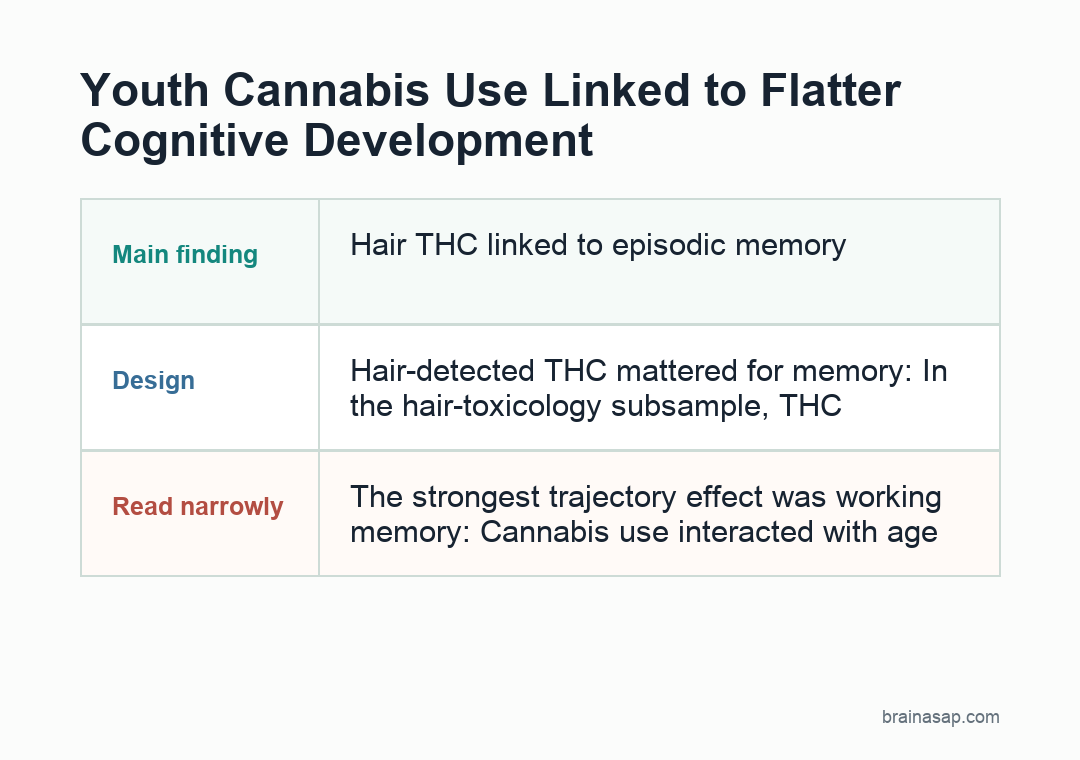
- The strongest trajectory effect was working memory: Cannabis use interacted with age for working memory with beta = -0.52, while other domains showed smaller but significant age interactions.
- Hair-detected THC mattered for memory: In the hair-toxicology subsample, THC exposure predicted worse episodic-memory trajectory, while CBD-positive youth did not differ significantly from controls.
Source: Neuropsychopharmacology (2026) | Wade et al.
ABCD Data Let Researchers Track Cognition Before Cannabis Use
Adolescent cannabis research has a basic timing problem. If cognitive testing starts after frequent cannabis use is already established, it is hard to know whether lower scores came before use, followed use, or reflected shared social and family risks.
This study used the ABCD cohort, a large US sample recruited at ages 9 to 10, before most participants had begun substance use. The analysis included data through ABCD Release 6.0, with annual substance-use assessment and repeated neurocognitive testing through about age 17.
Researchers also avoided a common weakness in teen substance-use studies: relying only on self-report. Cannabis exposure was identified from several sources:
- Self-report: substance-use interviews and timeline followback data captured reported cannabis use over time.
- Short-window testing: oral-fluid and urine toxicology helped identify recent cannabis exposure.
- Longer-window testing: hair toxicology captured roughly the prior 3 months of more sustained exposure.
- CBD records: parent and youth reports of medicinal CBD use helped separate cannabinoid categories.
Combining self-report and toxicology improved exposure classification because adolescents may underreport substance use, while toxicology can miss one-time or low-level use.
Cannabis Users Improved Less Across Several Cognitive Domains
The main result was not a simple “cannabis users scored lower at baseline” story. Youth who later initiated cannabis use often showed slightly better cognitive performance in late childhood, then had flatter gains as adolescence progressed.
The cannabis group included 2,204 participants, compared with 9,664 controls. Models adjusted for age, sex, alcohol use, nicotine use, other substance use, family history of substance problems, prenatal substance exposure, baseline psychopathology, parental education, race and ethnicity, study site, family clustering, and within-person repeated measures.
Across the primary models, cannabis-use status interacted with age for several tasks:
- Working memory: beta = -0.52, the largest reported age-interaction effect.
- Episodic memory: beta = -0.32, with the cannabis group worse than controls by ages 15 to 17.
- Processing speed: beta = -0.24, with controls showing greater age-related improvement.
- Inhibitory control: beta = -0.21, shifting from early advantage to later worse performance.
- Verbal recall and long-delay memory: both showed smaller but significant flatter trajectories.
The slope is the practical signal. Controls kept improving with age as expected.
Cannabis-using youth often improved too, but the improvement was smaller, flatter, or shifted toward worse performance in mid-to-late adolescence.
Hair Toxicology Pointed More Toward THC Than CBD
The secondary analysis asked a narrower question: whether specific cannabinoids detected in hair were tied to cognitive change. Hair testing is not a perfect measure of all cannabis exposure, but it is useful for identifying more sustained recent use.
In the hair-analysis sample, researchers compared 546 controls with no hair cannabinoids, 81 THC-only participants, and 21 CBD-positive participants. The key result was specific to episodic memory.
THC-only status interacted with age for episodic memory, beta = -0.60, p = .007. Higher episodic-memory scores are better, so the negative interaction means THC-positive youth showed less age-related improvement than controls.
CBD-positive youth did not differ significantly from controls in that model. The researchers were careful not to overinterpret that null result, because the CBD-positive group was small and CBD products can be mislabeled or contaminated with THC.
The THC finding fits the biological concern behind adolescent cannabis exposure. THC acts through cannabinoid signaling during a period when the brain is still changing rapidly, especially in memory, attention, and executive-control systems.
The Result Supports Delay, Not Panic
The study does not prove that cannabis alone caused every flatter cognitive trajectory. Observational cohort data can reduce confounding, but it cannot remove every family, personality, environment, or motivation factor that might shape both cannabis initiation and cognition.
Still, the design is stronger than many older cannabis-cognition studies. Researchers had cognitive data before most cannabis use, a large sample, multiple exposure measures, repeated testing, and extensive covariate control.
The most careful interpretation is straightforward: earlier adolescent cannabis use was associated with reduced cognitive-development gains. That is different from saying every teen who tries cannabis will have measurable impairment, but it does support public-health messages that delay initiation during early adolescence.
Several limitations keep the result bounded:
- Residual confounding: unmeasured time-varying factors could still influence both cannabis use and cognitive development.
- Hair subsample size: the cannabinoid-specific analysis used 645 participants, and the CBD-positive group had only 21.
- Exposure detail: frequency, dose, potency, product type, and exact timing of use still need more follow-up.
- Development still ongoing: the cohort is not yet through young adulthood, when some cognitive trajectories may widen, narrow, or stabilize.
For now, the study adds a useful middle ground between alarm and dismissal. Cannabis initiation in adolescence was not linked to one isolated test score.
It was linked to a broader pattern of flatter cognitive growth, and hair data made the THC-memory signal more specific.
Citation: DOI: 10.1038/s41386-026-02395-1. Wade et al. Longitudinal neurocognitive trajectories in a large cohort of youth who use cannabis: combining self-report and toxicology. Neuropsychopharmacology. 2026.
Study Design: Prospective longitudinal cohort analysis using ABCD Study neurocognitive testing and cannabis-use classification from self-report plus toxicology.
Sample Size: 11,036 youth in the primary analysis; 645 youth in the repeated hair-toxicology cannabinoid analysis.
Key Statistic: Cannabis use interacted with age across cognitive domains, with working memory beta = -0.52; hair-detected THC predicted worse episodic-memory trajectory, beta = -0.60, p = .007.
Caveat: Observational design cannot fully remove residual confounding, and the cannabinoid-specific hair analysis had a small CBD-positive group.