Chlorpyrifos Linked to 2.5x Higher Parkinson’s Risk
TL;DR: A pesticide sprayed on US crops decades ago more than doubles your risk of Parkinson’s disease, and new research shows exactly how it damages dopamine neurons.
You probably never heard of chlorpyrifos, but your neighborhood may have been sprayed with it. This common agricultural insecticide was applied to millions of acres across California and the US until the EPA phased out indoor use in 2001. Now, a major new study reveals that people exposed to this pesticide 10-20 years before developing Parkinson’s disease carried a 2.5-fold increased risk — evidence that connects environmental toxins to one of neurology’s most stubborn puzzles.
Key Findings
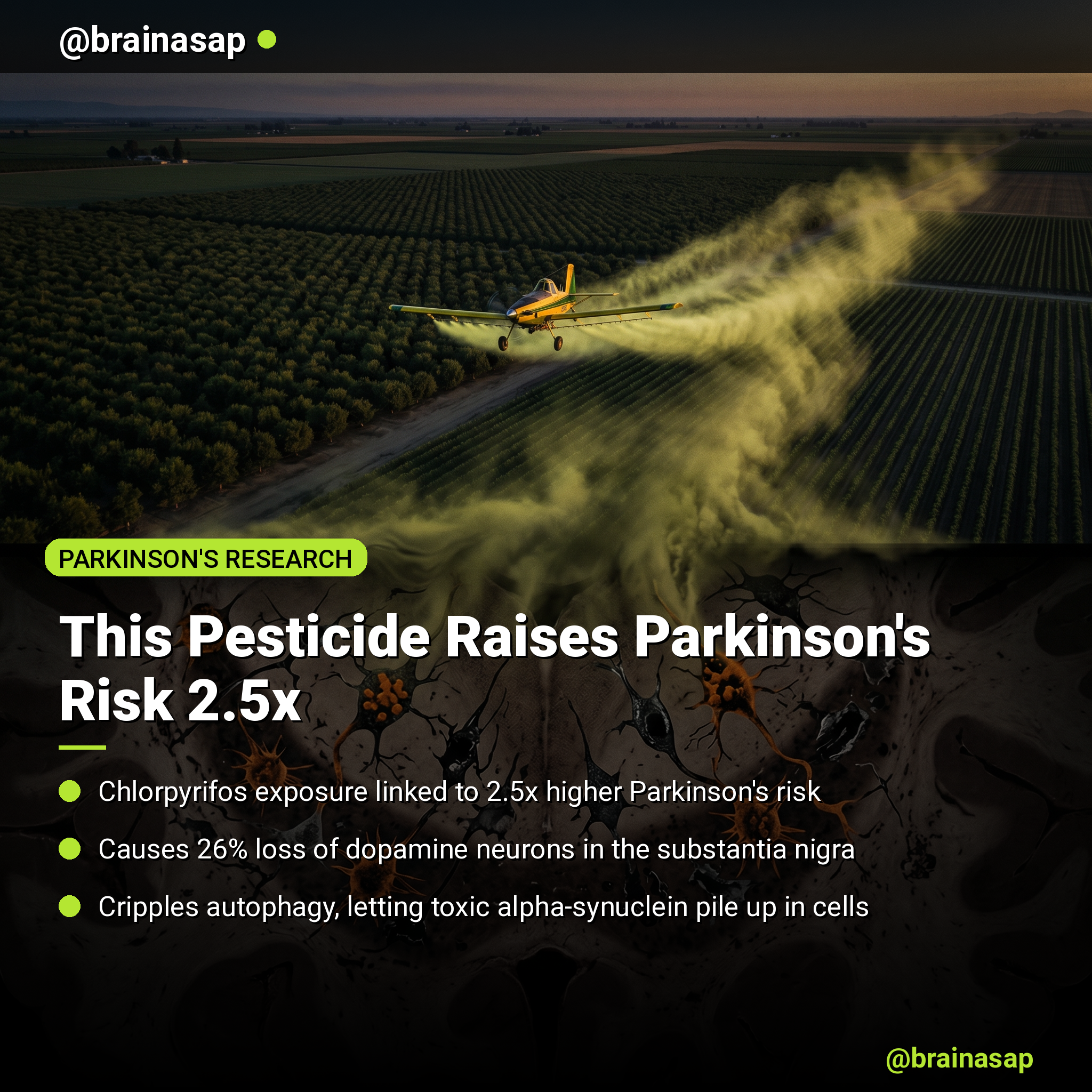
- 2.5-fold increased risk in humans: Long-term residential or occupational exposure to chlorpyrifos was associated with more than double the risk of developing Parkinson’s disease in a California cohort study of 829 patients and 824 controls.
- 26% dopaminergic neuron loss in mice: Inhaled chlorpyrifos exposure caused a selective loss of dopamine-producing neurons in the substantia nigra, the brain region most vulnerable in Parkinson’s disease.
- Alpha-synuclein accumulation: Chlorpyrifos triggered pathological accumulation of alpha-synuclein protein and phosphorylated forms in dopamine neurons — a hallmark pathology of Parkinson’s.
- Autophagy dysfunction is the culprit: The neurotoxicity works by impairing autophagy (the cell’s cleanup system), causing damaged proteins to pile up and kill neurons. Blocking autophagy alone replicated the neuron loss.
- Strongest link in 10-20 year window: The association between chlorpyrifos exposure and Parkinson’s was most robust when exposure occurred 10-20 years before disease onset, suggesting a long latency period typical of neurodegeneration.
- Zebrafish model confirms mechanism: Transgenic zebrafish lacking the gene for y1-synuclein (the fish version of alpha-synuclein) were protected from chlorpyrifos toxicity, proving alpha-synuclein is necessary for the pesticide’s damage.
Source: Molecular Neurodegeneration (2025) | Hasan et al.
The Long Shadow of Agricultural Exposure
Parkinson’s disease kills dopamine neurons — the brain cells that drive movement, motivation, and motor control. For decades, scientists have known that this selective neuronal death has environmental roots, but pinpointing which toxins and how they work has been painfully slow. Chlorpyrifos stands out because it was widespread, well-documented, and now, finally, mechanistically explained.
The study leveraged California’s Pesticide Use Report database, a record dating back to 1972 that tracks every commercial pesticide application by location and crop. This gave researchers something rare in environmental epidemiology: precise, historical exposure data for 829 Parkinson’s patients and 824 controls in three agricultural counties. They linked residential and workplace addresses to decades of pesticide spray logs, then performed logistic regression to estimate exposure risk.
The results were unambiguous. Any exposure to chlorpyrifos was associated with a 1.35-fold increased risk of Parkinson’s. But the hazard ratio climbed to 1.47-fold for exposure 20-10 years before disease onset, and peaked at 1.74-fold for the 10-year window closest to diagnosis. This temporal pattern is exactly what you’d expect from a neurotoxin that takes years to accumulate damage invisible to the naked eye.
How Chlorpyrifos Kills Dopamine Neurons
Understanding the mechanism required moving beyond human epidemiology into animals. Researchers exposed male mice to aerosolized chlorpyrifos for 11 weeks in a dose-controlled inhalation chamber — a method that mimics how agricultural workers and nearby residents actually encounter the pesticide. The mice maintained their body weight and showed no overt behavioral changes initially, but beneath the surface, their brains were being systematically dismantled.
Immunohistochemistry revealed the damage: chlorpyrifos-exposed mice showed a 26% loss of tyrosine hydroxylase (TH)-positive dopaminergic neurons in the substantia nigra, the brain region selectively destroyed in Parkinson’s. Critically, other dopamine regions — the ventral tegmental area — were spared. This selective vulnerability mirrors the human disease, suggesting the mechanism is directly relevant.
But the cellular pathology went deeper. Western blot analysis showed that phosphorylated alpha-synuclein (pS129) was elevated 1.66-fold in the exposed brains compared to controls. Alpha-synuclein is the protein that misfolds, aggregates, and clogs up dopamine neurons in Parkinson’s patients; its accumulation is one of the disease’s defining hallmarks. The question wasn’t whether chlorpyrifos triggered alpha-synuclein pathology — it clearly did — but how.
[Insert image: pathway diagram showing chlorpyrifos → autophagy dysfunction → alpha-synuclein accumulation → dopamine neuron loss]
Autophagy Failure: The Missing Link
The breakthrough came when researchers looked at autophagy — the cell’s recycling system that degrades damaged proteins and worn-out organelles. In chlorpyrifos-exposed brains, they found reduced levels of LC3-II and Lamp2a, two key markers of autophagic flux. The system that should clean up toxic alpha-synuclein was shutting down. This wasn’t just a side effect; it was the core mechanism driving cell death.
To prove this, researchers used transgenic zebrafish embryos — a faster, genetically transparent model. Zebrafish larvae exposed to chlorpyrifos showed a dramatic loss of dopamine neurons, but when the researchers knocked out the gene for y1-synuclein (the zebrafish homolog of human alpha-synuclein), the neurons survived. This genetic experiment is the gold standard for mechanism: it proves that chlorpyrifos toxicity absolutely requires alpha-synuclein to occur. No synuclein, no neuronal death.
In mice, blocking autophagy directly — using morpholinos to reduce LC3 protein — replicated the damage. Conversely, stimulating autophagy with calipeptin reduced the neuron loss. This creates a clear causal chain: chlorpyrifos impairs autophagy, alpha-synuclein accumulates unchecked, dopamine neurons die.
Why This Matters for Prevention and Treatment
This study does two things simultaneously: it establishes chlorpyrifos as a genuine, mechanistically validated risk factor for Parkinson’s disease, and it identifies autophagy as a therapeutic target. The findings have immediate practical implications. Farmers, agricultural workers, and residents in spray zones now have concrete evidence to advocate for stricter pesticide regulations and personal protective equipment. Exposure assessment based on historical agricultural records is feasible — not just guesswork.
For drug development, the autophagy axis opens new doors. If stimulating autophagy protects dopamine neurons from chlorpyrifos in mice, could autophagy enhancers slow disease progression in Parkinson’s patients exposed to this or similar toxins? The answer isn’t obvious yet, but it’s testable. This is how environmental epidemiology becomes translational: you find a toxin, decode its mechanism, and hunt for interventions that block that specific pathway.
Strengths and Limitations
The California study’s main strength is its exposure assessment. Using pesticide spray records linked to residential and workplace addresses is far more accurate than relying on participant recall, which is prone to bias and inaccuracy over decades. The animal models provide the mechanistic evidence that human studies cannot — proving causality rather than just association.
One limitation: the latency between exposure and diagnosis is long, and the study cannot exclude reverse causality or unmeasured confounders that might partly explain the association. The zebrafish model, while elegant, uses very high chlorpyrifos concentrations (250 nM) to study embryonic development — conditions that may not fully translate to chronic adult exposure at lower doses. Mice were exposed for only 11 weeks, not a lifetime. Longer-term, lower-dose models might reveal different or more nuanced mechanisms.
Finally, chlorpyrifos is one toxin among many. Parkinson’s risk is multifactorial — genetics, aging, head trauma, and other environmental exposures all play roles. This study doesn’t suggest chlorpyrifos is the sole cause, but rather one documented, preventable risk factor in a complex disease.
The Bigger Picture
Chlorpyrifos was widely used until the EPA restricted indoor applications in 2001, but agricultural use continues in many countries. Millions of people in the US were exposed decades ago during the peak spray years, creating a cohort now reaching the age when Parkinson’s typically emerges. This research is a call to acknowledge environmental contributions to neurodegeneration and to pursue rigorous epidemiology paired with mechanistic validation.
The pesticide itself may be a window into a broader category of neurotoxins with similar mechanisms. If other organophosphates, carbamates, or agrochemicals impair autophagy and trigger alpha-synuclein pathology, the same therapeutic angles apply. This is how one paper on one pesticide becomes a roadmap for understanding and potentially preventing a disease that affects nearly a million Americans.
Citation: Hasan KMM, Barnhill LM, Paul KC, Peng C, Zeiger W, Ritz B, et al. The pesticide chlorpyrifos increases the risk of Parkinson’s disease. Molecular Neurodegeneration. 2025;21(1):3. DOI: 10.1186/s13024-025-00915-z
Authors’ affiliations: Department of Epidemiology and Department of Environmental Health, University of California, Los Angeles; Parkinson’s Environment and Genes (PEG) Study Consortium; UCLA Movement Disorder Clinic; Jane and Terry Semel Institute for Neuroscience and Human Behavior, David Geffen School of Medicine, Los Angeles, CA, USA; and Department of Neurodegenerative Disease, University of Pittsburgh School of Medicine, Pittsburgh, PA, USA.