Daily Cognitive Precision Predicted Goal Follow-Through
TL;DR: Sharper-than-usual cognitive days predicted same-day follow-through: a one-standard-deviation jump in precision translated to roughly 40 extra minutes of goal-directed work.
Key Findings
- Sharper days predicted follow-through: The study followed university students intensively rather than comparing high- and low-performing people once.
- 9,248 daily time points: Microtasks measured fluctuations in cognitive processing precision alongside goals, progress, mood, sleep, and motivation.
- Same-person shifts mattered: On days when a person’s cognitive precision was higher than usual, goal setting and achievement were also higher.
- Academic and everyday goals: The effect appeared across both school-related goals and nonacademic tasks.
- About 40 minutes of work: A one-standard-deviation shift in cognitive precision was statistically comparable to roughly 40 minutes of work.
Source: Science Advances (2026) | Wilson et al.
Cognitive precision sounds like a lab abstraction until it explains a familiar day: one morning your plans feel clean and executable; another morning the same task feels like pushing through fog. This study argues that those daily cognitive state changes are measurable. They help explain why intentions turn into behavior on some days and evaporate on others.
The Intention-Behavior Gap Was Measured Within People
Psychology has long had a puzzle: people with better cognitive task performance do not always show dramatically better real-world follow-through when researchers compare one person with another. That can make cognition look less relevant to daily achievement than common sense suggests.
This paper changed the level of analysis. Instead of asking whether naturally sharper people do more, it asked whether the same person does more on days when their cognitive processing is sharper than usual.
That distinction is not cosmetic. Between-person studies can miss state effects because people differ in schedules, constraints, goals, personality, and opportunity. A within-person design lets each participant become their own baseline.
Microtasks Captured the Foggy-Day Problem
The researchers used a microtask design to track cognitive function day after day. The goal was to estimate domain-general processing precision: how cleanly and efficiently a person was processing information at that moment.
The same daily assessments captured goal setting, goal progress, mood, sleep, and motivation, which makes the result harder to wave away as simply “good mood makes people productive.” The cognitive signal remained meaningful even after accounting for other daily factors.
That is the useful everyday lesson. A failed plan does not necessarily always mean weak character or low commitment. Sometimes the brain state available for executing the plan is simply worse that day.
Forty Minutes Made the Effect Feel Concrete
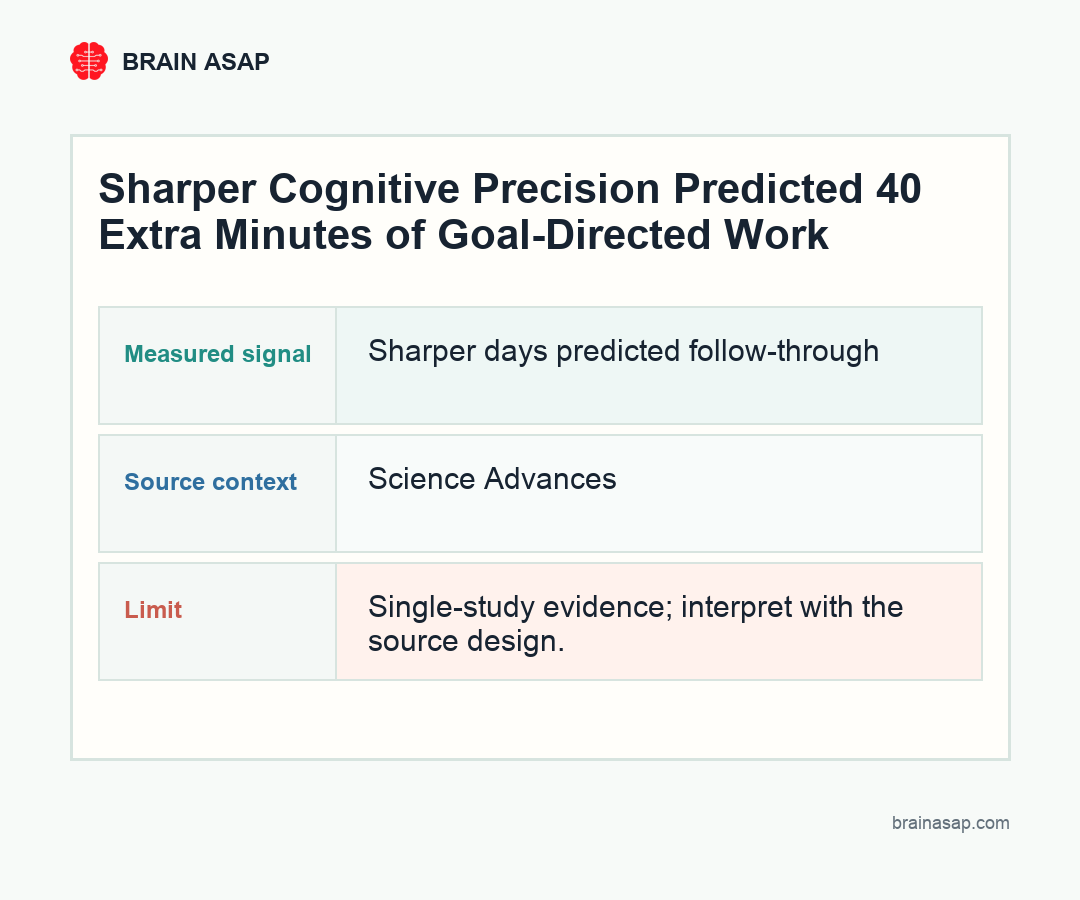
The paper’s most memorable statistic is the work-equivalent estimate. A one-standard-deviation increase in cognitive precision had an effect statistically comparable to about 40 minutes of work.
That number gives the study a practical texture. It does not show a cognitive test literally adds 40 minutes to the clock. It means that the behavioral difference associated with a better cognitive-precision day was in the range of a meaningful chunk of effort.
The effect also did not depend on trait self-control or conscientiousness. People who were generally disciplined and people who were not showed the same basic pattern: daily cognitive ups and downs predicted daily follow-through.
Goal Science Gets More Dynamic
There is a subtle but important shift here. Productivity advice often treats follow-through as a stable identity: disciplined people do the thing; undisciplined people do not. This study points to a more dynamic model.
People can have better and worse execution windows. Those windows are shaped by several moving parts:
- State factors: mood, sleep, motivation, and daily context.
- Cognitive precision: how cleanly information is processed on that particular day.
- Task fit: whether demanding goals are scheduled when usable control is actually available.
That does not remove responsibility, but it does make responsibility smarter.
If hard tasks are possible to schedule, the best time may be when the person is cognitively clear, not just when the calendar has a blank rectangle. For students, clinicians, coaches, and anyone managing demanding work, that is a more humane and more mechanistic way to think about follow-through.
Why the Study Does Not Prove a Brain-Training Fix
The paper does not show that improving cognitive precision through an app, stimulant, supplement, or training protocol will automatically improve life outcomes. It measured naturally occurring fluctuations and their relationship to daily behavior.
The sample was also university students, so the findings need testing in older adults, clinical populations, shift workers, people with ADHD, people with depression, and other groups where cognitive state changes may be especially consequential.
Still, the study lands because it explains a recognizable human problem without flattening it into laziness. Some days, the brain really is better positioned to close the gap between intention and behavior. The next step is learning how to detect those days and how to support people when precision is low.
Why Trait Self-Control Did Not Explain the Daily Swings
One important detail is that the cognitive-precision effect was not meaningfully moderated by trait self-control or conscientiousness. The reason is those traits often dominate the way people explain follow-through: disciplined people execute, less disciplined people drift.
The study suggests a more layered model. A generally conscientious person can still have a low-precision day, and a less conscientious person can still have a high-precision window. Daily state does not replace personality, but it can change how much usable control a person has at a particular moment.
For clinical readers, this is especially relevant to ADHD, depression, insomnia, substance use recovery, and anxiety disorders, where cognitive state can fluctuate dramatically. The paper did not study those groups directly, but it gives a framework for asking better questions about why follow-through can collapse even when intention is real.
Planning Around Precision Is the Practical Test
The obvious applied question is whether people can detect high-precision windows and place demanding tasks there. That could mean passive tracking, short cognitive probes, sleep-informed scheduling, or simply learning a personal rhythm well enough to avoid treating every hour as interchangeable.
The hard part is avoiding a new productivity superstition. A low-precision day should not become an excuse to abandon important goals. It might instead call for a different task mix: fewer open-ended decisions, more environmental scaffolding, smaller steps, or social accountability until cognitive clarity returns.
That is where the study becomes practical without becoming gimmicky. It supports flexible goal design: protect the hardest work for clearer windows, and reserve lower-precision periods for tasks that need less working memory, less ambiguity, or more external structure.
The deeper point is compassion with accountability. A person can still be responsible for goals while also recognizing that cognitive state changes the cost of reaching them.
That frame is useful for students because it replaces shame with a scheduling problem the next study can actually test.
The Study Also Helps Explain Burnout Friction
The findings also speak to a quieter problem in burnout and academic stress. When people are overloaded, they often keep making plans because planning briefly restores a sense of control. The harder part is converting those plans into action when attention, processing clarity, and mental energy are unstable.
A daily precision measure gives researchers a way to separate intention failure from execution-state failure. That distinction could matter for interventions: some days call for motivation, but other days may call for sleep recovery, task simplification, or reducing cognitive load.
Paper: Day-to-day fluctuations in cognitive precision predict the domain-general intention-behavior gap. Science Advances. 2026;12(6):eaea8697. DOI: 10.1126/sciadv.aea8697
Authors: Wilson et al.
Study Design: Intensive longitudinal daily-assessment study using cognitive microtasks and goal reports.
Sample Size: 184 university students and 9,248 time points across 12 weeks.
Key Statistic: A one-standard-deviation shift in cognitive precision was statistically equivalent to about 40 minutes of work.