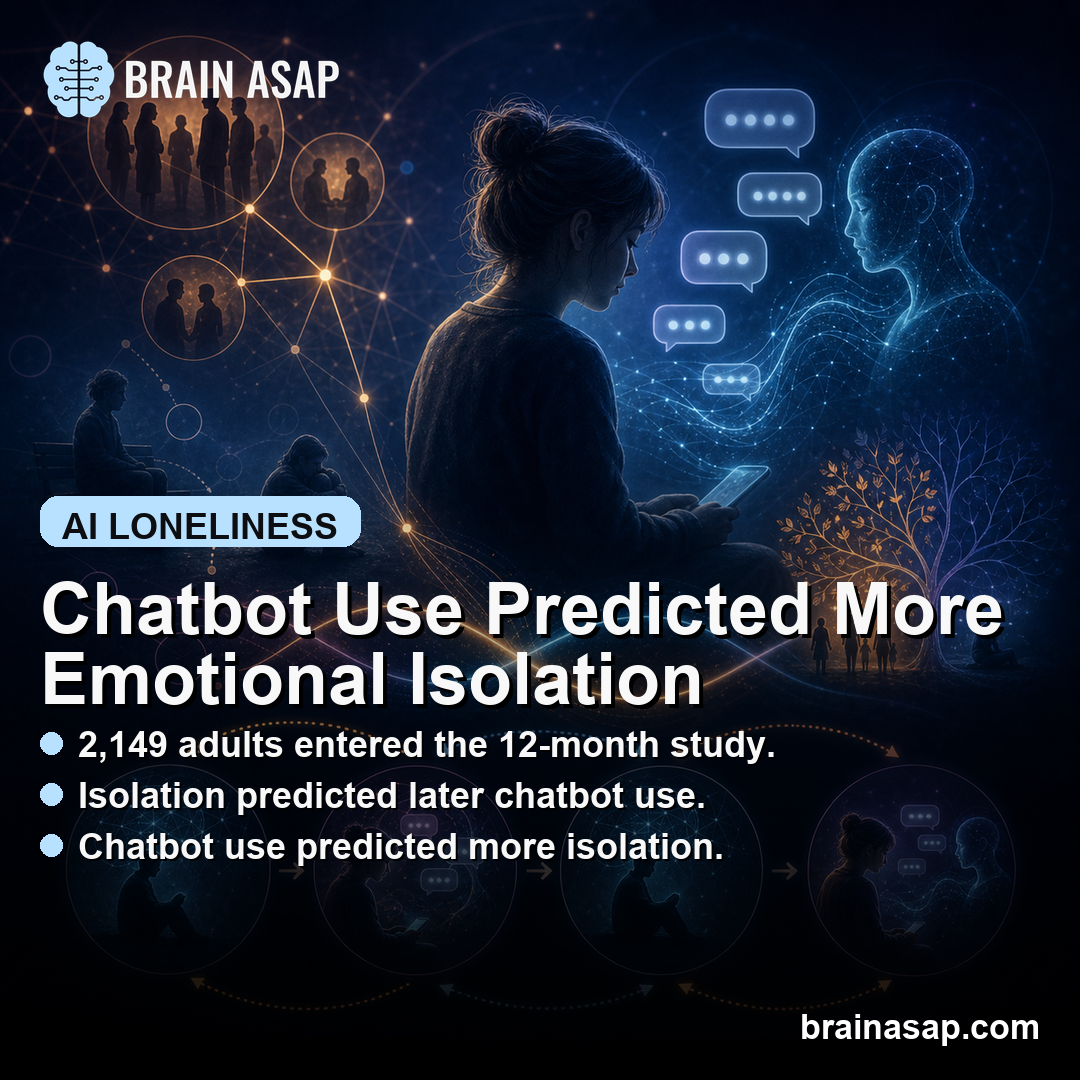
TL;DR: A 12-month four-wave longitudinal study in Psychological Science (N=2,149 adults across the UK, US, Canada, and Australia) found that feeling more emotionally isolated predicted higher chatbot use four months later — and that higher chatbot use, in turn, predicted further increases in emotional isolation at the next wave.
Key Findings
- Bidirectional link with emotional isolation: More emotional isolation at one wave predicted higher social chatbot use four months later, and higher chatbot use at one wave predicted further increases in emotional isolation at the next.
- One-way link with overall social connection: Lower overall social connection predicted higher chatbot use at the next wave, but higher chatbot use did not significantly predict lower social connection later — the worsening effect appeared specifically on emotional isolation.
- Roughly 26%–30% used chatbots socially at each wave: The frequency of social chatbot use stayed relatively stable across the 12-month window rather than rising or falling globally.
- Major life events did not drive chatbot use: Relocations, breakups, new romantic relationships, and becoming a parent were not associated with subsequent increases in social chatbot use, which weakens a “stress-response” alternative explanation.
- Cross-lagged design across four waves: 2,149 participants from four English-speaking countries; 979 completed all four surveys; average age 40; 49% men. The lagged design lets each variable predict the other at the next wave while accounting for prior levels.
- Observational and self-report — causality is not established: No randomization, no direct behavioral measure of chatbot use, and the authors describe the analyses as exploratory. The pattern is consistent with a worsening-loop hypothesis but does not prove it.
Source: Psychological Science (2026) | Folk & Dunn
Conversational AI has been described both as a scalable answer to the loneliness epidemic and as something that may actively make the problem worse.
Most evidence so far has come from cross-sectional studies, which cannot separate “lonely people use chatbots” from “chatbot use increases loneliness.”
A longitudinal cross-lagged design is the cleanest observational test available for the second question.
Four Survey Waves Tested Both Loneliness-to-Chatbot and Chatbot-to-Loneliness Directions
Researchers Dunigan Folk and Elizabeth Dunn ran four survey waves spaced roughly four months apart across 12 months.
Each wave measured four things:
- Social chatbot use: How often participants used chatbots socially in the prior four months — life advice, social conversation, companionship-seeking.
- Emotional isolation: How emotionally isolated participants felt during that same period.
- Overall social connection: A broader composite measure of social embeddedness and connection.
- Major life events: Relocations, breakups, new romantic relationships, becoming a parent — used as control variables for outside social stressors.
The cross-lagged design lets each variable predict the other at the next wave, while statistically accounting for the prior level of the outcome being predicted.
In plain terms: if emotional isolation at wave 1 predicts chatbot use at wave 2 even after accounting for chatbot use at wave 1, that is evidence the relationship runs from loneliness to chatbot use across time, not just within a single moment.
The strongest version of the test runs the same logic in both directions and asks which arrows are significant.
The Sample Was Larger Than Most Chatbot-Loneliness Studies
The cohort was demographically broader than the college-student samples that dominate AI-companionship research:
- Enrolled: 2,149 adults who completed at least one wave.
- Full retention: 979 completed all four waves; another 466 completed three.
- Country mix: United Kingdom (50%), United States (28%), Canada (14%), Australia (8%).
- Demographics: Average age 40; 49% men.
That mix matters because chatbot-companionship research has been dominated by young US-college samples, and the loneliness pattern in that group may not generalize.
Loneliness Predicted Higher Chatbot Use at the Next Wave
The first directional finding matched the expected pattern.
Participants who felt more emotionally isolated at one wave used chatbots more for social purposes four months later, after accounting for prior chatbot use.
The same was true for the broader social-connection metric. Participants who felt less socially connected at one wave reported higher subsequent chatbot use at the next.
Neither effect was driven by major life events. Researchers explicitly tracked four event categories:
None of these life events predicted increases in social chatbot use. That weakens a “life stressor caused both” alternative explanation for the loneliness-to-chatbot-use direction.
The reverse direction is the new and more controversial finding.
Participants who used chatbots more at one wave reported more emotional isolation four months later, after accounting for their previous emotional-isolation score.
This is what the loneliness-loop hypothesis would predict: shallow but always-available simulated companionship may crowd out the human interactions that more reliably reduce emotional isolation, leaving the user worse off over time.
The effect was specific to emotional isolation.
When researchers ran the same lagged model with the broader social-connection variable as the outcome, higher chatbot use did not significantly predict lower social connection at the next wave.
That asymmetry matters — emotional isolation captures something narrower than overall social embeddedness, and the worsening signal only showed up on the narrower measure.
Chatbot Use Was Stable Across the Year
Across waves, roughly 26% to 30% of participants reported using chatbots for social purposes in the prior four months.
That figure stayed relatively stable across the 12-month window.
The cross-lagged effects therefore are not an artifact of a population-wide shift in usage; they reflect within-person changes against a steady aggregate baseline.
That stability is itself useful context.
About 1 in 4 to 1 in 3 adults in this multi-country sample used chatbots socially at any given measurement period — high enough to make the chatbot-loneliness relationship a population-level question, not a niche concern.
Why Folk and Dunn Stop Short of a Causal Claim
- Observational design: No randomization, no experimental manipulation of chatbot exposure. Causal language is reserved.
- Self-reported usage: Chatbot use was reported by participants rather than measured directly through device or platform logs. Self-report introduces recall and reporting bias.
- Exploratory analysis label: Folk and Dunn describe the cross-lagged analyses as exploratory rather than pre-registered confirmatory tests, which raises the bar for replication before drawing strong conclusions.
- Asymmetry across outcomes: The chatbot-use-to-isolation arrow was significant for emotional isolation but not for the broader social-connection variable, which is a real inconsistency rather than a uniform “chatbots are bad” effect.
- Mechanism is inferred, not measured: The “shallow companionship crowds out real relationships” interpretation fits the data, but the study did not measure changes in real-world social behavior to confirm it.
AI Companions May Worsen Emotional Isolation in Already-Lonely Users
The clinical takeaway is narrower than headline framings suggest, but real.
For people already feeling emotionally isolated, defaulting to AI companions as a coping strategy may not be neutral — it may be associated with worse emotional isolation over the following months, even when usage frequency does not look high in absolute terms.
For clinicians and researchers, the more important contribution is methodological:
- Longitudinal evidence standard: A 12-month four-wave cross-lagged design is closer to the standard of evidence required to evaluate the AI-loneliness question than the cross-sectional surveys that have dominated the field so far.
- Clean next test: A randomized trial that varies chatbot-companionship exposure under controlled conditions while tracking real-world social behavior — friend contact, conversation depth, time with family, support seeking — alongside emotional isolation.
- Outcome-specific reading: The worsening signal is on emotional isolation specifically, not on broader social connection. Clinicians and researchers should keep those measures separate rather than collapsing them into a single “loneliness” label.
Until the trial evidence arrives, this longitudinal finding is what the field has — and it does not run uniformly in the direction of “AI companionship helps.”
Citation: DOI: 10.1177/09567976261427747. Folk D, Dunn E. How Does Turning to AI for Companionship Predict Loneliness and Vice Versa? Psychological Science. 2026.
Study Design: 12-month four-wave longitudinal cross-lagged panel survey across the UK, US, Canada, and Australia, with controls for prior values and major life events.
Sample Size: 2,149 adults completed at least one wave; 979 completed all four; 466 completed three. Average age 40; 49% men.
Key Statistic: Emotional isolation at one wave predicted higher chatbot use four months later; higher chatbot use predicted further increases in emotional isolation at the next wave. Social-connection-to-chatbot-use was significant; the reverse direction was not. Roughly 26%–30% reported social chatbot use at each wave.
Caveat: Observational design; self-reported chatbot use; analyses described by authors as exploratory; the chatbot-use-to-isolation arrow appeared for emotional isolation but not for the broader social-connection measure; mechanism inferred but not directly measured.