Childhood Loneliness Multiplied Psychosis Risk in EU-GEI
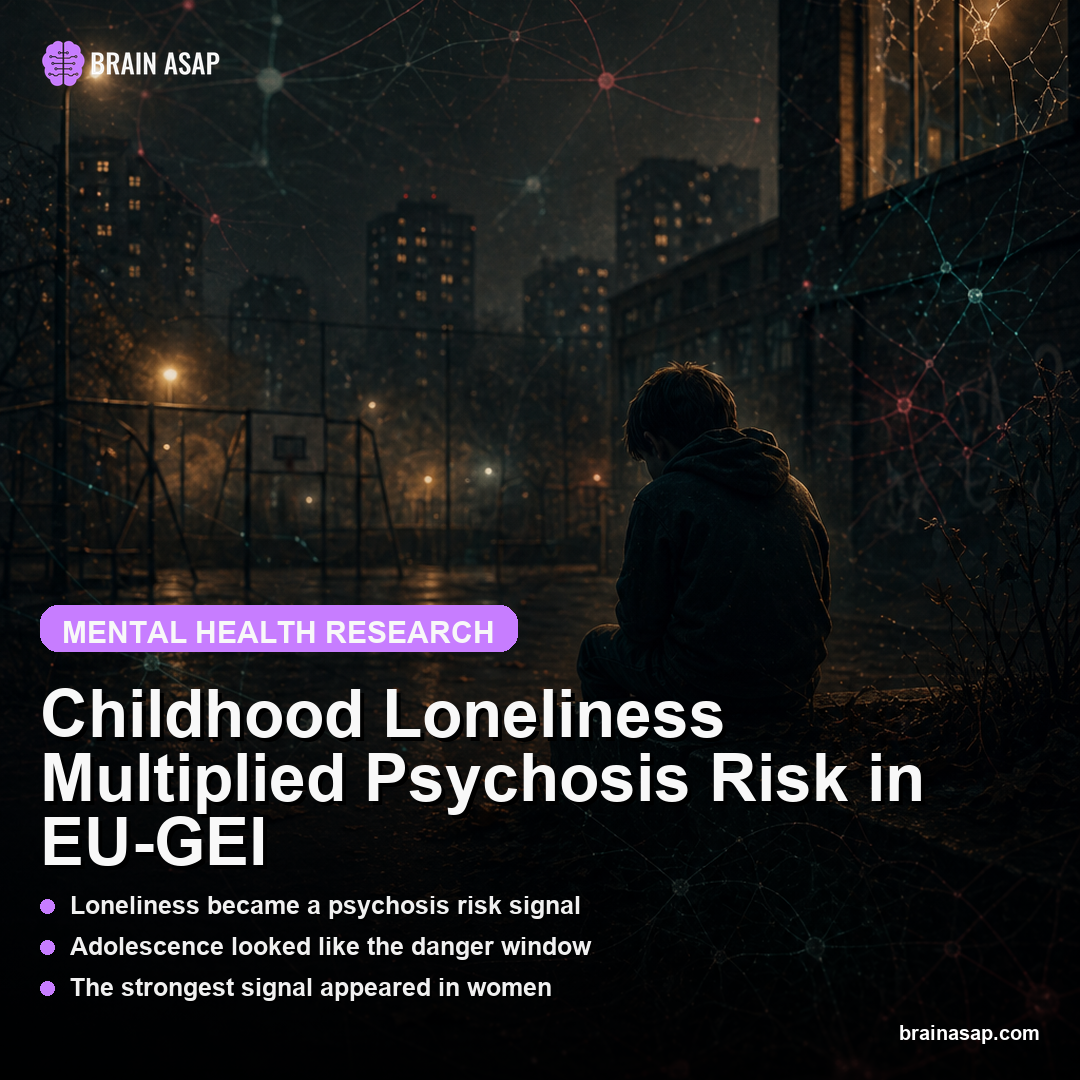
TL;DR: Loneliness that started before age 12 and persisted into adolescence tracked with sharply higher schizophrenia-spectrum risk, especially when it stacked on top of genetic liability.
Key Findings
- Persistent loneliness carried the risk signal: The EU-GEI analysis included 1,261 people with schizophrenia-spectrum disorders, 1,282 unaffected siblings, and 1,525 healthy controls.
- Loneliness before age 12 carried 5.20x odds: Retrospectively reported prolonged loneliness in childhood was associated with a more than fivefold increase in odds of schizophrenia-spectrum disorder.
- Adolescent loneliness rose to 7.26x odds: Loneliness between ages 12 and 16 showed an even stronger association, suggesting the teenage window may be especially sensitive.
- Gene-environment interaction peaked in adolescence: The additive interaction between loneliness and schizophrenia polygenic risk reached RERI 23.46 during adolescence, indicating that social and genetic risks did not just add up cleanly.
- Females showed the largest effect size: For adolescent loneliness, females reached 10.04x odds while males reached 5.50x odds, making the sex split hard to ignore.
- Prediction improved beyond genetics alone: Combining loneliness with genetic risk raised predictive value to 17% overall and 22.5% in females, versus roughly 2.6% to 2.8% for genetic risk alone.
Source: The British Journal of Psychiatry (2026) | Andreu-Bernabeu et al.
Psychosis research usually treats social withdrawal as an early symptom. This paper flips the timeline and asks whether loneliness itself, sustained across childhood and adolescence, can help shape later schizophrenia-spectrum risk long before a first episode appears.
Why Psychosis Risk Models Should Take Loneliness Seriously
There is a familiar chicken-and-egg problem in psychosis research. People who go on to develop schizophrenia-spectrum disorders often become socially withdrawn, but that does not tell us whether social isolation was an early symptom, a co-traveler, or part of the risk architecture itself.
This study tackles that problem by looking backward across development. Instead of measuring whether someone felt lonely last month, it asks whether they experienced prolonged loneliness during two key windows: before age 12 and between ages 12 and 16.
Adolescence is not just more of childhood. Peer belonging, threat sensitivity, and self-concept all get rewired at once, which can make social exclusion a different kind of biological and psychological stressor.
What EU-GEI Saw When Childhood Loneliness Was Tracked Into First-Episode Risk
The data came from the European Gene-Environment Interactions in Schizophrenia study, one of the larger multinational psychosis cohorts built for precisely these kinds of questions. The sample structure gave the authors a useful gradient: patients with schizophrenia-spectrum disorders, their unaffected siblings, and healthy controls.
The sibling-control structure helped separate raw case-control contrast from familial vulnerability. The headline numbers were large even by psychiatric epidemiology standards: prolonged loneliness before age 12 was associated with an odds ratio of 5.20, and prolonged loneliness during adolescence rose to 7.26.
Those are not tiny risk drifts that only matter after giant sample sizes. They are signals big enough to force a reframing of what clinicians often need to pay attention to when they hear a young person describe feeling persistently cut off from peers.
Adolescence Looked Like the More Dangerous Window
The stronger adolescent signal is probably the most intuitive and most important finding in the paper. Adolescence is when social ranking becomes brutally salient, when rejection gets encoded more intensely, and when the brain systems involved in self-other processing are still maturing.
The age-12-to-16 period was therefore a plausible amplifier rather than just a second measurement point. The study’s gene-environment analysis fits that idea. The additive interaction between loneliness and schizophrenia polygenic risk was strongest in adolescence, with a Relative Excess Risk due to Interaction of 23.46.
The developmental pattern had three parts:
- Early childhood signal: loneliness before age 12 was associated with 5.20x higher odds of schizophrenia-spectrum disorder.
- Adolescent signal: loneliness from ages 12 to 16 was associated with 7.26x higher odds.
- Genetic interaction: adolescent loneliness combined with higher schizophrenia polygenic risk produced the strongest excess risk.
Inherited vulnerability looked much more consequential when it coincided with prolonged social disconnection during a developmentally fragile stage.
How the Female Signal Changed the Practical Meaning of the Results
The sex difference is where the paper becomes harder to wave away as a broad psychosocial signal. In females, adolescent loneliness was associated with an odds ratio of 10.04. In males it was still substantial, at 5.50, but the female effect was strikingly larger.
That gap does not show the mechanism is settled. It could reflect differences in social processing, reporting, developmental timing, stress physiology, or how loneliness interacts with other exposures such as bullying, trauma, and depression. But the magnitude is too large to treat as statistical decoration.
The predictive piece reinforces the point. Genetic liability alone gave predictive values in the low single digits.
Once loneliness and its interaction with genetics were included, prediction rose to 17% overall and 22.5% in females. That is still nowhere near a screening tool you would deploy clinically tomorrow, but it is a dramatic jump relative to genetics alone.
The sex split also changes how prevention questions should be framed. A result this large does not prove that girls are biologically more vulnerable to loneliness, but it does argue against averaging away female-specific risk signals when social stress and psychosis liability are analyzed together.
What This Paper Can and Cannot Say About Causality
This is not a prospective birth cohort, and the authors are relying on retrospective reports of loneliness. That means recall bias is a live issue, especially when studying people who have already developed a major psychiatric illness. The article also cannot fully untangle loneliness from related exposures such as bullying, family instability, or early affective symptoms.
Still, the paper earns attention because the pattern is coherent across several dimensions at once: timing, genetic interaction, and sex differences. If this were just noisy retrospective storytelling, you would not expect the adolescence window and the female subgroup to stand out so clearly.
There is also a conceptual gain even if causality remains unsettled. Risk models for psychosis often center on genes, cannabis exposure, trauma, and urbanicity. Persistent loneliness may deserve to sit much closer to that list than it currently does.
The Clinical Usefulness May Be in Prevention, Not Prediction Scores
The practical opening is not a loneliness-plus-PRS dashboard for psychosis clinics. It is earlier recognition that prolonged loneliness in childhood and adolescence may be one of the more visible and modifiable signals of vulnerability before illness becomes obvious.
That has a very different flavor from most psychosis biomarkers. A clinician, school counselor, or family member cannot inspect someone’s polygenic score by conversation, but they can notice when a young person has spent years feeling socially cut off, excluded, or chronically alone.
If future studies replicate the result prospectively, the implication is straightforward: social disconnection may be a risk exposure worth intervening on early, especially in genetically vulnerable adolescents and especially in girls. That would not make loneliness the full explanation. It would move persistent loneliness from background sadness to a serious part of the risk equation.
Paper: Linking prolonged childhood and adolescent loneliness to schizophrenia spectrum disorders: results from EU-GEI study. The British Journal of Psychiatry. 2026;228(5):428-436.. DOI: 10.1192/bjp.2025.100
Authors: Andreu-Bernabeu et al.
Study Design: Cohort study
Sample Size: 4,068 people across cases, siblings, and controls: The EU-GEI analysis included 1,261 people with schizophrenia-spectrum disorders, 1,282 unaffected siblings, and 1,525 healthy controls.
Key Statistic: Loneliness before age 12 carried 5.20x odds: Retrospectively reported prolonged loneliness in childhood was associated with a more than fivefold increase in odds of schizophrenia-spectrum disorder.