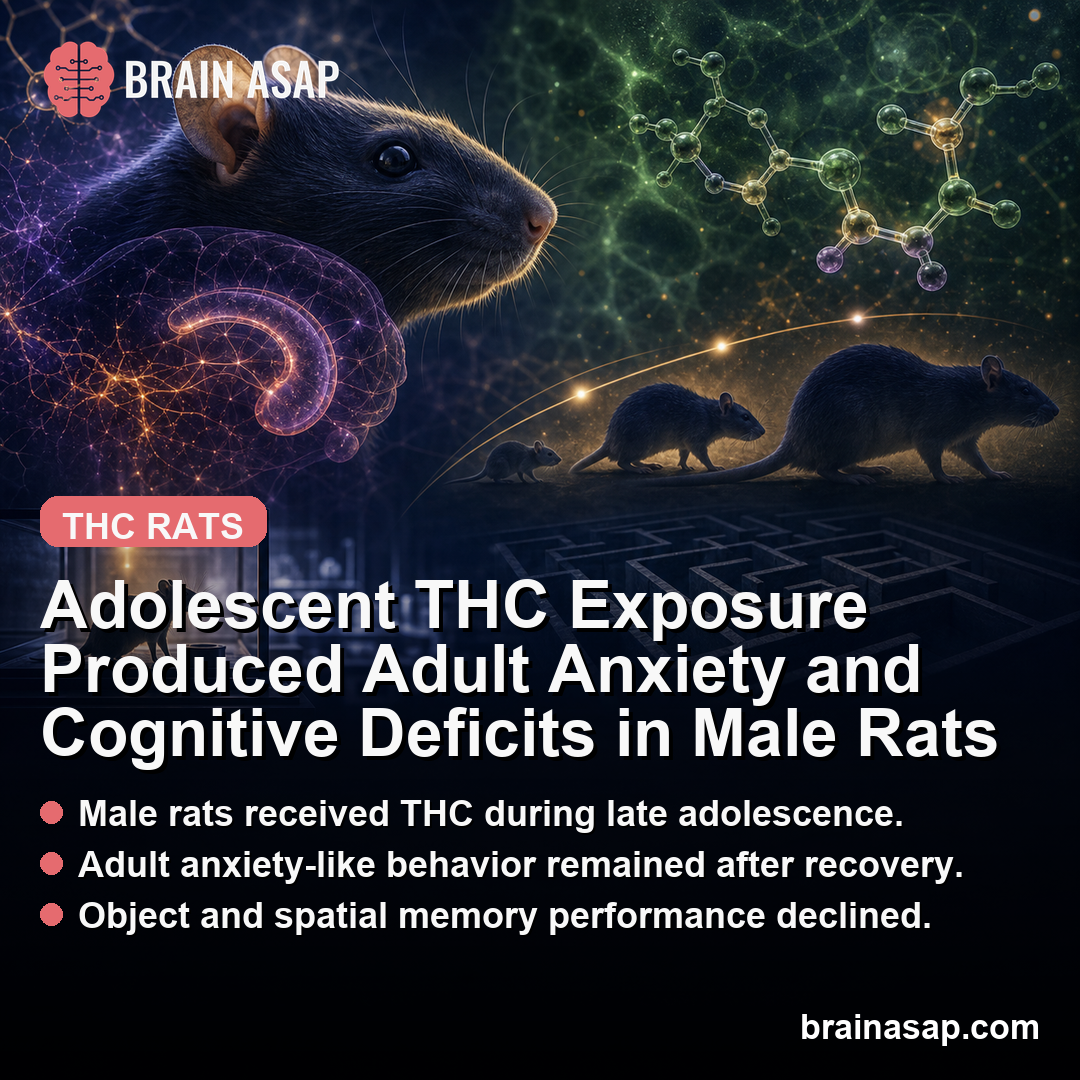
TL;DR: A 2026 rat study in Psychopharmacology found that THC exposure during late adolescence left adult animals with elevated anxiety-like behavior and impaired object-recognition and spatial-memory performance after a drug-free recovery period.
Key Findings
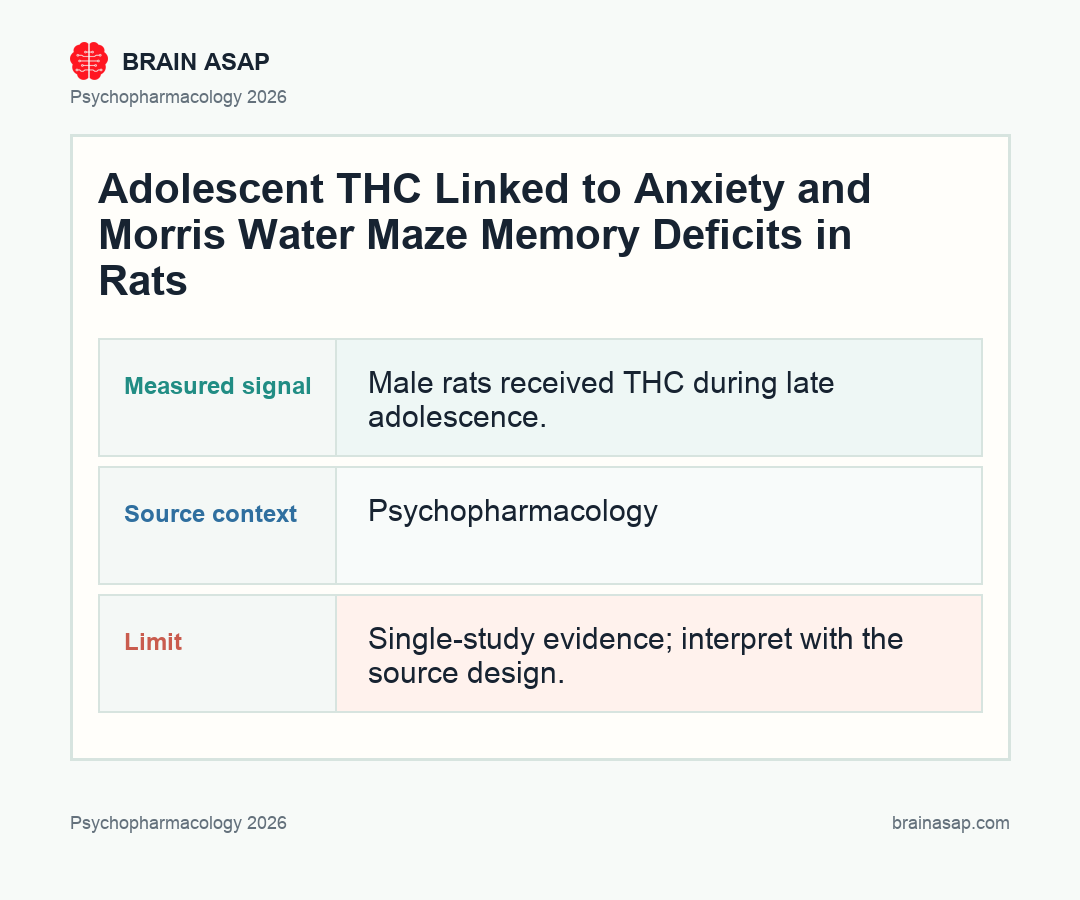
- Adolescent THC exposure produced lasting anxiety-like behavior in adulthood: Rats given THC (5 mg/kg/day) from postnatal day 42 to 62 (late adolescence in rats) showed elevated anxiety-like behavior on the elevated plus maze and light-dark transition tests after a drug-free period.
- Cognitive deficits persisted into adulthood: Adult animals previously exposed to adolescent THC showed impairments in novel object recognition and Morris water maze performance — standard memory and spatial cognition tests.
- The exposure window is the critical variable: The same drug at the same dose given to adolescent vs adult brains produces different long-term consequences. Adolescent brains are still developing in ways that make them vulnerable to lasting THC effects.
- Drug-free interval didn’t restore baseline: The cognitive and anxiety effects appeared after a recovery window without further THC exposure — meaning the changes aren’t acute drug effects but persistent alterations.
- Translational relevance to rising potency cannabis: If adolescents are using higher-potency products more frequently than past generations, the long-term consequences this rat model demonstrates may be amplified in human populations.
- Mechanism likely involves endocannabinoid system development: Adolescent brain maturation includes development of the endocannabinoid signaling system. Exogenous THC during this window can disrupt that maturation in ways that produce lasting effects on anxiety circuits and cognitive function.
Source: Psychopharmacology (2026) | Lumor JS, Nyberg H, Nerem E, Andersen JM, Bogen IL
Public perception of cannabis has shifted dramatically over the past two decades. Legalization, medical-cannabis programs, and the normalization of recreational use have all contributed to a sense that cannabis is a relatively low-risk substance.
Two specific patterns have intensified: cannabis potency has risen sharply (modern strains often contain 4-5 times the THC of older varieties) and young adults seeking treatment for cannabis use disorder has increased.
The Lumor study is one of the cleaner direct tests of what frequent adolescent THC exposure does to the adult brain.
Why Adolescent Cannabis Use Has Been Hard to Study Cleanly
Human adolescent cannabis research faces several methodological challenges that make causal inference difficult:
- Self-selection: Adolescents who use cannabis differ from non-users in many ways — family environment, mental health, peer influence, socioeconomic context — that independently affect adult outcomes.
- Confounded exposures: Cannabis use often co-occurs with alcohol, tobacco, and other substance use, making isolated cannabis effects hard to identify.
- Pre-existing vulnerabilities: Adolescents with anxiety or cognitive vulnerabilities may be more likely to use cannabis, then attribute later symptoms to the drug rather than to pre-existing factors.
- Long follow-up periods: Tracking adolescent users into adulthood requires multi-decade studies that are expensive and prone to attrition.
- Variable use patterns: Frequency, dose, THC content, and route of administration vary widely across users, making aggregate “ever-used” measures imprecise.
Animal models can isolate the cannabis exposure variable. The Lumor team used a controlled adolescent THC dosing protocol with drug-free recovery before testing — a design that human cohort studies cannot replicate.
How Adolescent THC Could Disrupt Brain Development
The adolescent brain isn’t a smaller version of the adult brain. Multiple developmental processes are still active during this window:
- Synaptic pruning and maturation — the cortex eliminates excess synapses and consolidates the connections that support adult cognition.
- Myelination of prefrontal circuits — white matter development continues into the third decade of life.
- Endocannabinoid system maturation — cannabinoid receptors and their endogenous ligands undergo developmental changes that shape adult function.
- Anxiety circuit development — amygdala, hippocampus, and prefrontal regions involved in emotional regulation reach mature configurations during late adolescence.
- Learning and memory circuits — hippocampal and cortical systems supporting memory continue refining through adolescence.
Exogenous THC during this window doesn’t just produce acute effects — it interferes with developmental processes that shape adult brain function. The persistence of anxiety and cognitive effects after a drug-free recovery period in the Lumor data fits this developmental-disruption framework.
What the Behavioral Tests Specifically Measured
The Lumor team used standard validated rat behavioral assays:
- Elevated plus maze (EPM): A widely used anxiety test where rats can choose between open arms (anxiety-provoking) and closed arms (safer feeling). More closed-arm time indicates higher anxiety-like behavior.
- Light-dark transition test: Another anxiety paradigm pitting attraction to dark/safe areas against exploration of bright/exposed areas. Reduced light-area time suggests increased anxiety.
- Novel object recognition: Tests recognition memory by measuring how much time rats spend exploring a novel vs familiar object. Reduced novel-object preference indicates memory impairment.
- Morris water maze (MWM): Spatial memory test in which rats learn to find a hidden platform in a water tank. Performance reflects hippocampal-dependent spatial learning.
The convergence of effects across both anxiety tests and both cognitive tests strengthens the conclusion. Adolescent THC didn’t just affect one narrow behavioral measure — it produced consistent deficits across multiple validated paradigms.
Why “5 mg/kg/day” in Rats Maps to Realistic Human Use
Translating rat doses to human equivalents is imprecise but the range used in the Lumor study (5 mg/kg/day across the adolescent window) corresponds to chronic moderate-to-heavy cannabis exposure in human terms when accounting for metabolism and route differences.
This is not a model of casual or experimental use — it represents the kind of frequent adolescent cannabis exposure that has become more common as legalization has expanded availability.
The implications are clearer when matched to current epidemiology:
- Daily or near-daily cannabis use among US high school seniors remains substantial in surveillance data.
- Modern cannabis products contain 15-25% THC or more compared to roughly 4% THC in 1990s-era cannabis.
- Concentrate products (vapes, dabs, edibles) can deliver substantially higher THC doses per use than traditional flower cannabis.
The frequent-use, high-potency profile that the Lumor protocol approximates is increasingly common in human adolescents.
What This Should Add to Cannabis Risk Communication
Public conversation about cannabis often oversimplifies the risk-benefit calculation:
- “Cannabis is natural, so it’s safe” — ignores that natural products can have lasting effects on developing systems.
- “Alcohol is worse than cannabis” — may be true on some metrics but doesn’t mean cannabis effects are negligible, especially in adolescents.
- “Adults can handle it, so adolescents probably can too” — ignores the developmental window vulnerability the Lumor study and others demonstrate.
The more nuanced message that the rat model supports is straightforward: frequent adolescent cannabis exposure produces effects that may persist into adulthood as elevated anxiety and cognitive impairment. The same exposure in adults likely produces different (and perhaps less persistent) effects.
Risk communication that ignores the developmental dimension is incomplete.
The Honest Limits of Translating Rat Models to Adolescent Cannabis Users
- Rat anxiety tests don’t capture human anxiety experience. EPM and light-dark transition measure aspects of anxiety-like behavior that translate imperfectly to clinical anxiety symptoms.
- Male-only rat sample. The Lumor study used male rats; sex differences in adolescent cannabis effects exist and the female-rat findings could differ.
- Pure THC vs whole-plant cannabis. The drug used was THC alone, not the complex mix of cannabinoids in actual cannabis products. Whole-plant effects could differ.
- Standardized exposure vs human variability. Human adolescent users have variable exposure patterns that the controlled rat protocol doesn’t replicate.
- Anxiety and cognitive deficits don’t equal psychiatric disorder. Behavioral changes in rats are suggestive but not equivalent to clinical anxiety or cognitive disorders in humans.
Age Limits Should Reflect Adolescent THC Biology
Cannabis policy in the US has been moving toward legalization at the state level, often with age restrictions (typically 21+) but with widely varying enforcement and accessibility.
The Lumor findings — alongside a growing body of similar work — argue for taking those age restrictions seriously rather than treating them as performative.
The policy implications follow from the biology:
- Age-restriction enforcement is important. If frequent adolescent cannabis use produces persistent adult deficits, legal frameworks that allow easy adolescent access through dispensary culture, edibles disguised as candy, or relaxed enforcement undermine the protective intent of age limits.
- Public health messaging should differentiate by age. “Cannabis is safer than alcohol” framings, even if accurate for adults, mislead adolescents about their specific risk profile.
- Cannabis use disorder treatment for young adults deserves more clinical attention given the rising treatment-seeking population the Lumor paper notes.
- Research investment in long-term cannabis effects should be commensurate with the scale of adolescent and young-adult use, which has been substantial enough to warrant systematic prospective study.
The Lumor study is not the final word on adolescent cannabis risk.
It is part of a converging body of evidence that frequent adolescent THC exposure produces effects on the adult brain that public discourse and policy have been slow to take seriously.
Cannabis legalization can be a defensible public-health policy while still acknowledging that adolescent exposure is biologically different from adult exposure and deserves different treatment in messaging, access, and research priorities.
Citation: DOI: 10.1007/s00213-026-07067-y. Lumor JS, Nyberg H, Nerem E, Andersen JM, Bogen IL. Long-term effects of adolescent THC exposure on anxiety-like behavior and cognitive function in male rats. Psychopharmacology. 2026.
Study Design: Male Sprague-Dawley rats given THC (5 mg/kg/day) or vehicle from postnatal day 42 to 62 (late adolescence); after drug-free recovery period, adult anxiety-like behavior assessed with elevated plus maze and light-dark transition tests; cognitive function evaluated with novel object recognition and Morris water maze.
Sample/Model: Male Sprague-Dawley rats — see full publication for sample sizes per behavioral test.
Key Statistic: Adolescent THC exposure produced elevated anxiety-like behavior on both EPM and light-dark transition tests plus cognitive deficits on object recognition and Morris water maze, persisting after the drug-free recovery period. The exposure window during late adolescence was critical for producing the lasting effects.
Caveat: Male-only rat sample; pure THC rather than whole-plant cannabis; controlled standardized exposure may not match human use patterns; behavioral measures translate imperfectly to clinical anxiety and cognitive disorders; sex-specific effects of adolescent cannabis exposure require separate study in female animals.