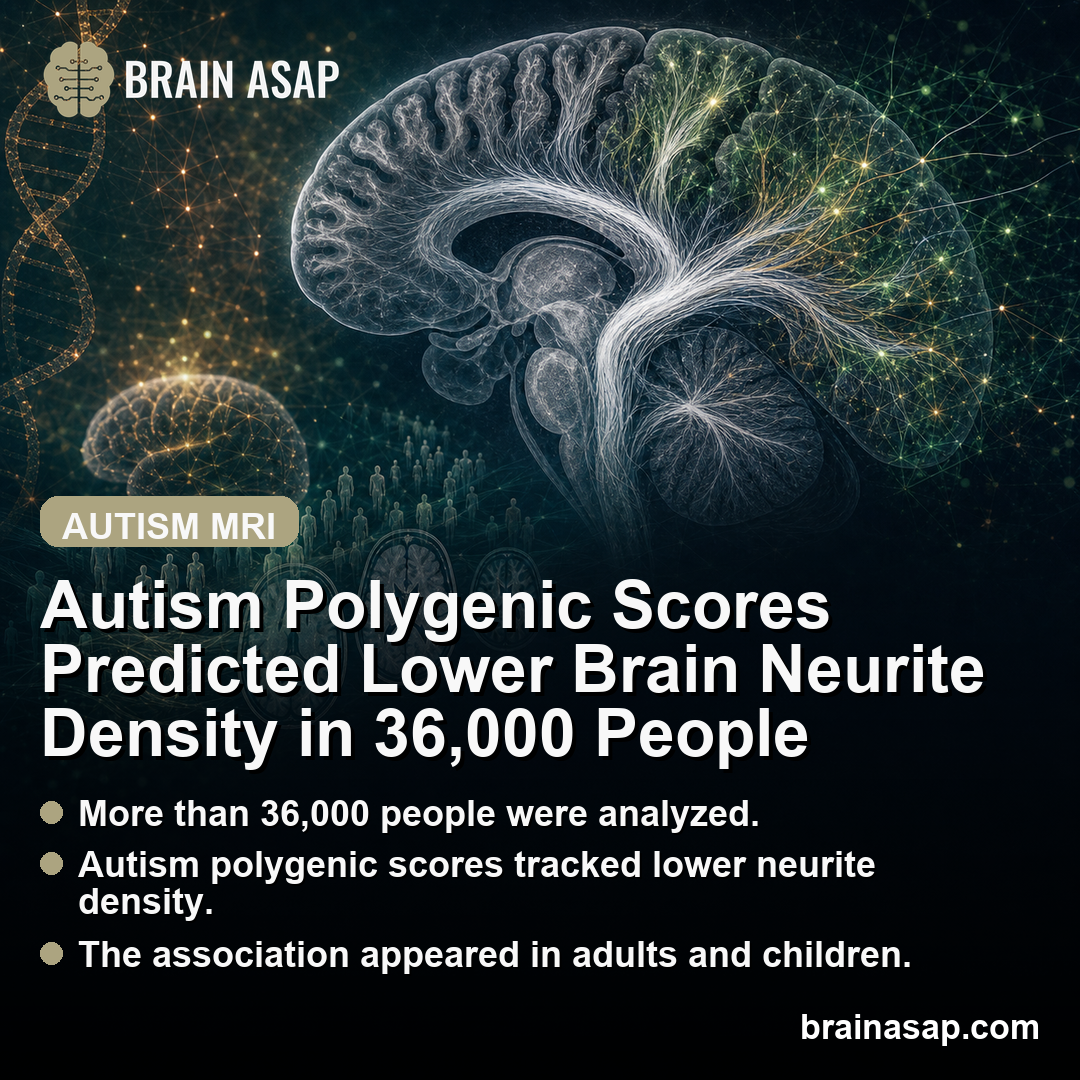
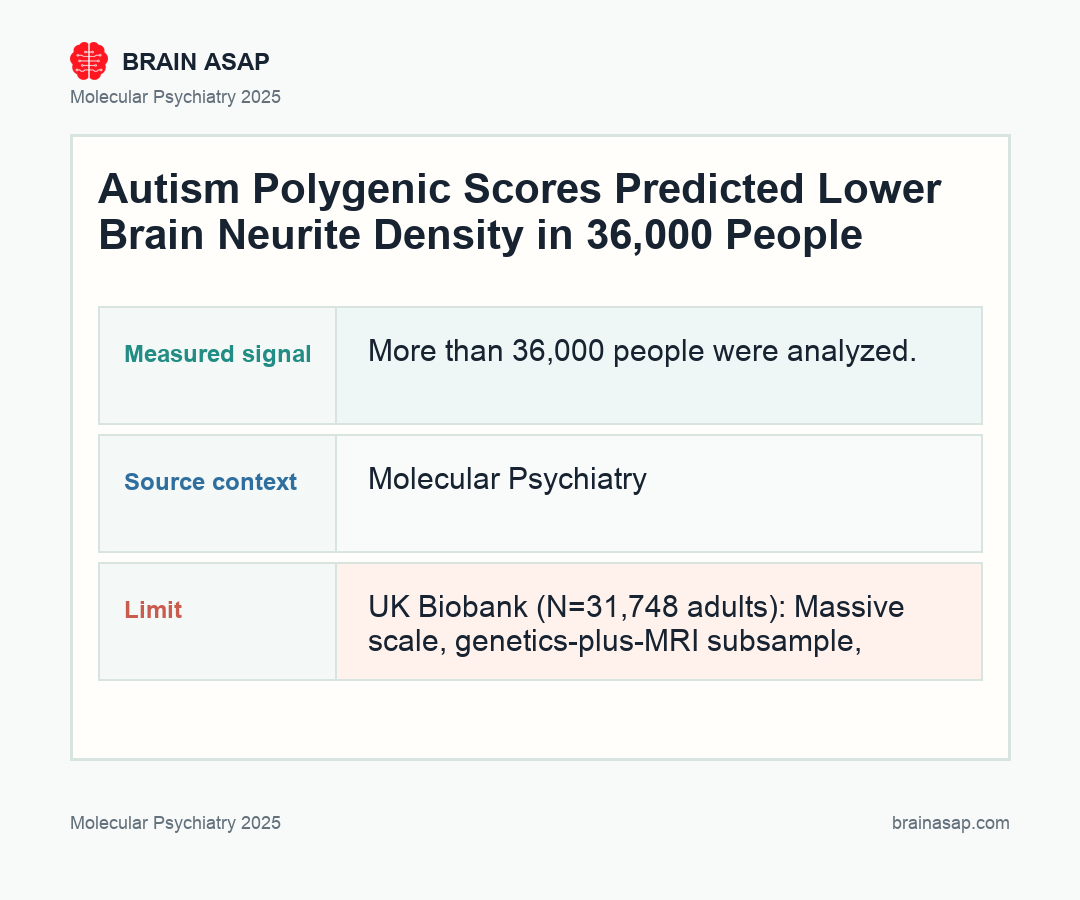
TL;DR: A 2025 Molecular Psychiatry study of more than 36,000 people found that higher autism polygenic risk was associated with lower MRI-derived neurite density, a measure of neural-fiber packing, across cortex and white matter in both children and adults.
Key Findings
- Higher autism polygenic score predicted lower neurite density: Across over 36,000 individuals, a robust negative association emerged between autism polygenic risk and an MRI-derived measure of intracellular volume fraction (neurite density).
- Effect held in both adults and children: UK Biobank adults (N=31,748) and ABCD children (N=4,928) showed the same direction and structure of association — the brain difference appears across the lifespan, not just in a developmental window.
- Both cortex and white matter affected: The lower-neurite-density signature appeared in cortical gray matter and in white matter tracts — a brain-wide structural pattern, not a focal anomaly.
- No sex difference in the association: Despite autism’s well-known male-skewed diagnosis rate, the polygenic-to-neurite-density relationship was equally strong in males and females.
- Genetic correlation matched the polygenic finding: Independent genome-wide methods confirmed the link, suggesting it’s not an artifact of polygenic score construction.
- No causal evidence yet: Mendelian randomization analyses could not establish that the autism genetic variants causally drive lower neurite density — a better-powered MR study with stronger genetic instruments is needed.
Source: Molecular Psychiatry (2025) | Gu et al.
Autism is one of the most strongly genetic psychiatric conditions, but most of the genetic risk does not come from a single mutation. It comes from the cumulative effect of hundreds of common variants, each contributing a small piece.
Polygenic scores summarize that cumulative risk into one number per person. Researchers asked a precise question: do polygenic scores for autism predict measurable brain structure differences in people without an autism diagnosis?
What “Neurite Density” Actually Measures
Neurite density refers to the packing of axons and dendrites — the thin neural fibers that connect cells — within a given volume of brain tissue. The MRI-derived metric the team used is called intracellular volume fraction.
It estimates what proportion of a tissue voxel is occupied by neurites versus extracellular space.
Lower neurite density doesn’t necessarily mean fewer neurons. It means the local volume is less densely packed with neural processes — potentially through thinner branching, sparser arborization, or differences in myelination.
Several lines of autism research have suggested altered structural connectivity and microstructure, but most prior studies were small and focused on diagnosed individuals.
The analysis takes the test to population scale and asks whether the genetic risk factors for autism predict this microstructural pattern even in people without an autism diagnosis.
The Two Cohorts That Made This Test Possible
Combining UK Biobank adult data with ABCD child data is the methodological move that makes this paper unusual:
- UK Biobank (N=31,748 adults): Massive scale, genetics-plus-MRI subsample, middle-aged-to-older population. Powers detection of small effect sizes and supports polygenic score testing in adults.
- ABCD (N=4,928 children): Adolescent Brain Cognitive Development study, large pediatric cohort with both genetics and MRI. Tests whether the same association exists in development.
Both cohorts produced the same direction of effect. Children with higher autism polygenic scores had lower neurite density. Adults with higher autism polygenic scores had lower neurite density. The structural signature isn’t unique to one developmental phase — it appears wherever the genetic variants are present, regardless of diagnosis.
Why “No Sex Difference” Matters More Than It Sounds
Autism is diagnosed in roughly 4× more boys than girls. This skew has driven decades of debate: is the underlying biology different between sexes, or is the diagnosis pathway biased? The Gu finding offers one specific data point.
The polygenic-to-neurite-density association was equally strong in males and females. If the male skew in autism diagnosis reflected a sex difference in how genetic risk translates to brain structure, you’d expect the relationship to differ between males and females. It doesn’t.
That’s consistent with the camouflaging/diagnostic-bias hypothesis — that girls and women carry similar autism genetic risk and similar brain-structure signatures, but their behavioral presentations and diagnostic pathways differ. The Gu paper doesn’t prove that hypothesis, but it removes one possible biological explanation for the sex skew.
Why Causality Is Still the Open Question
The Gu team ran Mendelian randomization (MR) analyses to test whether autism genetic variants causally drive lower neurite density. The MR analyses didn’t establish causation. Two interpretations:
- The relationship is genuinely non-causal — autism polygenic variants and neurite density variants are correlated through some shared upstream factor.
- The MR was underpowered. Mendelian randomization for complex traits requires strong genetic instruments and large samples; even 36,000 people may not be enough to detect modest causal effects.
The authors flag the second interpretation as plausible — better-powered MR with stronger instruments could change the picture. For now, the strongest claim is correlation, not causation.
What This Means for How We Should Think About Autism Genetics
Several implications follow from the Gu data:
- Autism genetic risk produces structural brain differences in everyone who carries it — not just diagnosed individuals. Diagnostic threshold may relate more to functional manifestation than to whether the underlying brain structure is affected.
- The structural signature is broad, not focal. Lower neurite density across cortex and white matter suggests autism polygenic risk affects general neural microstructure, not a specific autism-causing region.
- The same genetic mechanism likely operates across the lifespan. If the association holds in both children and adults, the brain effect probably emerges early and persists rather than being an aging-related phenomenon.
- Sex-equal genetic-to-structure mapping is a real finding — and it complicates simple “biological sex difference” explanations of autism’s diagnostic male-skew.
The Honest Limits of What 36,000 MRIs Can Tell You
- Effect sizes are small. Polygenic score relationships at this scale are statistically robust but individual-level prediction is weak. Knowing one person’s polygenic score barely tells you their neurite density.
- Most participants don’t have autism. The data are about general-population genetic variation in autism risk, not about diagnosed individuals. Whether the same association holds in diagnosed cohorts requires separate testing.
- Neurite density is one of many possible structural measures. The fact that it tracked autism polygenic risk doesn’t preclude other structural measures (cortical thickness, surface area, network connectivity) showing different relationships.
- UK Biobank ancestry composition is predominantly European. Polygenic scores derived from European-ancestry data don’t transfer cleanly to other populations — generalization beyond European ancestry needs separate work.
What This Adds to the Big Picture of Autism Brain Biology
For decades, autism brain research bounced between focal accounts (the amygdala, the fusiform face area, the cerebellum) and connectivity-based accounts (under-connectivity vs over-connectivity, network-level organization).
The Gu paper adds something different: a microstructural signature in neurite density that tracks autism genetic risk across cortex, white matter, both sexes, and both childhood and adulthood.
The signature is not dramatic or focal, but it appears robustly across one of the largest combined genetic-MRI samples ever assembled.
If autism’s polygenic architecture acts in part by reducing neural fiber packing across the brain, that is a starting point for understanding how dozens of small genetic effects compound into a phenotype — and a different kind of biomarker target than localized structural anomalies that have proven hard to replicate.
Citation: Gu et al. Polygenic scores for autism are associated with reduced neurite density in adults and children from the general population. Molecular Psychiatry. 2025. DOI: 10.1038/s41380-025-02927-z
Study Design: Combined neuroimaging and genetic analysis using polygenic scores and genetic correlations to test associations between autism genetic risk and MRI-derived neurite density (intracellular volume fraction); Mendelian randomization for causal inference.
Sample Size: N=31,748 UK Biobank adults plus N=4,928 ABCD children — over 36,000 total individuals.
Key Statistic: Robust negative association between autism polygenic risk and neurite density across cortex and white matter tracts, present in both children and adults, with no sex difference; Mendelian randomization analyses did not provide evidence for a causal relationship, though authors note this should be revisited with better-powered genetic instruments.
Caveat: Population-level effect sizes are small for individual prediction; UK Biobank ancestry is predominantly European; sample is non-diagnosed general population — whether same associations hold in diagnosed autism cohorts needs separate testing.