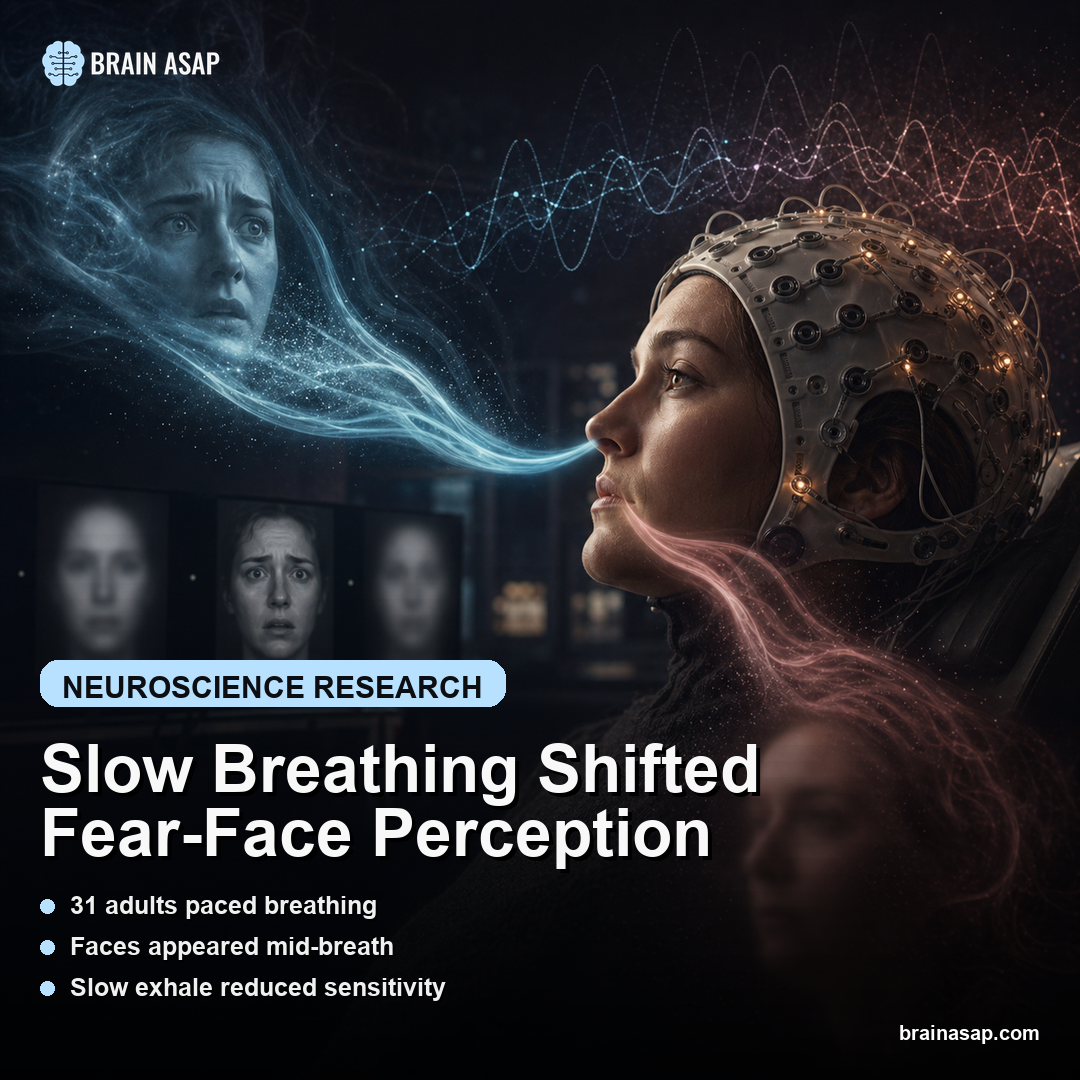
TL;DR: A 2025 study in European Journal of Neuroscience found that slow breathing sharpened fearful-face perception during inhalation but weakened it during exhalation, with magnetoencephalography showing brain-timing changes before the face appeared.
Key Findings
31 adults judged faces while breathing on cue: The main experiment paired normal-paced and slow-paced breathing with a fearful-versus-neutral face discrimination task.
Faces flashed for one tenth of a second: Morphed fearful-neutral faces appeared for 0.1 seconds at the midpoint of inhalation or exhalation.
Slow inhale improved sensitivity: Compared with normal breathing, slow-paced breathing increased perceptual sensitivity during inspiration. Slow exhale reduced sensitivity: The same slow breathing pace decreased perceptual sensitivity during expiration.
Magnetoencephalography captured fast brain timing: MEG, a method that tracks tiny magnetic fields from neural activity, showed that alpha/beta activity and respiration-brain synchronization shifted before the face appeared.
Source: European Journal of Neuroscience (2025) | Hsu et al.
Slow breathing is often sold as a general calming tool, as if the whole breath simply turns down the brain’s volume. Researchers found a narrower timing effect: the perceptual result depended on whether a face appeared during the inhale or the exhale.
A Face-Detection Task Tested Inhale Versus Exhale Timing
The experiment did not use easy emotional photographs.
Participants saw faces digitally morphed between fearful and neutral expressions, so each image sat near a perceptual boundary.
That made small changes in sensitivity easier to detect.
The timing was just as important.
Faces appeared for only 0.1 seconds, and they were placed at the midpoint of either inspiration or expiration.
The researchers were not asking whether breathing generally changes mood; they were asking whether a visual decision changes depending on the exact breath phase.
Participants performed the task while following visual cues for normal-paced breathing or slow-paced breathing. Magnetoencephalography, or MEG, tracked cortical activity with millisecond timing while respiration was monitored in parallel.
Face perception is not a passive camera feed.
The brain has to decide whether a brief, ambiguous expression carries threat information.
When the image is near the fear-neutral boundary, tiny shifts in attention, sensory gain, or cortical timing can move the decision.
The study design therefore puts breathing in the right place scientifically. If respiration really helps organize perception, it should show up when the visual system is uncertain, not when the answer is obvious.
Inhalation and Exhalation Pointed in Opposite Directions
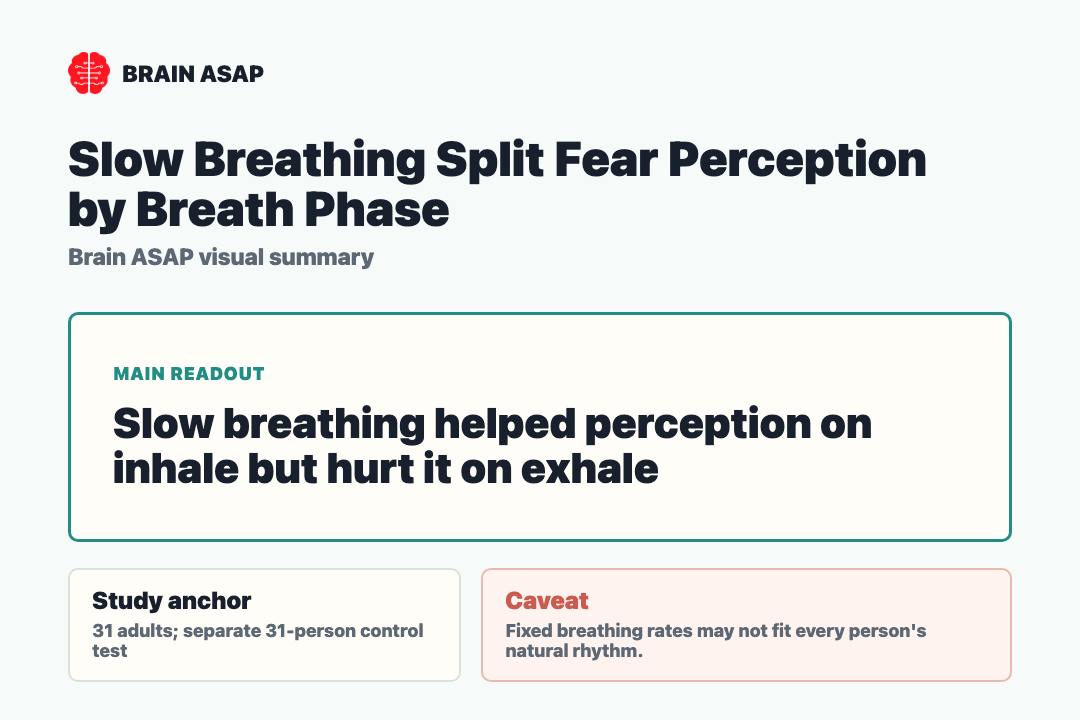
The behavioral result was direct. Slow-paced breathing improved perceptual sensitivity when the face appeared during inhalation. The same slow pace reduced perceptual sensitivity when the face appeared during exhalation.
Breathwork is often discussed as one continuous state. This paper shows that slow breathing is not one perceptual condition. Inhalation and exhalation can push visual sensitivity in opposite directions.
The finding also avoids a simple “slower is calmer, therefore better” story.
Better perception occurred during slow inhalation, not across the whole slow-breathing block. Worse perception occurred during slow exhalation, even though exhalation is often the phase people associate with relaxation.
That does not make exhalation harmful. A phase that helps someone settle down does not necessarily be the same phase that sharpens detection of a fearful face.
Magnetoencephalography Tracked the Brain Before the Face Appeared
The magnetoencephalography (MEG) timing matters because it makes the effect less likely to be only a response habit.
MEG is informative here because it captures brain activity on the scale of milliseconds, which is the timing needed for a 0.1-second face task.
The relevant neural patterns emerged in the prestimulus period, before the face was shown.
The authors linked the behavioral split to a hierarchy of time-frequency effects.
Slow breathing reduced prestimulus theta phase coherence by weakening respiration-brain phase synchronization.
That weaker entrainment then related to changes in phase-power coupling and response-related activity in the alpha/beta range.
Behind the signal-processing language is a concrete finding: the breath rhythm changed the neural context into which the face arrived. A face landing during slow inhalation entered a different brain state than a face landing during slow exhalation.
That prestimulus point is the most important neuroscience detail in the paper.
It suggests breathing was not only changing how people pressed a button after seeing the face.
It was changing the readiness state before perception began.
The alpha/beta range is often involved in sensory readiness, attention, and response preparation. The paper does not reduce those rhythms to one simple function, but it uses them as evidence that respiration was coupled to the brain’s perceptual setup.
The Control Group Helped Rule Out a Visual-Cue Artifact
Paced-breathing studies have an obvious problem: the cue itself can change attention. If people are watching a breathing guide, maybe the guide, not the breathing, explains the brain rhythms.
To address that, the researchers ran a separate control experiment with another 31 adults. This group breathed naturally and then followed normal-paced visual breathing cues.
Basic cue-related brain-wave differences were not statistically significant. The authors also checked whether air volume or cardiac rhythms explained the effect.
Those factors did not fully account for the perception shift. That does not make the mechanism final, but it narrows the most obvious alternative explanations.
The control does not eliminate every possible confound.
Participants still knew they were in a breathing task, and slow breathing can change comfort, effort, and attention.
But the extra experiment makes it less consistent with the result as nothing more than watching a moving cue.
This Is Not a Mindfulness Treatment Study
The study should not be oversold as clinical advice.
It was a controlled perception experiment in healthy adults, not a trial for anxiety, trauma, panic, or emotion regulation.
The task involved brief facial-expression judgments, not real social interaction.
There is also an individual-fit issue.
Fixed breathing rates does not necessarily match every person’s natural rhythm, lung capacity, comfort level, or autonomic baseline.
A paced breath that feels easy to one person can feel effortful to another.
That individual-fit caveat is especially important for consumer breathwork claims.
A protocol that helps one person settle might make another person monitor their body too intensely.
The study used controlled timing because science needs control, but real breathing practices are usually adapted to the person.
- Strongest claim: Slow breathing can alter visual sensitivity in a breath-phase-specific way.
- Main mechanism clue: Prestimulus alpha/beta dynamics tracked the inhale-exhale split.
- Main boundary: The study measured brief fearful-face perception in healthy adults.
- Clinical caution: Breath pacing often need to be individualized before it is treated as a reliable intervention.
Breathwork Needs Timing, Not Just Speed
The result shows that breathing is not just a general arousal dial. It is a rhythm the brain can use to time perception, so the same face can be processed differently depending on where it lands in the breath cycle.
For neuroscience, the paper gives body-brain coupling a measurable clock.
Respiration can help shape when the cortex is more or less ready to process certain kinds of sensory evidence.
The same person, same stimulus, and same slow-breathing block can produce different perceptual outcomes depending on inhale versus exhale.
For everyday breathwork claims, “slow down your breathing” is too blunt.
The more more specific question is what slow breathing is doing at each phase of the cycle, and whether the goal is vigilance, emotional discrimination, relaxation, or something else entirely.
The study does not settle those uses, but it shows why timing has to be part of the question.
Citation: DOI: 10.1111/ejn.70369. Hsu et al.. Slow-Paced Breathing Modulates Perceptual Sensitivity to Facial Expression. European Journal of Neuroscience. 2025.
Study Design: Paced-breathing facial-expression perception experiment using MEG, plus a separate breathing-control experiment.
Sample Size: 31 adults in the main MEG experiment and 31 different adults in the control experiment.
Key Statistic: Compared with normal-paced breathing, slow-paced breathing decreased perceptual sensitivity during expiration but increased it during inspiration.
Caveat: The study tested controlled perception tasks, so it should not be read as a complete guide to breathwork, anxiety treatment, or everyday emotion regulation.