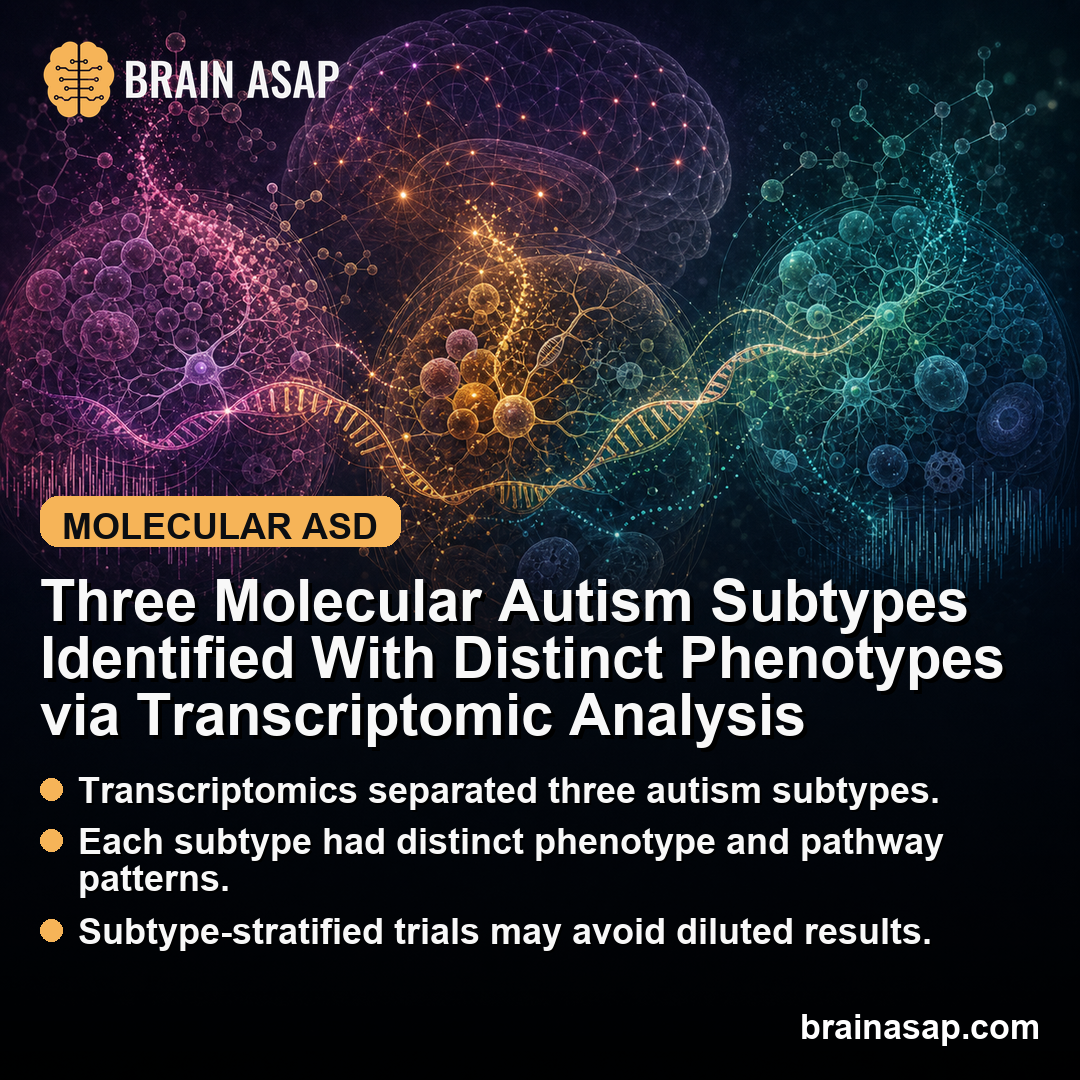
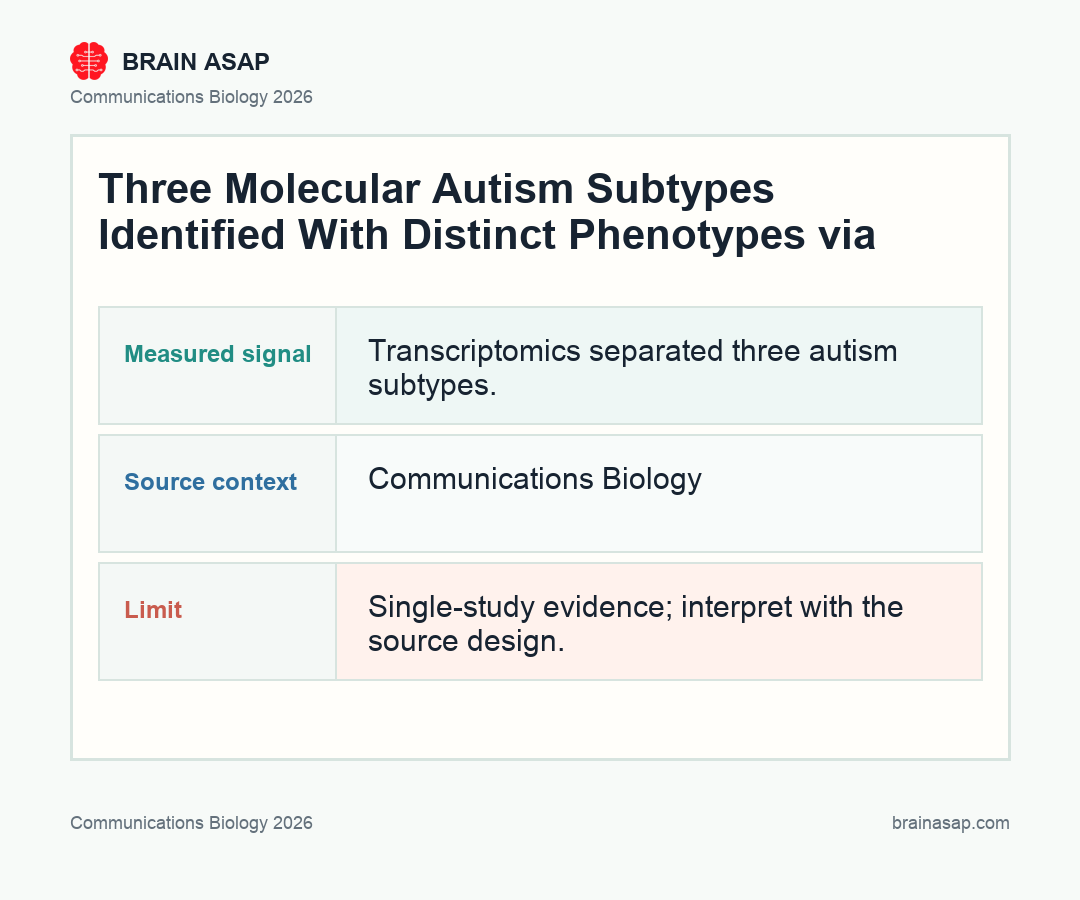
TL;DR: A 2026 Communications Biology transcriptomic analysis identified three molecular subtypes of autism spectrum disorder, each linked to a distinct phenotypic profile and biological pathway pattern.
Key Findings
- Three molecular subtypes emerged from transcriptomic analysis: Researchers identified three distinct molecular subtypes of autism spectrum disorder using transcriptomic data, each with its own gene expression signature.
- Each subtype has a distinct phenotypic profile: The molecular subtypes mapped onto different clinical presentations — not the same autism with different gene-expression versions, but biologically distinct subgroups with characteristic phenotypes.
- Each subtype implicates different functional pathways: The molecular subtypes activate different biological pathways — suggesting different mechanistic origins and potentially different therapeutic targets.
- Stratification is what genetics has been pointing toward: Hundreds of autism risk genes affecting different cellular processes have always suggested heterogeneous biology. Subtyping makes that heterogeneity actionable rather than just descriptive.
- Implications for clinical trials: Mixing all autism subtypes in one trial may dilute or hide treatment effects that work for some subgroups. Subtype-stratified trials become a credible next step.
- Behavioral diagnosis can hide biology: Clinicians have long suspected that “autism” covers multiple distinct conditions sharing a behavioral surface. Transcriptomic subtyping is an empirical step toward proving that suspicion correct.
Source: Communications Biology (2026) | Pang T, Zheng X, Liu JJ, Lu L, Yang L, Chang S
Autism diagnosis is behavioral. The DSM and ICD criteria identify autism through patterns of social communication, restricted interests, sensory processing, and developmental trajectory — but the same diagnostic label is applied to people whose underlying biology is almost certainly different.
Genetics work has identified hundreds of risk genes affecting different cellular processes. Imaging shows heterogeneous brain differences. Clinical phenotypes range across language ability, intellectual function, sensory profile, and social presentation.
Whether autism is one biological condition with diverse expressions, or several distinct conditions sharing a behavioral surface, has been one of the field’s enduring questions.
Why Behavioral Diagnosis Can Hide Biological Heterogeneity
The behavioral autism phenotype — differences in social communication and restricted/repetitive behaviors — can be produced by very different underlying biological causes:
- Single-gene syndromes (Fragile X, Rett, tuberous sclerosis) cause autism through specific molecular mechanisms.
- Copy-number variants (16p11.2, 22q11.2, etc.) involve dozens of genes whose deletion or duplication produces autism phenotypes.
- Polygenic common-variant risk contributes additional autism liability through hundreds of small-effect variants.
- De novo mutations in protein-coding genes affect autism risk through pathways including synaptic function, chromatin modification, and transcriptional regulation.
- Environmental contributions (prenatal factors, immune events, perinatal complications) can interact with genetic risk to shape the phenotype.
All of these causal pathways converge on similar behavioral diagnoses.
If treatment trials enroll patients based on behavior, they end up mixing biologically distinct subgroups whose response to a given intervention should be different. That’s part of why so many autism intervention trials produce mixed or null results — treatment effects in some subgroups get drowned out by lack of effect in others.
Subtyping by molecular signature offers a way out of that bind, but only if the subtypes are real, biologically meaningful, and clinically actionable.
What Transcriptomic Subtyping Actually Looks At
Transcriptomics measures gene expression — what the cell is actively transcribing into RNA, which reflects which genes are being used. Unlike DNA sequencing, which captures static genetic risk, transcriptomic analysis captures dynamic functional states.
The Pang team applied this approach to autism samples and asked whether distinct expression patterns clustered into separate groups:
- If autism were biologically homogeneous, transcriptomic profiles should form one cluster with continuous variation around the cluster center.
- If autism contained discrete biological subtypes, profiles should form multiple distinct clusters with different gene expression patterns.
The data fit the second pattern. Three molecular clusters emerged, each with its own characteristic gene expression signature. Importantly, the clusters weren’t just mathematically distinct — they mapped onto different clinical phenotypes and engaged different biological pathways.
Why “Three Subtypes” Could Restructure How Autism Trials Are Run
If the Pang findings replicate in independent samples, the implications for autism research are concrete:
- Treatment trials should pre-stratify by molecular subtype. An intervention that works strongly in one subtype but not others would currently be dismissed as ineffective when averaged across the whole autism population. Subtype-stratified trials would catch what general trials miss.
- Mechanistic studies become more interpretable. If each subtype implicates different biological pathways, basic-science research on synaptic function, immune contributions, or chromatin biology can match its model system to the subtype that involves that pathway.
- Personalized intervention becomes possible in principle. Knowing which subtype a child belongs to could shape which therapies, supports, and (when applicable) medications might fit best.
- Biomarker development gains a target. Each subtype’s molecular signature offers a path toward clinical biomarkers that could eventually distinguish subtypes outside research settings.
- Genetics-to-clinic translation gets a stratifier. Hundreds of risk genes can be mapped onto specific subtypes rather than treated as a single risk pool.
What This Doesn’t Yet Show
Transcriptomic subtyping is a starting point, not a finish line. Several questions remain open:
- Are the subtypes stable over development? Transcriptomic state can change with age, environment, and other factors. Whether autism subtypes derived in one age window apply across childhood, adolescence, and adulthood needs longitudinal validation.
- Do the subtypes predict treatment response? The clinical utility of subtyping depends on whether subtype membership actually changes how patients respond to interventions — that requires direct trial work, not retrospective clustering.
- Are the subtypes etiologically distinct? Different gene expression profiles could reflect different causal origins or different downstream states from a shared upstream cause. Distinguishing those scenarios matters for prevention and intervention strategy.
- How do molecular subtypes relate to existing clinical subtyping? Clinicians already informally distinguish autism presentations — high-functioning vs profound, sensory-driven vs social-driven, regression vs early-onset. Whether the molecular subtypes align with these clinical categories or cut across them is unclear.
- Sample size and replication: First-pass molecular clustering can be unstable across samples. Independent replication will determine whether the three-subtype structure holds up.
How This Fits the Bigger Push Toward Stratified Psychiatry
Autism isn’t the only psychiatric category facing the heterogeneity problem. Depression, schizophrenia, and ADHD all show similar patterns — behaviorally defined diagnoses covering biologically diverse subgroups whose treatment response differs in ways the diagnostic labels can’t capture.
The general approach — use molecular signatures (transcriptomic, genetic, neuroimaging, or combinations) to subtype within behavioral diagnoses — is the dominant direction of stratified-psychiatry research.
If the Pang findings replicate, autism becomes one of the cleaner examples of this approach producing actionable subgroups. Other conditions are likely to follow as the same methods get applied across psychiatric diagnoses.
The clinical timeline is longer than the research timeline. Even if molecular subtyping proves robust in research settings, applying it routinely in clinical autism evaluation requires accessible biomarkers, validation across diverse populations, regulatory acceptance, and provider training.
The Pang paper is one early step in a multi-decade project of restructuring psychiatric diagnosis around biology rather than behavior alone.
The Honest Boundary on Autism Subtype Research
- Transcriptomic subtyping is not a clinical test. The methods used in this paper require research-grade biological samples and analytic capacity not available in routine clinical autism evaluation.
- Subtyping is not a substitute for behavioral diagnosis. The behavioral phenotype is what makes autism clinically meaningful for the affected person and family. Molecular subtyping informs research and eventually treatment, but doesn’t replace clinical assessment.
- Three subtypes is a finding, not a final answer. Different methodological choices, different samples, and different age ranges might produce different cluster structures. The three-subtype result needs replication and refinement.
- Identity considerations matter. Many autistic people resist medicalized framings of autism as a condition to be subtyped, treated, or stratified. Research stratification for treatment trials is one thing; how subtyping is communicated to autistic communities is another.
Why This Matters for Autistic People and Their Families
The day-to-day relevance of molecular subtyping for autistic individuals and their families depends on what comes next. If subtype-stratified treatment trials produce clearer benefit in defined subgroups — behavioral interventions, medications, supports tailored to molecular subtype — the research becomes practically meaningful.
If subtyping remains a research-only construct without translation to clinical decision-making, the practical impact is limited.
For now, the takeaway is conceptual but real: autism’s biological heterogeneity is no longer a hand-waved abstraction — it has a specific molecular structure that can be measured, replicated, and targeted. Research that takes that heterogeneity seriously is more likely to produce findings that hold up than research that continues to treat autism as one condition.
Citation: Pang T, Zheng X, Liu JJ, Lu L, Yang L, Chang S. Transcriptomic analysis in autism spectrum disorder suggests three molecular subtypes with distinct phenotypic profiles and functional pathways. Communications Biology. 2026. DOI: 10.1038/s42003-026-10059-5
Study Design: Transcriptomic clustering analysis of autism spectrum disorder samples to identify molecular subtypes; subtype mapping onto phenotypic profiles and functional biological pathways.
Sample/Cohort: See full publication for sample sizes and source cohorts.
Key Statistic: Three molecular subtypes of autism spectrum disorder were identified, each with distinct phenotypic profiles and characteristic activated functional pathways — supporting the hypothesis that the behavioral autism diagnosis covers multiple biologically distinct subgroups.
Caveat: First-pass molecular clustering requires independent replication; whether subtypes are stable across development, predict treatment response, or reflect distinct etiologic origins remains to be tested; clinical translation requires accessible biomarkers and validation across diverse populations.