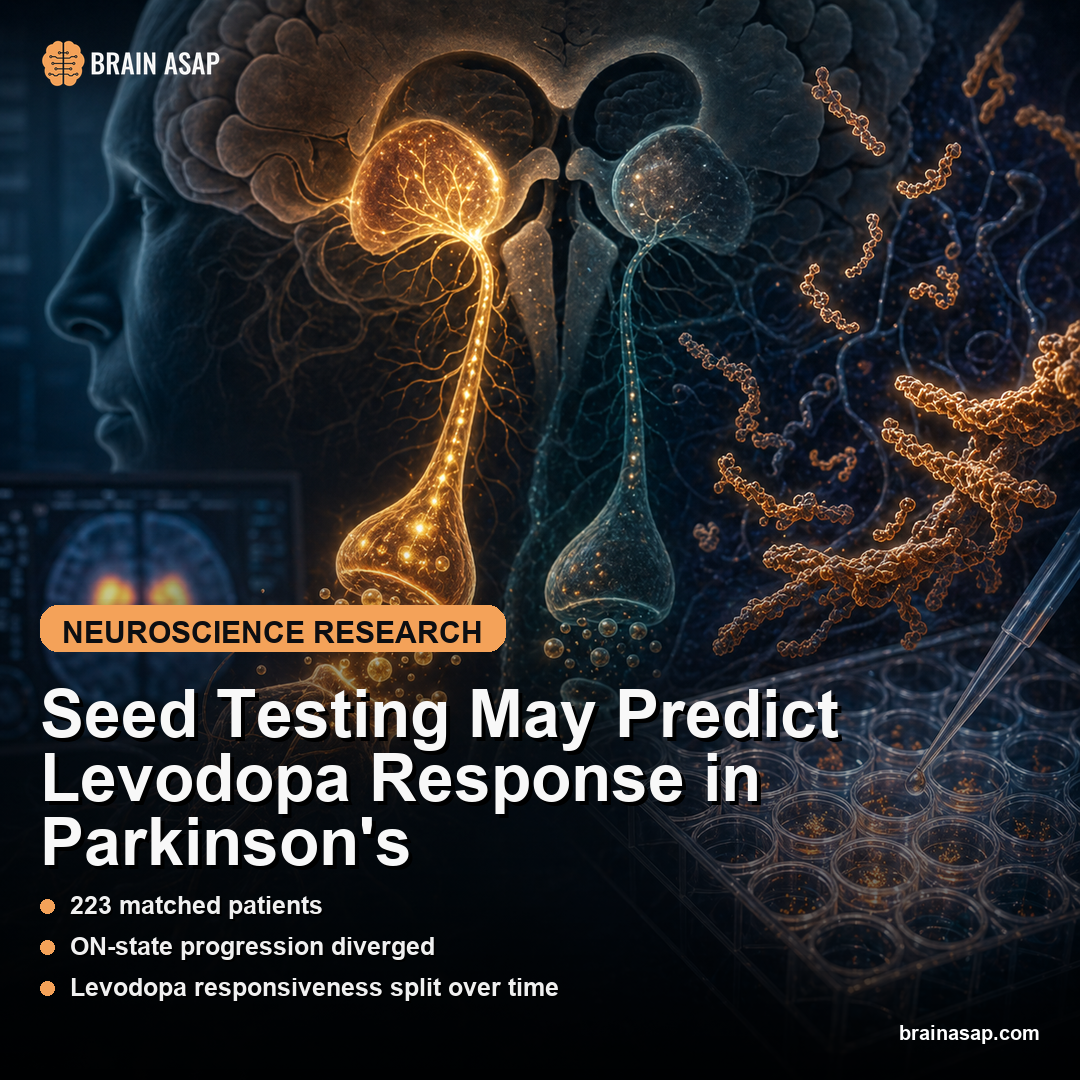
TL;DR: A 2026 medRxiv preprint found that alpha-synuclein seed-positive Parkinson’s patients had slower ON-medication motor progression, measured while usual Parkinson’s medication was active, and more sustained levodopa responsiveness than matched seed-negative patients.
Key Findings
- 223 matched patients: The analysis compared 40 SAA-negative and 183 SAA-positive sporadic Parkinson’s patients from PPMI.
- ON-state progression diverged while medication was active: SAA-positive patients progressed more slowly while ON medication, meaning testing while usual Parkinson’s medication was active, at 0.87 versus 3.47 MDS-UPDRS Part III points per year.
- Levodopa responsiveness split over time: Proportional responsiveness increased in SAA-positive patients but declined in SAA-negative patients (p=0.036).
- Dopamine imaging supported the pattern: SAA-negative patients had lower caudate DAT binding at treatment initiation and faster dopaminergic decline.
- Complications were not the full explanation: SAA-positive patients had fewer motor complications at treatment start, but complication progression was similar.
Source: medRxiv (2026) | Azizi et al.
Levodopa is the central motor treatment in Parkinson’s disease, but patients do not all follow the same response curve. This study asks whether one biomarker can explain part of that split: the alpha-synuclein seed amplification assay.
SAA Status Split the Same Parkinson’s Diagnosis
Parkinson’s disease is usually tied to misfolded alpha-synuclein, but not every clinically diagnosed patient tests positive on seed amplification assays.
That creates a clinical classification problem.
The treatment question is whether seed-negative patients respond to dopamine therapy the same way.
The researchers used the Parkinson’s Progression Markers Initiative, a longitudinal cohort with clinical visits, medication-state motor exams, dopamine transporter imaging, and cerebrospinal fluid (CSF), the fluid surrounding the brain and spinal cord alpha-synuclein seed amplification testing.
Seed amplification assays work by asking whether a patient’s sample contains misfolded alpha-synuclein capable of triggering further aggregation in the lab.
In Parkinson’s research, that has mostly been discussed as a diagnostic tool.
This paper pushes it into a more clinically practical issue: whether the assay also says something about treatment response.
That is a more practical bar.
A biomarker has limited value if it only tells clinicians what they already suspect.
A biomarker that helps anticipate the next several years of medication response could shape follow-up, counseling, and trial design.
PPMI Matched 40 Seed-Negative Patients Against 183 Seed-Positive Patients
The analysis focused on sporadic Parkinson’s patients who had started levodopa and had ON and OFF medication motor scores. SAA-negative and SAA-positive patients were matched on age, sex, and disease duration at treatment initiation.
The final matched sample included 40 SAA-negative patients and 183 SAA-positive patients. The analysis separated three treatment-relevant measures:
- ON-state progression: how motor scores changed while medication was active.
- OFF-state progression: how the underlying motor burden changed away from medication benefit.
- Levodopa responsiveness: the difference between OFF-state testing after medication withholding and ON-state testing while usual Parkinson’s medication was active.
The investigators also adjusted models for age, sex, and levodopa equivalent daily dose. Medication response can be distorted by dose, sex differences in levodopa pharmacology, and disease duration.
Matching does not make this a randomized trial, but it reduces obvious imbalance. The key interaction was time, SAA status, and medication state.
In the ON state, SAA-positive patients progressed at 0.87 points per year, while SAA-negative patients progressed at 3.47 points per year.
Lower is better here because it means slower worsening.
That does not show SAA-negative patients had no levodopa response.
They still improved by roughly 30% at treatment initiation.
The difference was trajectory: their proportional responsiveness declined over time, while SAA-positive patients showed increasing proportional benefit.
That nuance changes the clinical reading. The finding is not “seed-negative Parkinson’s does not respond to levodopa.” The better interpretation is that seed-negative patients may lose response durability faster, even when they show a meaningful early response.
The absolute response analysis pointed in the same direction but was less statistically decisive. SAA-positive patients showed a larger increase in absolute medication responsiveness over time, while SAA-negative patients were relatively stable, but the interaction did not meet conventional significance.
Dopamine Transporter Imaging Added a Mechanism
The imaging result made the clinical pattern more plausible. SAA-negative patients had lower caudate DAT binding near treatment initiation, with mean binding ratios of 0.54 compared with 0.75 in SAA-positive patients.
They also showed faster dopaminergic decline over time. If presynaptic dopamine terminals are disappearing faster, the brain can have less capacity to convert levodopa into usable dopamine signal, which could explain diminishing responsiveness.
The DAT-SPECT result is valuable because it keeps the interpretation from being purely statistical.
The treatment-response split tracked with a biological readout of dopamine terminal integrity.
SAA-negative patients started lower and declined faster, matching the idea that levodopa has less presynaptic machinery to work with over time.
SAA Testing Could Forecast Levodopa Durability
Reduced levodopa responsiveness can raise concern for atypical parkinsonism, but this paper argues for a subtler view. Some SAA-negative patients can still sit within the Parkinson’s spectrum while following a different dopaminergic trajectory.
That distinction could matter for counseling, trial stratification, and treatment planning. A biomarker that predicts response durability would be more useful than one that only helps at diagnosis.
It could also matter for clinical trials.
If SAA-negative and SAA-positive Parkinson’s patients follow different treatment trajectories, mixing them without stratification could blur drug effects.
Trials testing symptomatic therapies or disease-modifying strategies often need to know which biology they are enrolling.
The motor-complication findings add another layer.
SAA-positive patients had fewer complications at treatment initiation, but the rate of complication progression did not differ clearly.
That suggests the biomarker is not simply marking dyskinesia risk; it is capturing a broader dopaminergic response pattern.
The 40-Patient Seed-Negative Group Still Needs Replication
This is a preprint and lacks external validation in an independent cohort. The SAA-negative group was also much smaller than the SAA-positive group, and follow-up duration differed between groups.
The study also modeled treatment response linearly.
Parkinson’s trajectories are rarely that tidy.
Response durability may bend, plateau, or change after medication adjustments, so future studies should test nonlinear patterns and replicate the finding in larger seed-negative samples.
Still, the signal is clinically notable because it links a molecular assay, medication response, and dopamine transporter decline. If replicated, SAA status can become a practical way to subtype Parkinson’s treatment trajectories.
For now, the finding is best read as stratification evidence, not a prescribing rule. It suggests that the biology captured by alpha-synuclein seeding is clinically meaningful, but it does not yet tell an individual patient how much levodopa they should take or when treatment should change.
The practical next step is replication in cohorts where seed status, medication dosing, imaging, motor complications, and clinical subtype are tracked together from early disease onward.
If the pattern holds, Parkinson’s care can move toward a more biological forecast: not just whether the diagnosis fits, but how durable the treatment response is likely to be.
That would be a major shift.
Patients already know Parkinson’s is heterogeneous because they live the variability.
A biomarker that helps explain that variability would make the disease less mysterious and clinical planning less reactive.
It would also make trial design cleaner. If seed-negative patients lose dopaminergic responsiveness faster, then future studies should either stratify by SAA status or risk mistaking biological heterogeneity for treatment failure.
The central lesson is not that one group is “real Parkinson’s” and the other is not. The lesson is that the same clinical label can contain different treatment-relevant biology.
That is exactly the kind of biomarker argument Parkinson’s research needs: one that connects molecular pathology to the decisions patients actually feel.
Citation: DOI: 10.64898/2026.04.21.26350973. Azizi et al.. Differential levodopa responsiveness and motor complication trajectories in Parkinson's disease by alpha-synuclein seed amplification assay status. medRxiv. 2026.
Study Design: Matched longitudinal cohort analysis using PPMI clinical, medication-state, imaging, and seed-amplification data.
Sample Size: 223 matched patients: The analysis compared 40 SAA-negative and 183 SAA-positive sporadic Parkinson’s patients from PPMI.
Key Statistic: ON-state progression diverged while medication was active: SAA-positive patients progressed more slowly while ON medication, meaning testing while usual Parkinson’s medication was active, at 0.87 versus 3.47 MDS-UPDRS Part III points per year.
Caveat: Preprint analysis with a small seed-negative group; treatment-response differences need prospective validation.