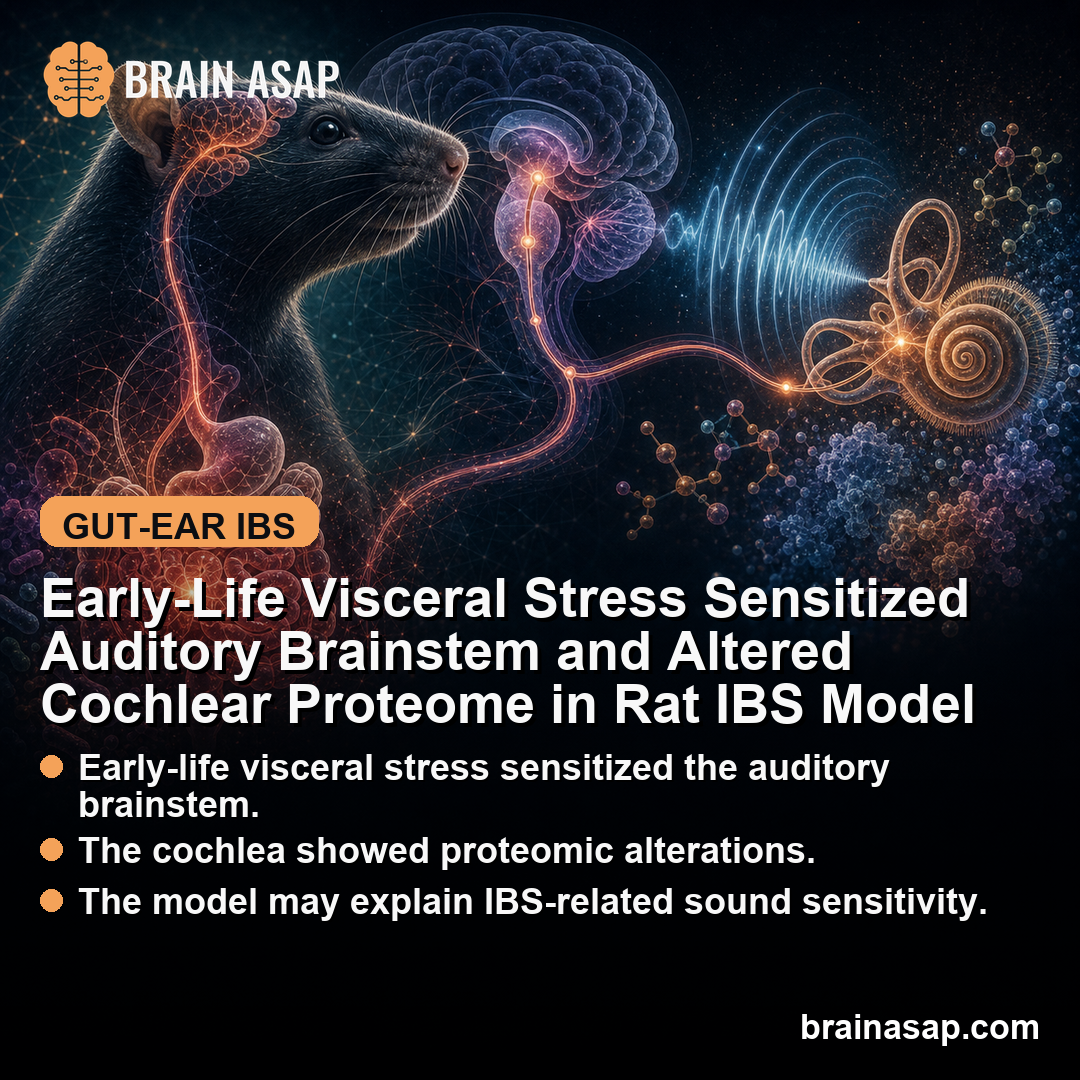
TL;DR: A 2026 rat study in Neurobiology of Stress found that early-life visceral stress produced adult IBS-like symptoms alongside auditory brainstem sensitization and cochlear protein changes, giving a mechanistic explanation for sound sensitivity reported by some IBS patients.
Key Findings
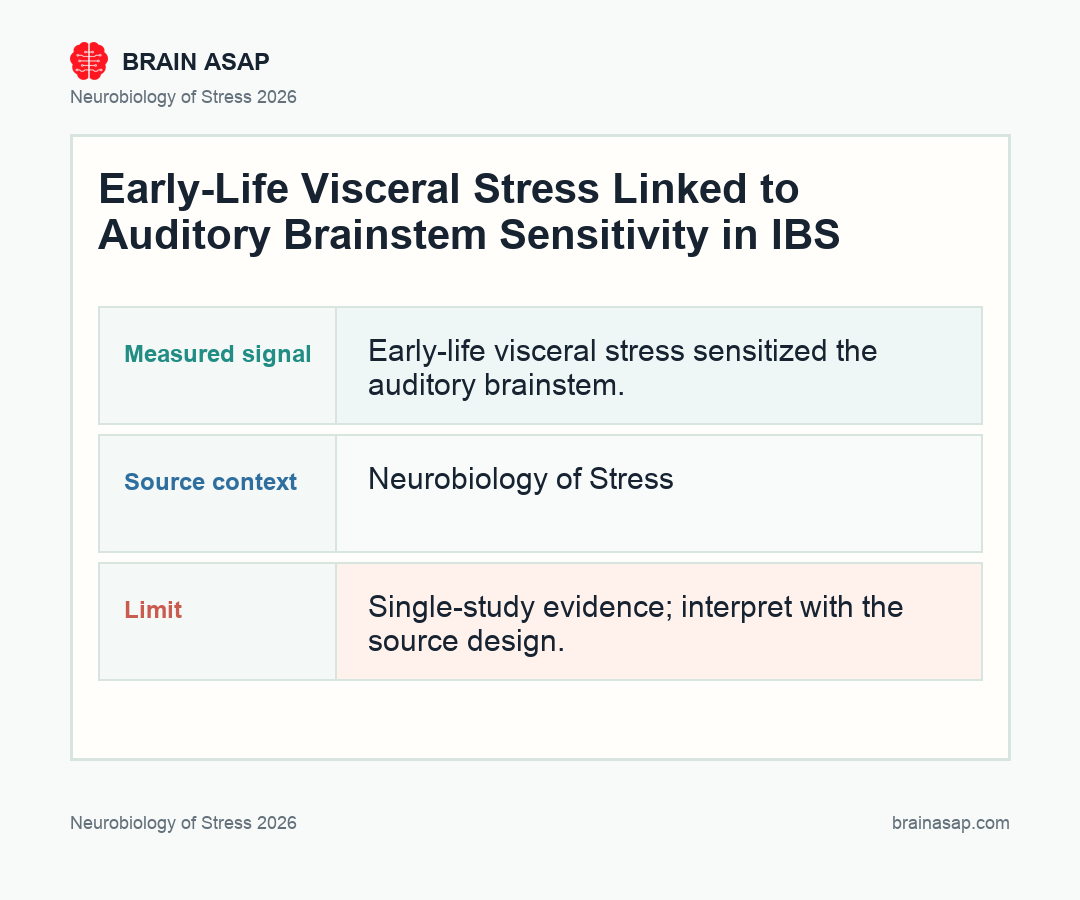
- Early-life visceral stress sensitized the auditory brainstem: Rats exposed to early-life visceral stress (the standard rat model of adult IBS) showed altered auditory brainstem responses — the gut adversity reshaped how sound was processed at the brainstem level.
- Cochlear proteomic alterations emerged: Beyond brainstem changes, the inner ear itself showed protein-level changes — meaning early visceral stress reaches all the way to the cochlea, the structure that converts sound into neural signal.
- Provides a mechanism for IBS-related auditory complaints: Patients with IBS often report sound sensitivity and auditory symptoms; the rat model gives a biological explanation for why gut conditions and auditory function might be coupled.
- Early-life origin is the key feature: The model uses early-life adversity to produce the adult phenotype — consistent with developmental-windows research showing that early gut and stress experiences shape adult sensory and visceral function.
- Cross-system effects of early-life stress have been underappreciated for sensory systems: Most early-life-stress research focuses on cognition, mood, and gut function. The auditory system has received much less attention as a target.
- Translational relevance for IBS clinical care: If gut and auditory sensitization share early developmental origins, sensory complaints in IBS patients deserve recognition and may share treatment targets with the gastrointestinal symptoms.
Source: Neurobiology of Stress (2026) | Zhang LY, Li XL, Jing YY, Yu LS
Patients with irritable bowel syndrome often describe surprising symptom clusters: hypersensitivity to noise, increased startle responses, difficulty in loud environments, and auditory complaints that do not fit typical hearing-loss patterns.
Clinicians have noted these comorbidities for years, but the mechanistic explanation has often stopped at broad labels such as stress generalization or central sensitization. The Zhang team built a specific mechanistic test in a rat model that produces adult IBS-like phenotypes through early-life visceral stress.
Why IBS Patients Report Auditory Symptoms That Don’t Fit Standard Categories
Clinicians treating IBS encounter a recurring pattern of symptoms that aren’t part of the standard IBS textbook description but show up reliably in patient histories:
- Hyperacusis — sound sensitivity where ordinary sounds feel uncomfortably loud.
- Increased startle responses to unexpected sounds.
- Difficulty in noisy environments — restaurants, parties, public transit feel overwhelming.
- Tinnitus — in subgroups of IBS patients, tinnitus is more prevalent than in age-matched controls.
- Migraine and noise sensitivity overlap with IBS at higher rates than chance.
The clinical pattern has been recognized but not explained. Standard accounts have framed it as “stress generalization” or “central sensitization,” but those framings don’t specify which neural systems are involved or why early gut adversity would specifically affect the auditory system.
How the Rat Model of IBS Was Used to Test the Auditory Connection
The early-life visceral stress paradigm has become a standard rodent model for adult IBS. The protocol involves subjecting young rats to repeated visceral pain stimuli during a critical developmental window. Adult animals develop IBS-like phenotypes including:
- Visceral hypersensitivity — exaggerated pain responses to gut distension.
- Altered gut motility — resembling functional gastrointestinal disorder patterns.
- Anxiety and stress reactivity changes — consistent with the comorbid mood symptoms common in human IBS.
- Gut-brain axis dysfunction — including microbiome changes and altered vagal signaling.
What the Zhang team added was systematic auditory measurement. Adult rats from the early-life-stress protocol were tested with auditory brainstem responses (ABRs) and had cochlear protein expression analyzed. The results showed both brainstem-level and cochlea-level changes consistent with auditory sensitization.
Why the Cochlear Proteomic Findings Are the More Surprising Part
Brainstem changes after early-life stress are perhaps less surprising — the brainstem integrates many forms of sensory and visceral information, and stress effects on brainstem function are well-documented. The cochlear changes are more striking:
- The cochlea is the inner-ear structure that converts sound waves into neural signals. Stress effects don’t typically reach this peripheral sensory organ.
- Cochlear proteomic alterations after early-life visceral stress mean the developmental impact extends to the most peripheral level of auditory processing.
- This is consistent with developmental programming — early-life conditions shape multiple organ systems, but extension to peripheral sensory organs hasn’t been a major research focus.
The proteomic-level changes also suggest that auditory sensitization in this model isn’t just a psychological consequence of altered stress reactivity — it’s a structural-functional change in the auditory system itself.
Why “Early Life” Matters for the Mechanism
The early-life specificity of the model fits a broader pattern in developmental neuroscience:
- Critical periods for sensory system development exist in early postnatal life. Disruptions during these windows can produce lasting alterations in sensory processing.
- Gut microbiome establishment happens during early life and shapes adult immune, metabolic, and possibly sensory function.
- HPA axis programming by early-life stress affects adult stress reactivity across multiple body systems.
- Immune system development during early life can be reshaped by adversity, with downstream effects on inflammation that affects multiple tissues.
The Zhang findings suggest the auditory system should be added to the list of organs and systems shaped by early-life adversity. This isn’t just relevant for IBS — it has implications for any clinical condition where early-life stress is a risk factor and auditory complaints are part of the picture.
What This Means for IBS Patients With Sound Sensitivity
The clinical implications are concrete:
- Auditory symptoms in IBS patients deserve recognition rather than dismissal. The mechanistic basis exists in animal models and almost certainly extends to human patients with similar developmental histories.
- Treatment should consider both systems. Patients with severe auditory sensitivity alongside IBS may benefit from comprehensive evaluation that includes audiologic assessment and noise-tolerance interventions, not just GI-focused care.
- Early-life adversity history is relevant clinical information for adults presenting with the gut-auditory pattern. The mechanistic origin in early life means the symptom cluster makes more sense when developmental history is considered.
- Sound-based environmental modifications — reducing exposure to overstimulating environments — may help these patients beyond what GI-targeted treatment alone provides.
Why This Connects to Broader Sensory Processing Research
The Zhang findings fit a wider literature suggesting that sensory processing differences and visceral dysregulation often co-occur because they share developmental and neural substrates. Other examples include:
- Migraine and IBS — comorbid at higher rates than chance, with shared central sensitization mechanisms.
- Fibromyalgia and sensory hypersensitivity — widespread pain plus heightened sensory responses.
- Autism and sensory processing differences — though through different developmental mechanisms.
- Anxiety disorders and exaggerated startle — shared brainstem circuit involvement.
The unifying theme is that sensory and visceral systems aren’t as compartmentalized as they appear — they share developmental windows, regulatory circuits, and adversity vulnerabilities. Conditions historically separated into “GI,” “audiologic,” and “psychiatric” categories often share underlying mechanisms when viewed through the developmental neurobiology lens.
The Honest Limits of This Animal Study
- Rat IBS is not human IBS. The animal model captures some features but cannot fully reproduce the heterogeneous human clinical condition.
- Auditory brainstem responses in rats translate imperfectly to human auditory complaints. Hyperacusis, tinnitus, and noise intolerance involve subjective and cortical processes the brainstem-level measurement cannot fully capture.
- Cochlear proteomic findings need follow-up to characterize which proteins are involved and what functional consequences they produce.
- The early-life-stress model may not fully replicate human early-adversity exposures, which include emotional, social, and environmental factors beyond visceral pain.
- Clinical translation requires validation in human cohorts with documented early-life adversity and current IBS plus auditory symptoms.
Why This Matters for How We Should Think About Functional Disorders
IBS is sometimes treated as a functional disorder with implicit dismissal: functional in the sense of “we cannot find a structural cause.” The Zhang findings suggest that functional labels often reflect the limits of current measurement rather than the absence of biological substrate.
Early-life visceral stress reshaped the auditory system at the proteomic level in this model. Patients reporting sound sensitivity alongside IBS may be describing downstream symptoms of related developmental disruption, not two unrelated complaints.
Recognizing the unity of these symptoms in the clinical conversation is a small but important shift. The patient who says “my noise sensitivity got worse around the same time as my IBS started” may be describing the same biology, not two separate complaints. The Zhang paper provides one specific mechanistic basis for taking that report seriously.
Citation: Zhang LY, Li XL, Jing YY, Yu LS. Early life visceral stress induces auditory brainstem sensitization and cochlear proteomic alterations in a rat model of irritable bowel syndrome. Neurobiology of Stress. 2026;42:100812.
Study Design: Rat model of early-life visceral stress (standard adult IBS modeling protocol) with adult auditory brainstem response measurement and cochlear proteomic analysis; comparison against control animals without early-life stress exposure.
Sample/Model: Rats undergoing early-life visceral stress vs controls — see full publication for sample sizes per assay.
Key Result: Early-life visceral stress produced adult auditory brainstem sensitization and cochlear proteomic alterations alongside the expected IBS-like gut phenotype — providing mechanistic basis for the clinically observed sound sensitivity that often accompanies IBS.
Caveat: Animal model of IBS with translational distance to human disease; brainstem-level measurements don’t fully capture cortical and subjective dimensions of human auditory complaints; specific cochlear proteins involved and their functional consequences require follow-up characterization.