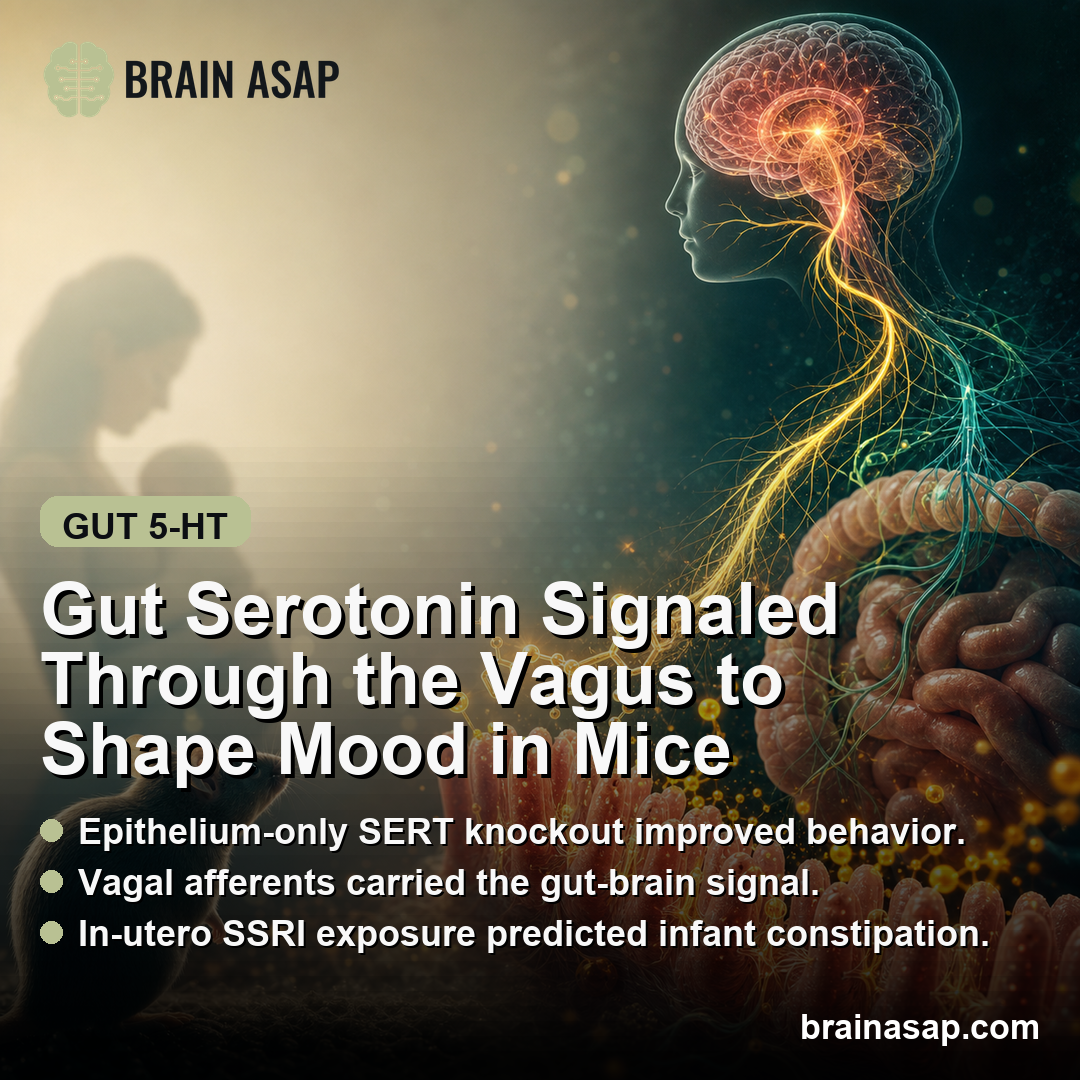
TL;DR: A 2024 Gastroenterology study found that intestinal epithelial serotonin reduced anxiety- and depression-like behavior in mice through vagal signaling, while prenatal SSRI exposure in a human cohort predicted infant functional constipation independent of maternal depression.
Key Findings
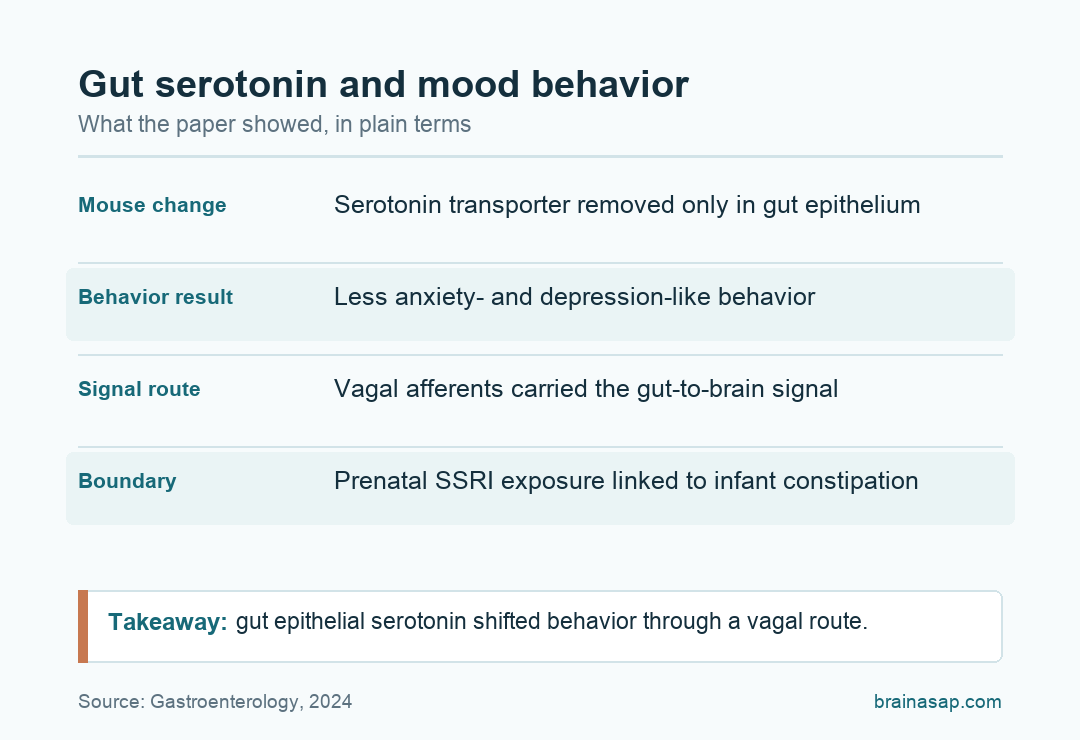
- Gut-only serotonin reuptake transporter ablation reduced anxiety and depression-like behavior: Targeting SERT only in the intestinal epithelium produced anxiolytic and antidepressant-like effects without disrupting GI motility or affecting brain function.
- Vagal afferents carried the signal: Surgical and pharmacological isolation showed afferent vagal pathways are the conduit by which intestinal epithelial serotonin reaches mood-regulating brain circuits.
- Inhibiting epithelial serotonin synthesis worsened mood: The reverse manipulation increased anxiety- and depression-like behavior, confirming the gut serotonin signal is operative in both directions.
- SSRI exposure in utero was a specific risk factor for infant functional constipation: A prospective birth cohort showed in utero SSRI exposure predicted disorders of gut-brain interaction (DGBI) — specifically functional constipation — in the first year of life.
- The link held independent of maternal depression: The effect on infant DGBI was not explained by maternal depressive symptoms — the SSRI exposure itself carried the signal.
- Reframes a 60-year-old drug class: SSRIs may not need to flood the brain to work — gut-targeted serotonin modulation could deliver the antidepressant effect with fewer central side effects.
Source: Gastroenterology (2024) | Bhattarai et al.
Selective serotonin reuptake inhibitors (SSRIs) are first-line treatments for depression and anxiety, but the field has never been clean about which compartment they actually act through. SSRIs raise serotonin signaling everywhere it matters: the brain, the intestinal epithelium, and the enteric nervous system. The Bhattarai team built mice that let them isolate one of those compartments at a time — and the answer was unexpected.
The intestinal epithelium turned out to be the part doing more of the work than anyone had attributed to it.
Why Knowing Which Compartment SSRIs Act Through Has Always Been Hard
About 90% of the body’s serotonin is made in the gut, not the brain. SSRIs block the serotonin reuptake transporter (SERT) systemically, raising local serotonin in every compartment that produces or responds to it. Decades of clinical psychiatry have assumed the brain compartment was the therapeutic target — but that assumption has never been cleanly tested, because broad pharmacology can’t isolate compartments.
The Bhattarai team used mouse genetics to do what pills cannot: knock out SERT only in the intestinal epithelium, leaving brain and enteric neuron SERT intact. If the brain were doing all the antidepressant work, this manipulation should do nothing for mood.
It did the opposite. Mice with epithelium-only SERT knockout showed reduced anxiety- and depression-like behavior.
The flip-side experiment, inhibiting serotonin synthesis only in epithelial cells, increased anxiety and depression-like symptoms. The intestinal epithelium is not just a downstream effector of an SSRI’s brain action; it is a primary driver of mood biology in this model.
The Vagus Nerve Is the Wire Connecting Gut Serotonin to Brain Mood
Showing that gut serotonin matters for mood is one thing. Identifying the route from gut to brain is another. The Bhattarai team used afferent vagal manipulation to test whether the signal flows through the vagus nerve — the major bidirectional cable between visceral organs and the brainstem.
It did. Cutting vagal afferents blocked the mood-regulating effects of intestinal epithelial serotonin. The vagus nerve is the conduit.
Why This Reshapes How SSRIs Should Probably Be Designed
The conventional drug-development logic for depression has been: get the molecule across the blood-brain barrier, raise serotonin in mood-relevant brain circuits, hope side effects are tolerable. SSRIs hit serotonin signaling everywhere — and the side effect profile reflects that broad reach: GI symptoms, sexual dysfunction, anxiety paradoxes, sleep disruption, and (in pregnancy) developmental concerns.
If gut-only serotonin elevation can deliver mood benefits through vagal signaling, a different drug-design strategy becomes plausible: target serotonin reuptake selectively in the intestinal epithelium, avoid the brain, and rely on the vagus nerve to carry the therapeutic signal upward. The therapeutic effect could persist while several systemic side effects could shrink.
This isn’t speculative pharmacology — there’s already a class of compounds (e.g., poorly absorbed SERT inhibitors) that could be evaluated this way. The mouse data make the case that the target is real.
The Pregnancy Finding That Connects Mouse Biology to Human Newborns
The same paper paired the mouse mechanism work with a prospective human birth cohort. The team tracked SSRI exposure during pregnancy and infant gastrointestinal outcomes in the first year of life.
The result was specific: in utero SSRI exposure was associated with increased risk of functional constipation, a defined disorder of gut-brain interaction (DGBI). The link held after adjustment for maternal depressive symptoms — meaning it isn’t simply a marker for which mothers had depression in pregnancy. The drug exposure itself carried the signal.
This human finding directly links the mouse mechanism to clinical reality. If intestinal serotonin signaling is being modulated by SSRIs during a critical developmental window, the gut-brain interaction system in the developing infant could be shaped in ways that produce DGBIs years later.
The Honest Boundary: Mouse Mechanism, Human Cohort, Translation Pending
The Bhattarai paper does the rare thing of pairing rigorous mouse mechanism work with human cohort data — but the translation isn’t complete:
- Mouse mood paradigms are not human depression. Anxiolytic-like and antidepressant-like behaviors in mice are validated proxies, but they don’t directly map onto major depressive disorder in patients.
- The pregnancy finding is observational. Even with covariate adjustment, residual confounding by depression severity, polypharmacy, or other lifestyle factors is possible.
- Gut-targeted SSRIs aren’t yet trialed in humans for depression. The pharmacological premise is plausible but unproven in a clinical population.
- The vagal afferent finding doesn’t fully exclude central effects. Mood biology is multi-route; the gut-vagus pathway adds to brain biology rather than replacing it.
Why This Matters for Both Psychiatry and Obstetrics
The Bhattarai paper does something unusual: it gives both psychiatry and obstetrics actionable mechanistic information from the same study. For psychiatry, it suggests SSRIs may be redesignable as gut-targeted medications. For obstetrics, it provides the first compelling biological account of why SSRI exposure during pregnancy might affect infant gastrointestinal development — through the same intestinal serotonin pathway that drives the drug’s mood effects.
That’s the interpretive payoff. The same gut-brain serotonin biology that may treat depression in adults may also shape gastrointestinal function in babies developing under maternal SSRI use. The therapeutic mechanism and the developmental risk share a substrate. Future drug design and pregnancy guidance both have to account for that.
Citation: Bhattarai et al. Intestinal Epithelial Serotonin as a Novel Target for Treating Disorders of Gut-Brain Interaction and Mood. Gastroenterology. 2024. DOI: 10.1053/j.gastro.2024.11.012
Study Design: Combined transgenic mouse work (intestinal epithelial SERT ablation, epithelial serotonin synthesis inhibition, surgical and pharmacological vagal afferent manipulation) with prospective human birth cohort assessing in utero SSRI exposure and first-year DGBI development.
Sample/Model: Conditional transgenic mice; human birth cohort (size in primary publication).
Key Result: Intestinal epithelial serotonin alone is sufficient to modulate mood-related behavior via vagal afferent pathways in mice; in utero SSRI exposure is a specific risk factor for first-year functional constipation in humans, independent of maternal depressive symptoms.
Caveat: Mouse mood paradigms are validated proxies, not clinical depression; pregnancy cohort is observational with potential residual confounding; gut-targeted SSRI strategy not yet tested in humans for depression.