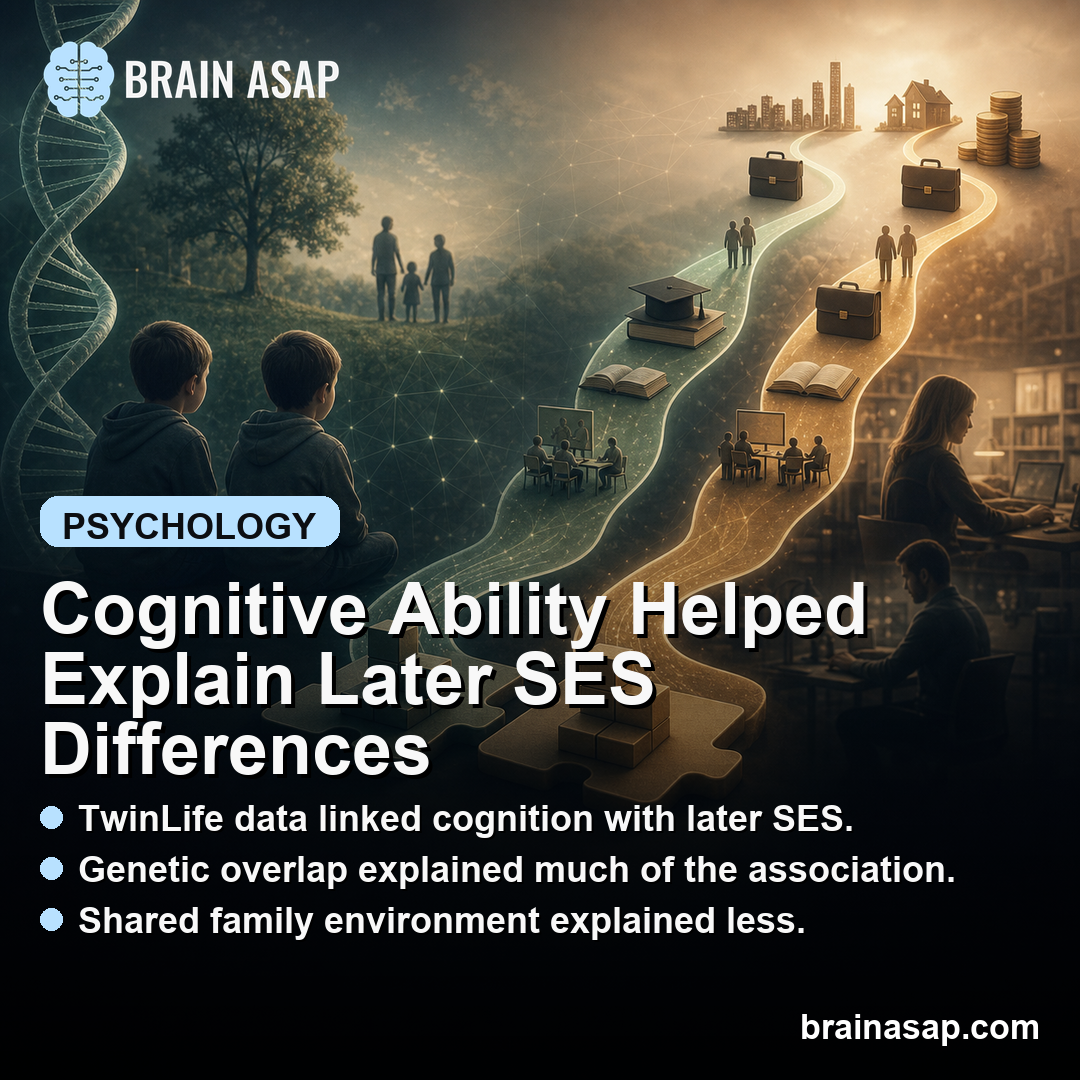
TL;DR: A 2026 study in Scientific Reports used the German TwinLife panel (228 monozygotic and 212 same-sex dizygotic twin pairs) to show that intelligence quotient (IQ) at age 23 predicted four socioeconomic status (SES) outcomes at age 27, with genetic factors explaining 69-98% of the IQ-SES association.
Key Findings
- IQ at age 23 predicted SES at age 27 across all four outcomes: phenotypic correlations were r = 0.34 with ISCED education level, r = 0.43 with Casmin education level, r = 0.27 with SIOPS occupational prestige, and r = 0.31 with ESeC occupational SES (all p < 0.001).
- Genes explained 69-98% of the IQ-SES link: Cholesky decomposition put the genetic share at 69% for ISCED, 81% for Casmin, 98% for SIOPS occupational prestige, and 98% for ESeC occupational SES.
- IQ heritability was 75%: the additive genetic component (A) of the Cattell Culture-Fair Test (CFT-20-R) explained 75% of individual differences in IQ at age 23 in the AE twin model, with no detectable shared family environment.
- SES outcomes were also moderately to highly heritable: heritability was 49% for ISCED education, 66% for Casmin education, 32% for SIOPS occupational prestige, and 71% for ESeC occupational SES in the AE twin models.
- Genetic correlations exceeded environmental correlations: the genetic correlation (rG) between IQ and SES ranged from 0.42 to 0.59 across the four outcomes, while the environmental correlation (rE) ranged from 0.01 to 0.23.
Source: Scientific Reports (2026) | Kajonius
The TwinLife Panel Followed German Twins From Age 23 to 27
The data came from TwinLife, a longitudinal twin family study run by the Leibniz Institute for Social Sciences. TwinLife enrolled more than 4,000 German families and interviews same-sex twin pairs face to face every 2 years, with phone surveys in between.
Researcher Petri Kajonius at Lund University used the slice of TwinLife in which both twins were between 20 and 30 years old. IQ was measured at age 23 (mean 23.1, SD 1.8) and SES was measured again at age 27 (mean 27.2, SD 1.9).
The analytic sample was 880 individuals, drawn from 228 monozygotic (MZ) twin pairs and 212 same-sex dizygotic (DZ) twin pairs, with pairwise sample sizes of 583 to 812 across analyses.
The participating sample was 57% women, 85% German citizens, and came from households where 44% had university-level education. The team used pairwise deletion to handle missing data after non-significant Missing-Completely-At-Random tests.
IQ Was Measured Once and SES Was Measured Four Different Ways
Cognitive ability at age 23 was measured with the Cattell Culture-Fair Test (CFT-20-R), a fluid-intelligence test with four subtests (figural reasoning, figural classification, matrices, and reasoning) and 56 timed items. Internal consistency in TwinLife was Cronbach’s alpha = 0.80.
SES at age 27 was indexed with two education measures and two occupation measures:
- Education level (ISCED): the International Standard Classification of Education, scored 0 to 10, with kindergarten at the bottom and a doctorate at the top.
- Education level (Casmin): the Comparative Analysis of Social Mobility in Industrial Nations classification, also scored 0 to 10.
- Occupational prestige (SIOPS): the Standard Index of Occupational Prestige Scale, scored 0 to 100 from each participant’s ISCO-08 occupation code.
- Occupational SES (ESeC): the European Socio-Economic Classification, scored 1 to 9, with higher scores indicating more autonomy and labor-market position.
Using two indicators per construct lets the analysis check whether genetic and environmental partitions hold up across different measurement choices.
IQ at Age 23 Predicted Every SES Outcome at Age 27
Within-person zero-order correlations confirmed that IQ at age 23 was associated with each SES outcome at age 27:
- ISCED education level: r = 0.34 (p < 0.001).
- Casmin education level: r = 0.43 (p < 0.001).
- SIOPS occupational prestige: r = 0.27 (p < 0.001).
- ESeC occupational SES: r = 0.31 (p < 0.001).
These four-year predictive correlations sit in the range that prior longitudinal meta-analyses have reported for IQ predicting later education and occupation, with correlations around r = 0.50 in larger samples.
Twin Models Put IQ Heritability at 75% and SES Heritability at 32-71%
Univariate classic twin design (CTD) models partitioned variance in each variable into additive genetic (A), shared family environment (C), and unique environment (E) components.
MZ-DZ correlation patterns and AIC-based model fit favored the more parsimonious AE model for most variables. Heritability estimates from the AE model were:
- IQ at age 23: 75% genetic, 25% unique environment.
- ISCED education level: 49% genetic, 51% unique environment.
- Casmin education level: 66% genetic, 34% unique environment.
- SIOPS occupational prestige: 32% genetic, 68% unique environment.
- ESeC occupational SES: 71% genetic, 29% unique environment.
The IQ heritability of 75% in this sample lines up with the upper end of typical twin estimates for late adolescence and emerging adulthood.
Heritability of SES indicators in the 32-71% range is also broadly consistent with a 2022 Norwegian twin panel that put the genetic component of five SES measures at 34-47%.
Cholesky Decomposition Showed Genes Carried Most of the IQ-SES Link
The headline analysis was a bivariate longitudinal Cholesky model that fed IQ at age 23 into SES at age 27 within twin pairs.
The model decomposes the cross-time, cross-trait covariance into genetic and environmental shares and produces a genetic correlation (rG) that tells researchers how much of the genes that influence IQ also influence each SES outcome.
The genetic share of the IQ-SES association across outcomes was:
- ISCED education level: 69% genetic, 31% environmental.
- Casmin education level: 81% genetic, 19% environmental.
- SIOPS occupational prestige: 98% genetic, 2% environmental.
- ESeC occupational SES: 98% genetic, 2% environmental.
The genetic correlations (rG) themselves were 0.43 for ISCED education, 0.59 for Casmin education, 0.42 for SIOPS occupational prestige, and 0.42 for ESeC occupational SES.
The environmental correlations (rE) were 0.23, 0.22, 0.01, and 0.02. In every outcome, the genetic correlation between IQ and SES was larger than the environmental correlation between them.
Researchers also reported the residual genetic and environmental variance in SES at age 27 that was not explained by IQ at age 23. For ISCED education, 41% of the SES heritability at age 27 was not explained by IQ genes, indicating SES-specific genetic variance beyond cognitive ability.
Single-Country Sample, Equal Environment Assumption, and Short Follow-Up Are Real Limits
Several constraints shape how far this result should travel:
- Single-country sample: the data come from German same-sex twin pairs in TwinLife, which is representative within Germany but not generalizable to non-Western, non-industrialized, or higher-mobility societies.
- Twin design assumptions: classic twin design relies on the equal environment assumption (that MZ twins share their environments to the same degree as DZ twins) and on additive genetics. Researchers acknowledge that ADE models incorporating dominance were not tested.
- Single fluid-intelligence measure: IQ at age 23 was measured only with the CFT-20-R, a fluid-intelligence test. Crystallized intelligence and other cognitive constructs were not modeled.
- Short follow-up window: the four-year gap between the IQ measurement and the SES outcome captures early career trajectory but does not reach mid-career or peak earnings. Heritability of SES tends to rise across adulthood, so longer windows could shift the estimates.
- Sample-size limits: 282-380 twin pairs entered each Cholesky model, and confidence intervals for individual model parameters are around ±0.09 standard deviations. Stable interpretation depends on replication in larger panels.
- No GWAS or polygenic score validation: the heritability estimates are SEM twin-based, not derived from measured DNA polygenic scores. Comparisons with DNA-based studies (such as the cited Polderman work) are useful but not equivalent.
Environmental pathways still remained in the TwinLife SES results: Researchers are explicit that twin-derived genetic shares describe variance partitioning within the studied population. They do not say that a person’s SES is fixed at birth, that intervention is futile, or that environment is unimportant.
They describe how much of the variability in IQ and SES, and how much of the IQ-SES link, can be attributed to genetic differences within the German emerging-adult population that TwinLife sampled.
Two practical takeaways follow:
- For research: studies modeling adult educational and occupational outcomes should consider including a cognitive measure or a genetically informed control. Otherwise, the apparent effect of family or school environments on adult SES will partly capture genetic transmission of cognitive ability.
- For policy: the result does not undercut the case for educational and occupational support. It does suggest that interventions aimed at adult outcomes should be evaluated against realistic baselines that account for the substantial genetic component of both IQ and SES.
The German TwinLife panel is unusual in offering both a longitudinal IQ measure in early adulthood and a structured set of education and occupation outcomes a few years later.
The comparison across two education indicators and two occupation indicators is the strongest argument for the result, since the genetic share of the IQ-SES link did not depend on the specific scale used.
Citation: DOI: 10.1038/s41598-026-37786-3. Kajonius PJ. Longitudinal associations between cognitive ability and socioeconomic status are partially genetic in nature. Scientific Reports. 2026;16:4315.
Study Design: Longitudinal twin study; classic twin design (CTD) and bivariate Cholesky decomposition in structural equation modeling, conducted in AMOS v.23, using two waves of the TwinLife panel.
Sample Size: 880 individuals from 228 monozygotic and 212 same-sex dizygotic twin pairs; 282-380 twin pairs per Cholesky model.
Key Statistic: Genetic share of the IQ-SES association was 69% (ISCED), 81% (Casmin), 98% (SIOPS), and 98% (ESeC). IQ heritability was 75%; SES heritability ranged from 32% to 71% across outcomes.
Caveat: Single-country German sample; classic twin design assumptions; only one IQ measure (fluid intelligence); short four-year follow-up window; modest twin pair counts per model.