
TL;DR: A 2025 survey study in Archives of Sexual Behavior linked violent pornography use to higher self-reported sexual aggression risk among university students, especially when pornography was perceived as realistic and peer rape myth acceptance was high.
Key Findings
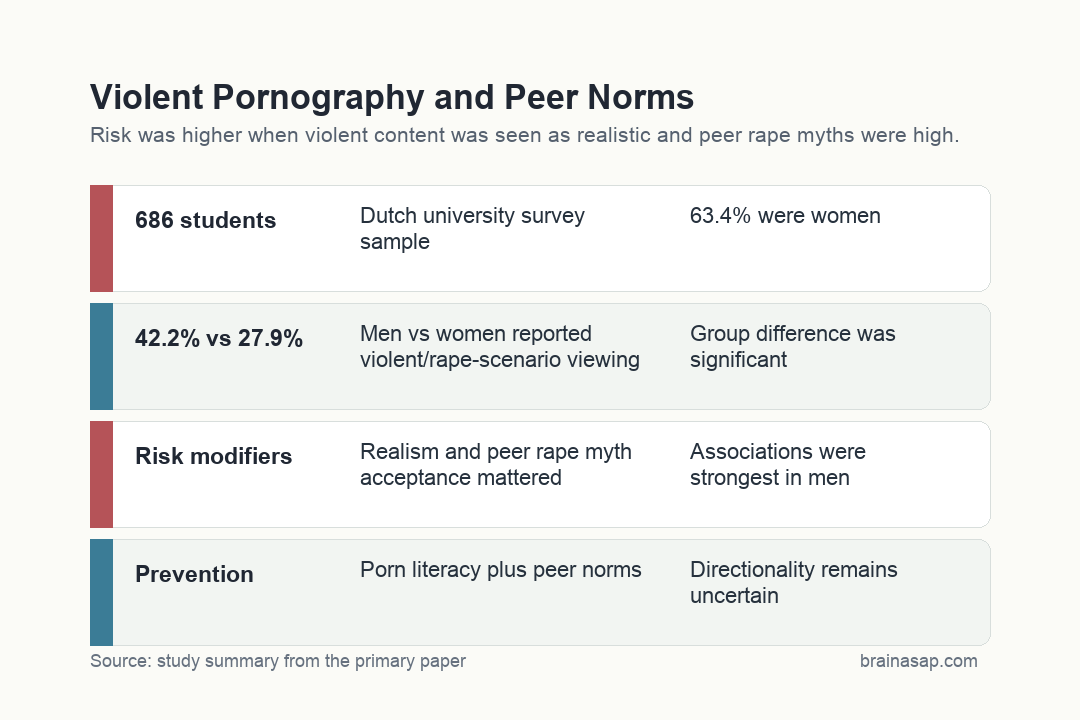
- 686 Dutch university students surveyed: The online sample was 63.4% female and measured pornography attitudes, violent-content exposure, peer rape myth acceptance, and self-reported sexual violence perpetration.
- Men reported more violent-content exposure: Violent sex or rape-scenario pornography was reported by 42.2% of men and 27.9% of women.
- Peer rape myth acceptance differed by gender: Men scored higher on perceived peer rape myth acceptance than women, with means of 36.81 vs 24.13.
- Violent pornography predicted risk most clearly in men: For male students, viewing violent pornography increased the risk of self-reported sexual violence perpetration.
- Realism strengthened the risk pattern: Violent pornography exposure was more strongly tied to perpetration risk when pornography was perceived as realistic.
- Peer norms mattered for both genders: Among women, the violent-pornography association emerged when peer rape myth acceptance was high.
Source: Archives of Sexual Behavior (2025) | de Roos and Ferrando
Violent pornography is often studied through sexual script theory, the idea that media, peers, and personal experience shape expectations about sexual situations.
This study tested a more specific question: whether violent pornography exposure was tied to sexual aggression risk differently depending on perceived realism and peer rape myth acceptance.
686 Students Reported Pornography Use, Peer Norms, and Sexual Aggression
The researchers surveyed university students in the Netherlands. The sample included 686 participants, and 63.4% were women.
The measures covered several connected domains:
- Pornography exposure: Frequency, weekly time, and specific content genres.
- Violent content: Whether participants viewed violent sex or rape-scenario pornography.
- Perceived realism: Whether pornography was seen as realistic.
- Peer rape myth acceptance: Whether participants perceived peers as endorsing myths that excuse or minimize sexual violence.
- Sexual violence perpetration: A self-report measure treated as dichotomous in the analysis.
The design is observational, so it cannot prove that pornography exposure caused aggression. It can show which combinations of media exposure and social beliefs were tied to higher reported risk.
Rape myth acceptance (RMA) refers to beliefs that excuse, minimize, or misrepresent sexual violence. In this study, the peer version asked whether participants perceived those beliefs as accepted by people around them.
The peer measure is different from asking only what one person believes privately. It captures the social climate students think they are living in, which can affect what behavior feels normalized, excused, or challenged.
Prevention work needs that distinction because people can misread peer norms. If students overestimate how much their peers accept coercive myths, then peer-norm correction can reduce permission for harmful behavior.
Men Reported More Pornography Use and Higher Peer Rape Myth Acceptance
Men reported more frequent pornography use, more diverse pornography content, and higher perceived peer rape myth acceptance than women.
For violent sex or rape-scenario pornography, the reported viewing rate was 42.2% in men and 27.9% in women. Men also rated pornography as more realistic, with mean realism scores of 2.53 vs 1.80.
Peer rape myth acceptance showed a large gender difference too. Men averaged 36.81, while women averaged 24.13.
Those descriptive differences set up the main model. The analysis was not just about exposure; it was about exposure interacting with beliefs and peer norms.
The content differences also show why genre-level measurement matters. Counting only total pornography frequency would miss whether a student is viewing violent or coercive scenarios, which can carry different scripts than nonviolent material.
The survey separated exposure type, perceived realism, and peer norms so the analysis could test a more specific risk pathway.
Realism and Peer Rape Myth Acceptance Changed the Risk Pattern
The key statistical feature was moderation. Violent pornography was not treated as a single-risk exposure operating the same way for everyone.
For male students, viewing violent pornography increased self-reported sexual violence perpetration risk. The exposure-risk pattern grew stronger when pornography was perceived as realistic and when peer rape myth acceptance was high.
For female students, the researchers did not find the same broad association. Violent pornography exposure was tied to perpetration risk when peer rape myth acceptance was high, suggesting social norms still changed how exposure related to behavior.
The moderation pattern fits a peer-norms model. Violent sexual scripts may be more harmful when they are treated as realistic and socially acceptable.
Perceived realism is important in that model because a viewer may treat violent content as entertainment, fantasy, instruction, or a reflection of what partners are expected to want. The study suggests the risk pattern changes when the content is read as closer to real sexual behavior.
Peer rape myth acceptance adds a second layer. If a peer group is perceived as minimizing coercion, then violent scripts may meet less internal or social resistance.
Porn Literacy Alone Is Too Narrow
The prevention implication is more specific than “pornography is bad.” The study points to realism beliefs and peer norms as intervention targets.
Potential prevention work would include:
- Porn literacy: Teaching that commercial pornography is scripted media, not a reliable guide to consent, pleasure, or real sexual behavior.
- Peer-norm correction: Reducing the belief that peers accept rape myths or excuse sexual coercion.
- Consent education: Making coercion, pressure, and violence explicit rather than treating them as ambiguous sexual scripts.
- Gender-inclusive prevention: Addressing men and women, since peer norms changed associations across the sample.
The peer-norm component is important because people may be more likely to act on a script when they think their social group accepts it.
The prevention target is therefore not only individual media literacy. A student may understand that pornography is scripted and still be influenced by a peer group that treats coercive myths as normal.
Changing the perceived peer climate gives prevention programs a second lever: make it clear that coercion, pressure, and rape myths are not socially accepted norms.
Directionality Remains the Main Limitation
The study’s strongest caution is causality. Because the survey was cross-sectional, it cannot establish whether violent pornography exposure led to aggression risk, whether people already interested in violent sex sought violent content, or whether both processes occurred.
The sexual perpetration measure was also dichotomous, which means the analysis could not model severity in detail.
The study focused on traditional audiovisual pornography. Other sexual media, including erotic literature and social-media sexual content, may involve different scripts and different audiences.
The sample was also university-based, so the findings should not be generalized automatically to adolescents, older adults, nonstudent populations, or people outside the Dutch context.
Even with those limits, the study helps separate three ideas that are often collapsed: exposure to violent content, belief that the content is realistic, and belief that peers excuse sexual violence.
The Safer Interpretation Is a Script-plus-Norms Model
The data support a script-plus-norms reading. Violent pornography exposure was more concerning when viewers saw the content as realistic and when they perceived peers as accepting rape myths.
This interpretation avoids overstating causality while still taking the risk pattern seriously. Prevention should target both media interpretation and peer norms, because the combination appears to matter more than exposure alone.
Citation: DOI: 10.1007/s10508-025-03199-y; de Roos and Ferrando, moderating effects on the link between violent pornography and sexual aggression, Archives of Sexual Behavior 2025;54:2671-2684.
Study Design: Cross-sectional online survey of pornography use, perceived realism, peer rape myth acceptance, and self-reported sexual violence perpetration.
Sample Size: 686 university students in the Netherlands; 63.4% female.
Key Statistic: Violent sex or rape-scenario pornography was reported by 42.2% of men and 27.9% of women; high realism and peer rape myth acceptance strengthened risk associations.
Caveat: Cross-sectional self-report design cannot establish causality or direction of effects.