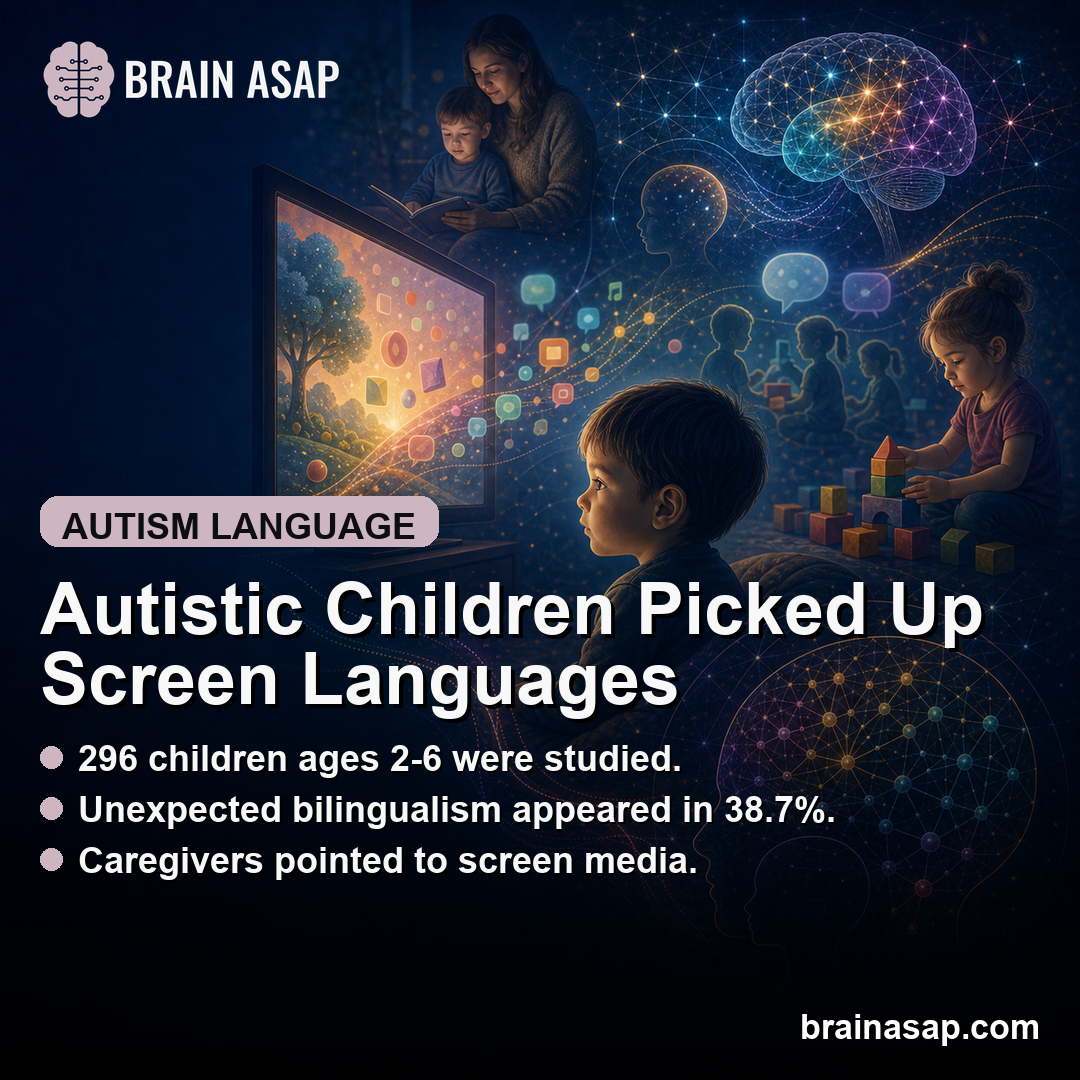
TL;DR: A 2026 study in the Journal of Child Psychology and Psychiatry found unexpected bilingualism in 38.7% of autistic children aged 2-6, about 4.4 times the rate in typically developing peers, with caregivers reporting screen media as the usual source.
Key Findings
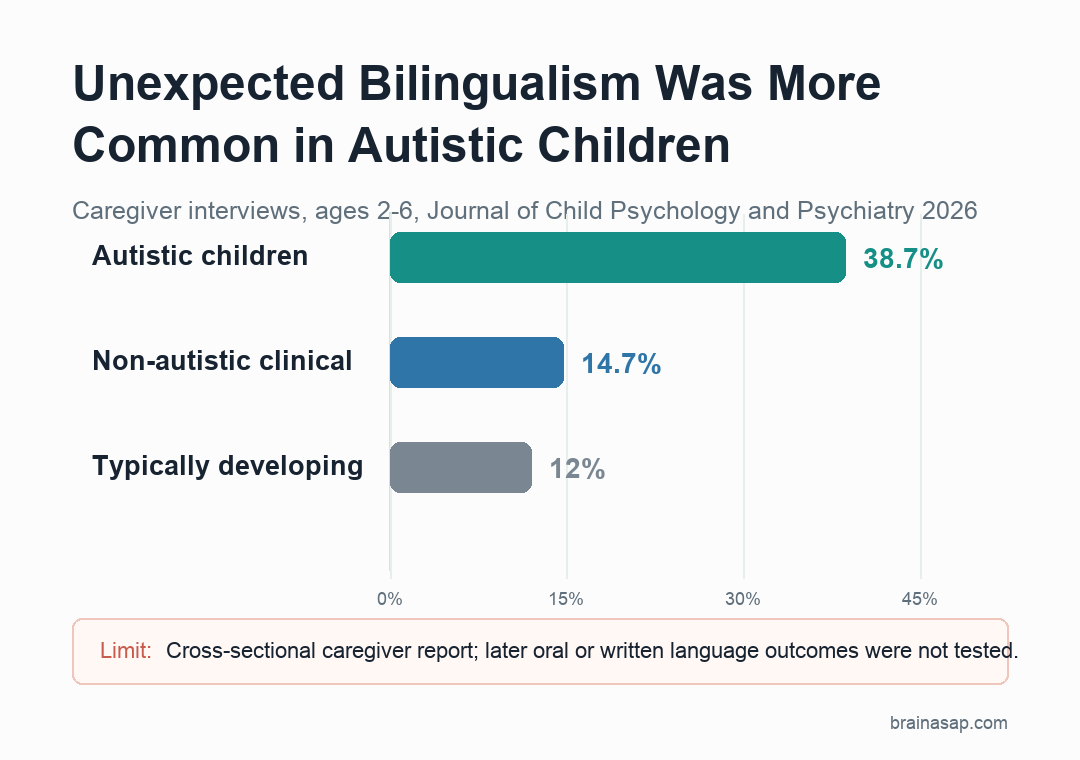
- 38.7% of autistic children showed unexpected bilingualism: Using a language absent from the child’s social environment was reported in 38.7% of 119 autistic children, versus 14.7% of 102 non-autistic clinical-comparison children and 12% of 75 typically developing children.
- 4.38× the odds versus typically developing peers: Autistic children were 4.38 times more likely than typically developing children to display unexpected bilingualism.
- 8.28× more likely to use English specifically: The cohort lived in a predominantly French-speaking part of Canada, and English was the most common unexpected language. Autistic children were 8.28 times more likely than typically developing peers to use English, even after the analysis accounted for the small amount of English exposure some children had received from people in their lives.
- Screens, not people, were the reported source: Caregivers reported that the unexpected language was acquired exclusively through non-interactive media — online videos, television, and tablet games — with some children actively requesting cartoons in a foreign language.
- Letter and number naming was the measurement anchor: 53% of the autistic sample had very limited verbal abilities, so researchers used letter- and number-naming in the unfamiliar language as a structured way to measure the skill in minimally verbal children.
Source: Journal of Child Psychology and Psychiatry (2026) | Gagnon et al.
Typical early language acquisition runs through social interaction with parents and peers.
Autistic children frequently show early speech delays and social-communication differences, which raises the issue of whether their language learning routes around the social channel and through other inputs instead.
This study tested one specific version of that issue by looking for what researchers call unexpected bilingualism: cases where a child uses a language that no one in their daily life speaks.
How Researchers Defined Unexpected Bilingualism
The researchers defined unexpected bilingualism as a child using a language that was completely absent from their social environment.
That definition is narrow on purpose. It excludes:
- Standard bilingual households: Where one or both parents speak the second language regularly.
- Daycare or community exposure: Where a peer or teacher provides routine social input in the language.
- Bilingual programs: Where the language is part of an instructional setting.
What remains is a child speaking, naming, or labeling in a language their environment does not provide socially.
That isolates the non-social acquisition route, which is the route the researchers wanted to test.
296 Canadian Children Aged 2 to 6 Across Autistic, Clinical, and Typical Groups
The cohort was 296 children aged 2–6 living in a defined Canadian geographic area:
- 119 autistic children
- 102 non-autistic children with other clinical diagnoses (including attention-deficit/hyperactivity disorder), serving as a clinical-comparison group
- 75 typically developing children
Researchers conducted detailed telephone interviews with caregivers about each child’s daily language use, interests, languages spoken at home and in daycare, and use of non-interactive media — television, computers, tablets, and mobile phones.
Letter- and number-naming in the unfamiliar language served as a structured way to measure the skill in children who barely spoke. About 53% of the autistic sample had very limited verbal abilities.
Autistic Children Showed Unexpected Bilingualism at Roughly Triple the Rate of Peers
The headline rates from the three groups:
- Autistic children: 38.7%
- Non-autistic clinical group: 14.7%
- Typically developing children: 12%
The gap between the autistic group and either comparison group is large enough to suggest an autism-specific learning route rather than a generic clinical-population effect.
Statistical analysis put the odds-ratio at 4.38 for the autistic-versus-typically-developing comparison.
The cohort lived in a predominantly French-speaking part of Canada, and English was the most common unexpected language.
Autistic children were 8.28 times more likely than typically developing peers to use English, even after the analysis accounted for the small amount of English exposure some children had received from people in their lives.
Caregivers Reported Screen Media as the Source, Not People
Caregivers reported that the children picked up the unfamiliar language entirely from non-interactive media rather than from any human source.
The reported sources were:
- Online videos: YouTube was the most commonly named platform.
- Television: Cartoons and children’s programming, sometimes specifically requested in a foreign language.
- Tablet games: Apps and interactive software where audio was in the unfamiliar language.
Some autistic children actively sought out the foreign-language version of media — for example, requesting cartoons only in English when their household spoke French.
That self-directed behavior is important because it suggests the children were not passively absorbing whatever was on. They were actively choosing content in the unfamiliar language.
Screen-Time Guidance Needs Autism-Specific Evidence
The dominant clinical message about screen time in early childhood is that it should be minimized, especially before age two.
The Gagnon results do not overturn that message, but they do complicate it for one specific population.
The implication is “lateral tutorship in autism intervention,” meaning self-directed learning supported by carefully chosen media — distinct from the interactive-rewards model used in Applied Behavior Analysis (ABA).
Mottron specifically pre-empted three misreadings of the result:
- Screen media is not a blanket recommendation: Regulated access to specific kinds of media may support language learning for some autistic children, but the study does not support long unstructured screen time.
- Not all autistic children are “genius learners”: Unexpected bilingualism showed up in ~39% of the autistic sample. This is a population pattern, not an individual prediction.
- This does not validate facilitated communication: The discredited practice of physically guiding a nonverbal person’s hand to type messages is not supported by these findings.
Long-Term Outcomes and Cognitive Mechanism Stay Open
- Caregiver-reported exposure: Researchers relied on caregiver memory to estimate how much social exposure to the unfamiliar language each child had received from people in their lives. That introduces recall and reporting error.
- Cross-sectional design with no follow-up past age six: The cohort was not followed past age six, so whether early unexpected bilingualism supports later oral or written language acquisition is an unresolved issue the team plans to address in follow-up work.
- Geographic context: The cohort lived in a specific Canadian region where French is the dominant social language and English-language media is widely available. The 8.28× English finding may not transfer to populations with different media ecosystems.
- Mechanism unconfirmed: The non-interactive-media-as-source finding is reported by caregivers; the underlying cognitive mechanism — why this learning route is more accessible to some autistic children — is not directly tested.
- Heterogeneity within autism: ~39% showed unexpected bilingualism; ~61% did not. The next research step is identifying which autistic profiles benefit most from this learning route.
Clinical takeaway: self-directed foreign-language media may be a learning channel for some autistic children, but the clinical interpretation should stay narrow:
- Self-directed media interest in autistic children should be assessed, not blocked by default: If an autistic child is repeatedly seeking out content in an unfamiliar language, that may be a usable language-learning channel rather than a problem behavior.
- Letter- and number-focused interest is a measurement opportunity: For minimally verbal autistic children, naming letters and numbers in any language can serve as a structured probe of language skill that less-verbal kids can engage with.
- Lateral tutorship is a research direction, not an intervention recommendation yet: The study team describes a future “recommendation system” that would subtly orient autistic children toward literacy-supporting media, but this has not been built or tested.
- Screen-time guidance benefits from population-specific calibration: Generic limits may miss that some autistic children are using non-interactive media as their primary language-acquisition channel during the speech-onset-delay window.
Citation: DOI: 10.1111/jcpp.70032. Gagnon D, Ostrolenk A, Mottron L. Early manifestations of unexpected bilingualism in minimally verbal autism. Journal of Child Psychology and Psychiatry. 2026
Study Design: Cross-sectional caregiver-interview study comparing unexpected bilingualism (use of a language absent from the child’s social environment) across three diagnostic groups in a defined Canadian geographic area.
Sample Size: N=296 children aged 2–6: 119 autistic, 102 non-autistic clinical-comparison (including ADHD), 75 typically developing.
Key Statistic: Unexpected bilingualism in 38.7% of autistic children vs 14.7% (clinical comparison) and 12% (typically developing); odds-ratio 4.38× vs typically developing peers; 8.28× for English use specifically after accounting for the small amount of social English exposure some children had received. Caregivers reported non-interactive media as the exclusive source.
Caveat: Caregiver-reported exposure (subject to recall error); cross-sectional with follow-up not yet conducted past age six; geographic specificity (predominantly French-speaking Canada with English media access); cognitive mechanism not directly tested.