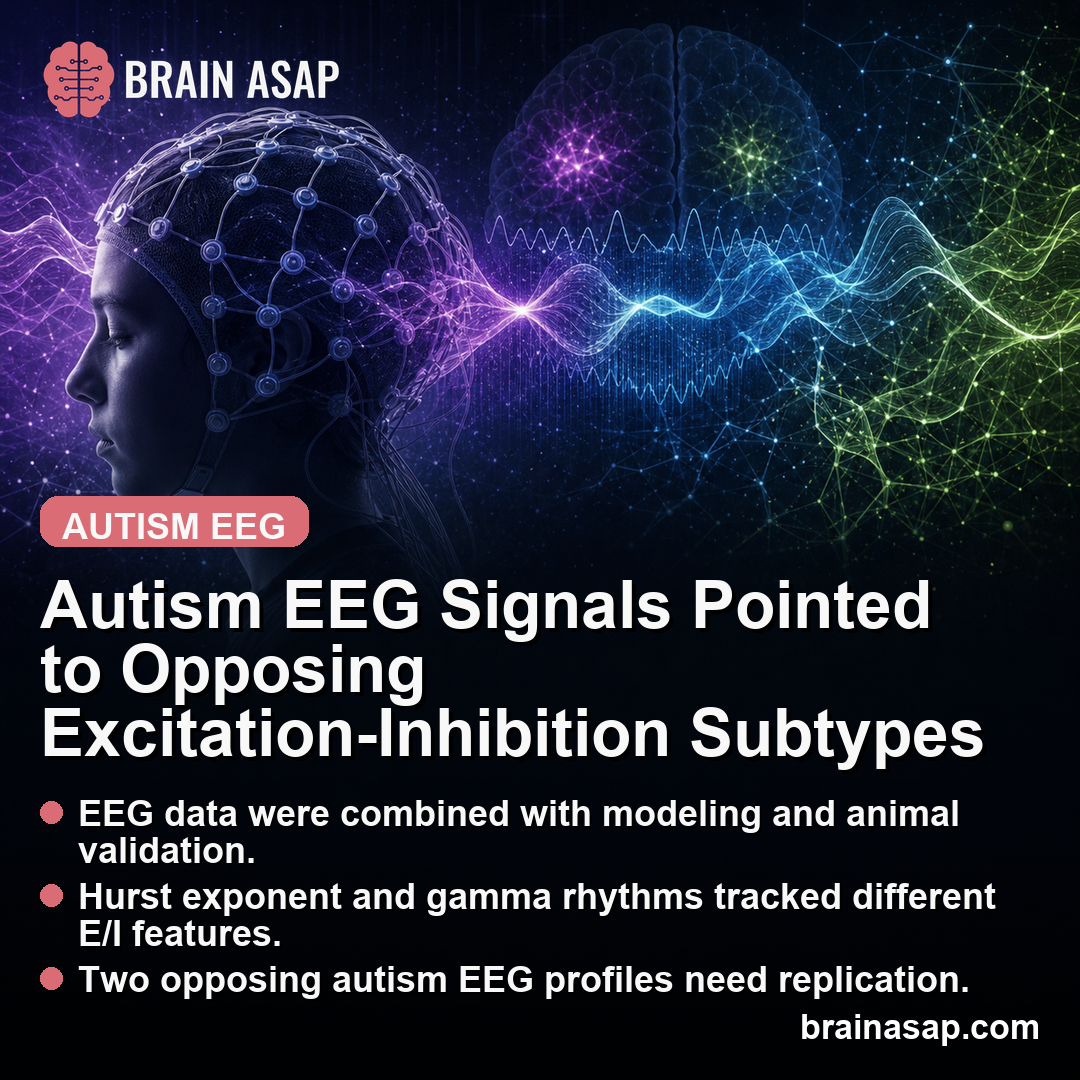
TL;DR: A 2026 preprint electrophysiology study in medRxiv found that the Hurst exponent and gamma oscillations tracked different aspects of excitation-inhibition balance, while human EEG data suggested two autism neurosubtypes with opposing Hurst-gamma profiles.
Key Findings
- Study type: an in-silico, animal-validation, and human EEG study of excitation-inhibition balance in autism.
- Human EEG dataset: human electroencephalography (EEG) data were interpreted alongside modeling and animal validation.
- Main result: The Hurst exponent and gamma oscillations tracked different aspects of excitation-inhibition balance.
- Second result: Human EEG data suggested two autism neurosubtypes with opposing Hurst-gamma profiles.
- Caution: The subtype model needs independent replication before it can guide clinical classification.
Source: medRxiv (2026) | Bertelsen et al.
Excitation-inhibition balance is a major autism neuroscience theory, but translating it to non-invasive human measurement has been difficult.
This preprint links computational modeling, animal validation, and electroencephalography, or EEG, a scalp measure of electrical brain activity, to define possible autism neurosubtypes.
The central claim is that EEG features may separate autism subgroups: Hurst exponent and gamma oscillations tracked different aspects of excitation-inhibition balance. The finding is about biological heterogeneity, not a clinic-ready autism test.
EEG Features Were Mapped to Excitation-Inhibition Biology
Design: an in-silico, animal-validation, and human EEG study of excitation-inhibition balance in autism. Sample Size: human electroencephalography (EEG) data combined with modeling and animal validation.
The study linked electrophysiology to excitation-inhibition biology, then asked whether human EEG profiles separated into meaningful subtypes. This design is important because autism is not one uniform neural pattern.
- Hurst exponent: The fractal feature was linked to single-neuron excitability.
- Gamma power: Gamma oscillations were linked to the excitation-to-inhibition conductance ratio.
- Human EEG: The study applied those features to autism data.
- Behavior: Subtype profiles differed in large-scale brain-behavior relationships.
Hurst and Gamma Captured Different Neural Signals
The main result separates two EEG features instead of collapsing them into one biomarker. Hurst exponent and gamma oscillations tracked different excitation-inhibition features, which gives the subtype model a biological rationale.
The human EEG analysis then suggested two autism neurosubtypes with opposing Hurst-gamma profiles. That part becomes clinically relevant only after independent replication.
The subtype claim rests on the direction of the two EEG features. One profile suggested a different excitation-inhibition state than the other, so averaging every autistic participant into one group could flatten biologically opposite patterns.
This is a heterogeneity finding rather than a diagnostic claim. The evidence points to a possible way of separating autism biology into EEG-defined groups, but it does not yet tell clinicians how to classify an individual patient.
The model has value because Hurst and gamma are not redundant measurements. Hurst captures scale-free structure in the EEG trace, while gamma power reflects faster oscillatory activity linked to local excitation-inhibition dynamics.
If those two features move in different directions across participants, a single average autism EEG profile can become misleading. Opposite profiles can cancel each other out and make the group look less biologically structured than it is.
The clinical relevance depends on whether the subtypes connect to stable traits. Language, cognition, sensory features, adaptive function, and treatment response would all need to be tested against the EEG groups before the categories have practical value.
- Measurement anchor: Hurst and gamma captured different aspects of excitation-inhibition balance.
- Subtype pattern: Human EEG data suggested two opposing Hurst-gamma profiles.
- Clinical boundary: Independent cohorts must reproduce the pattern before it can guide assessment or treatment studies.
Two Autism Neurosubtypes Had Opposing EEG Profiles
EEG is attractive because it is relatively accessible, but it is also noisy and sensitive to analysis choices. A subtype model has to survive different samples, recording systems, and preprocessing pipelines.
The cleaner read is that autism EEG profiles may reflect more than one excitation-inhibition pattern. The study does not prove a diagnostic classification system.
Language and cognition differences by subtype make the finding more relevant than a purely technical EEG split. Still, those clinical patterns need to be tested prospectively.
Language and Cognition Patterns Varied by Subtype
Replication limit: the subtype model needs independent replication before it can guide clinical classification.
The language and cognition pattern gives the EEG split a behavioral test. A subtype model that only separates waveforms is weaker than one that also tracks measurable clinical differences.
The EEG groups are not ready for patient labels. The stronger near-term use is research design: separate participants by the Hurst-gamma profile, then test whether the groups differ in development, adaptive function, sensory features, medication response, or longitudinal outcomes.
That kind of follow-up would show whether the EEG split marks a stable biological subgroup or a sample-specific pattern.
Even so, the direction of interpretation should stay conservative. EEG can help define research groups, but autism diagnosis still depends on developmental history, behavior, function, and clinical assessment.
- Preprint status: The findings require peer review.
- Subtype stability: Groups need replication in independent samples.
- EEG inference: Scalp features are indirect measures of cellular mechanisms.
- Clinical use: No diagnostic claim should be made from this alone.
The limitation is replication. EEG subtypes matter only if independent groups can find the same profiles and connect them to stable clinical features.
Autism E-I Subtypes Need Independent Replication
This is a subtype study, not a replacement for autism assessment.
- Best use: Use it as evidence that autism EEG findings may split in opposite biological directions.
- Do not overread: Do not treat the Hurst-gamma profiles as validated clinical labels yet.
- Next question: Replicate the same EEG subtypes in independent cohorts and test whether they predict outcomes or treatment response.
The value is specificity: autism biology may be mixed, and EEG could help separate that mixture if the pattern holds.
Citation: DOI: 10.1101/2023.11.22.23298729. Bertelsen et al. Electrophysiologically-defined excitation-inhibition autism neurosubtypes. medRxiv. 2026.
Study Design: An in-silico, animal-validation, and human EEG study of excitation-inhibition balance in autism.
Sample Size: Human electroencephalography (EEG) data combined with modeling and animal validation.
Key Statistic: The Hurst exponent and gamma oscillations tracked different aspects of excitation-inhibition balance.
Caveat: The subtype model is preprint evidence and needs independent replication before clinical use.