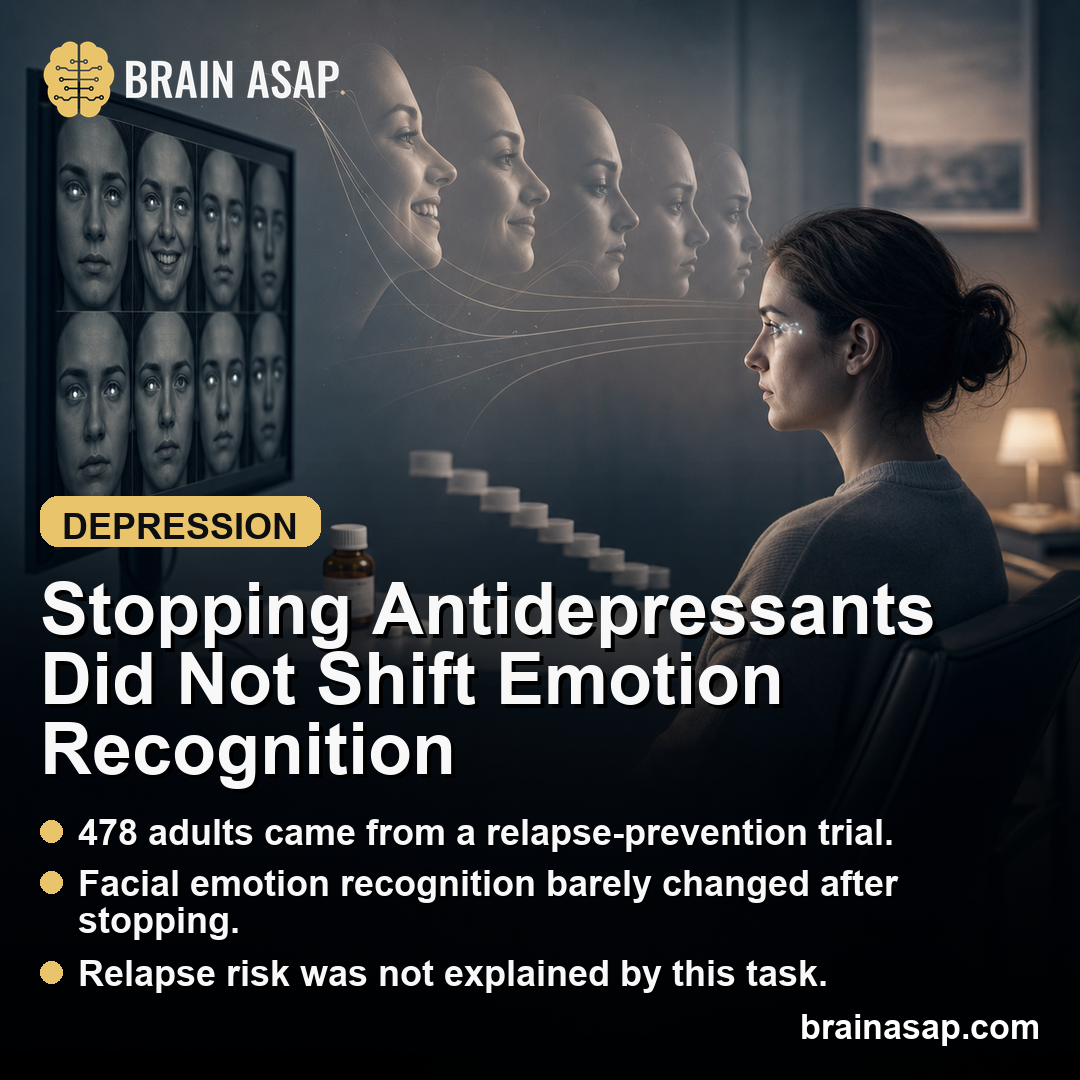
TL;DR: A 2026 study in Psychological Medicine found that stopping maintenance antidepressants did not meaningfully change facial emotion recognition over 12 or 52 weeks in adults with recurrent depression who were currently well.
Key Findings
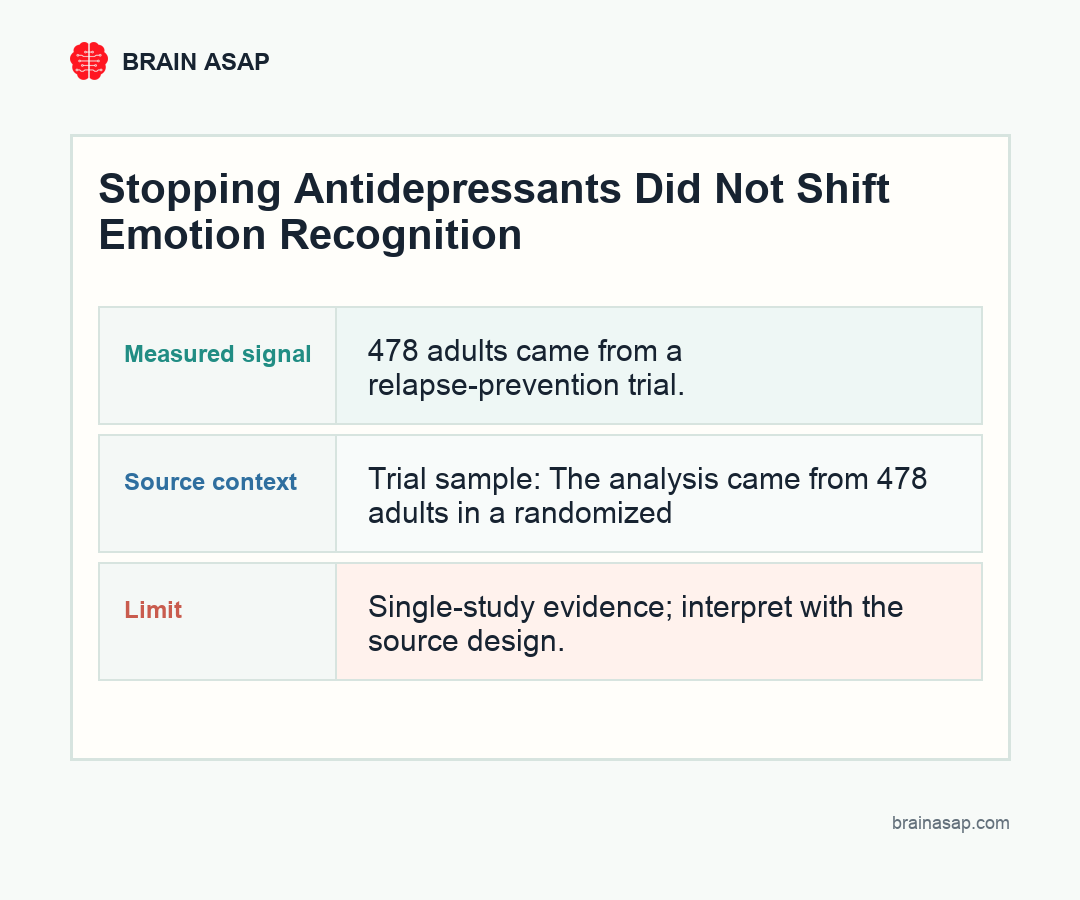
- Trial sample: The analysis came from 478 adults in a randomized antidepressant relapse-prevention trial.
- Emotion task: Participants classified morphed faces from happy to sad, producing a 0 to 45 happy-face classification score.
- No 12-week shift: Discontinuation versus maintenance differed by 0.23 happy classifications at 12 weeks, with a 95% confidence interval from -0.5 to 1.0.
- No 52-week shift: The 52-week difference was 0.29 happy classifications, with a 95% confidence interval from -0.5 to 1.2.
- Symptoms still related: Higher PHQ-9 depression-symptom scores were linked to fewer happy classifications, while GAD-7 anxiety scores were linked to more happy classifications.
Source: Psychological Medicine (2026) | McKenzie et al.
Maintenance Antidepressants Were Tested Against Placebo Substitution
Antidepressant emotional-processing theories propose that treatment can reduce negative bias before mood symptoms improve. Many laboratory studies support early changes in how emotional information is processed.
This analysis asked whether that mechanism could be detected in a larger, longer clinical setting. Participants had recurrent depression, were currently well, and were randomized either to continue maintenance antidepressants or to move through placebo substitution.
The emotion task used faces that morphed from happy to sad. The main outcome was the number of faces classified as happy, so a higher score meant participants interpreted more ambiguous faces as happy.
The analysis therefore tested a maintenance question, not the first days of treatment. Participants were not entering an acute antidepressant trial; they were stable enough to take part in a relapse-prevention study.
Happy-Face Classifications Did Not Differ at 12 or 52 Weeks
Of the randomized sample, 462 participants completed at least one facial emotion task. Discontinuing antidepressants did not change task performance compared with maintenance treatment at the two main follow-up points.
At 12 weeks, the adjusted mean difference was 0.23 happy classifications , with a 95% confidence interval from -0.5 to 1.0 and p = 0.5. At 52 weeks, the difference was 0.29 , with a 95% confidence interval from -0.5 to 1.2 and p = 0.5.
Both estimates were small relative to a 0 to 45 task scale.
- Baseline: Participants completed the facial emotion task before follow-up.
- 12 weeks: Maintenance and discontinuation groups did not differ meaningfully.
- 52 weeks: The longer follow-up also did not show a maintenance-treatment advantage.
Depression and Anxiety Scores Related to the Task in Opposite Directions
The task was not meaningless. Higher PHQ-9 depression-symptom questionnaire scores were associated with fewer happy-face classifications cross-sectionally and longitudinally.
Anxiety moved differently. Higher GAD-7 anxiety-symptom questionnaire scores were associated with more happy classifications in the reported model. That opposite direction shows why emotional-processing measures need careful clinical interpretation.
Depression severity may bias ambiguous faces toward less positive interpretation. Anxiety may affect task strategy or threat monitoring in a different way.
The trial result does not erase those symptom links. Maintenance treatment assignment did not explain them.
The symptom associations also help validate the task as psychologically relevant. A null group difference is more informative when the same task still tracks meaningful symptom variation inside the sample.
Laboratory Emotional-Bias Findings Did Not Generalize Cleanly
Short-term laboratory studies often detect antidepressant-related shifts in emotional processing. This long-term relapse-prevention sample tested a different question: whether maintaining medication sustains a positive facial-emotion bias in adults who are already well.
For this task, maintenance treatment did not produce more happy classifications than discontinuation at 12 or 52 weeks, even though symptom severity related to the same outcome.
One interpretation is that early emotional-processing effects may be time-limited, task-specific, or harder to detect after remission. Another possibility is that facial emotion recognition is not the right marker for long-term maintenance mechanisms.
Those possibilities lead to different research plans. Time-limited effects call for earlier measurement, while task-specific effects call for broader emotional-learning and decision-making assays.
Another possibility is patient heterogeneity. Some adults may show measurable emotional-processing shifts from medication, while a broad remission sample may dilute smaller subgroup effects.
Relapse Prevention Still Requires Outcomes Beyond Face Tasks
The clinical decision about antidepressant maintenance depends on relapse risk, side effects, previous illness course, patient preference, and withdrawal concerns. A facial emotion task cannot replace those outcomes.
The study narrows one mechanistic claim. If maintenance antidepressants prevent relapse for some patients, this analysis did not support sustained positive facial-emotion bias as the detectable explanation.
Future work can test other emotional-processing tasks, earlier post-discontinuation time points, and subgroup differences. The present data are strongest as a correction to an overly simple mechanism: long-term maintenance treatment did not keep happy-face classifications higher.
Clinical interpretation should stay anchored to relapse outcomes. A patient could benefit from maintenance treatment for reasons that this facial-emotion task does not measure.
Other relapse-prevention mechanisms could include:
- Sleep stability: fewer mood-destabilizing sleep disruptions.
- Reduced rumination: less repetitive negative thought under stress.
- Reward learning: changes in motivation or reinforcement that a facial-emotion task would not capture.
None of those mechanisms would necessarily change how many morphed faces a participant labels as happy.
The negative facial-task result is therefore a boundary around one mechanism, not a general verdict on antidepressant maintenance for recurrent depression or individualized relapse prevention.
For clinicians, the trial argues against using this specific face task as a stand-alone maintenance biomarker in practice.
Citation: DOI: 10.1017/S0033291726104000. McKenzie et al. Do antidepressants change our interpretations of facial emotions? Psychological Medicine. 2026
Study Design: Mechanistic analysis within a randomized antidepressant relapse-prevention trial comparing maintenance treatment with placebo substitution.
Sample Size: 478 randomized adults with recurrent depression who were currently well; 462 completed at least one emotion task.
Key Statistic: Group differences in happy-face classifications were 0.23 at 12 weeks and 0.29 at 52 weeks, both with p = 0.5.
Caveat: The task indexes one form of emotional processing and may not capture other mechanisms of relapse prevention.