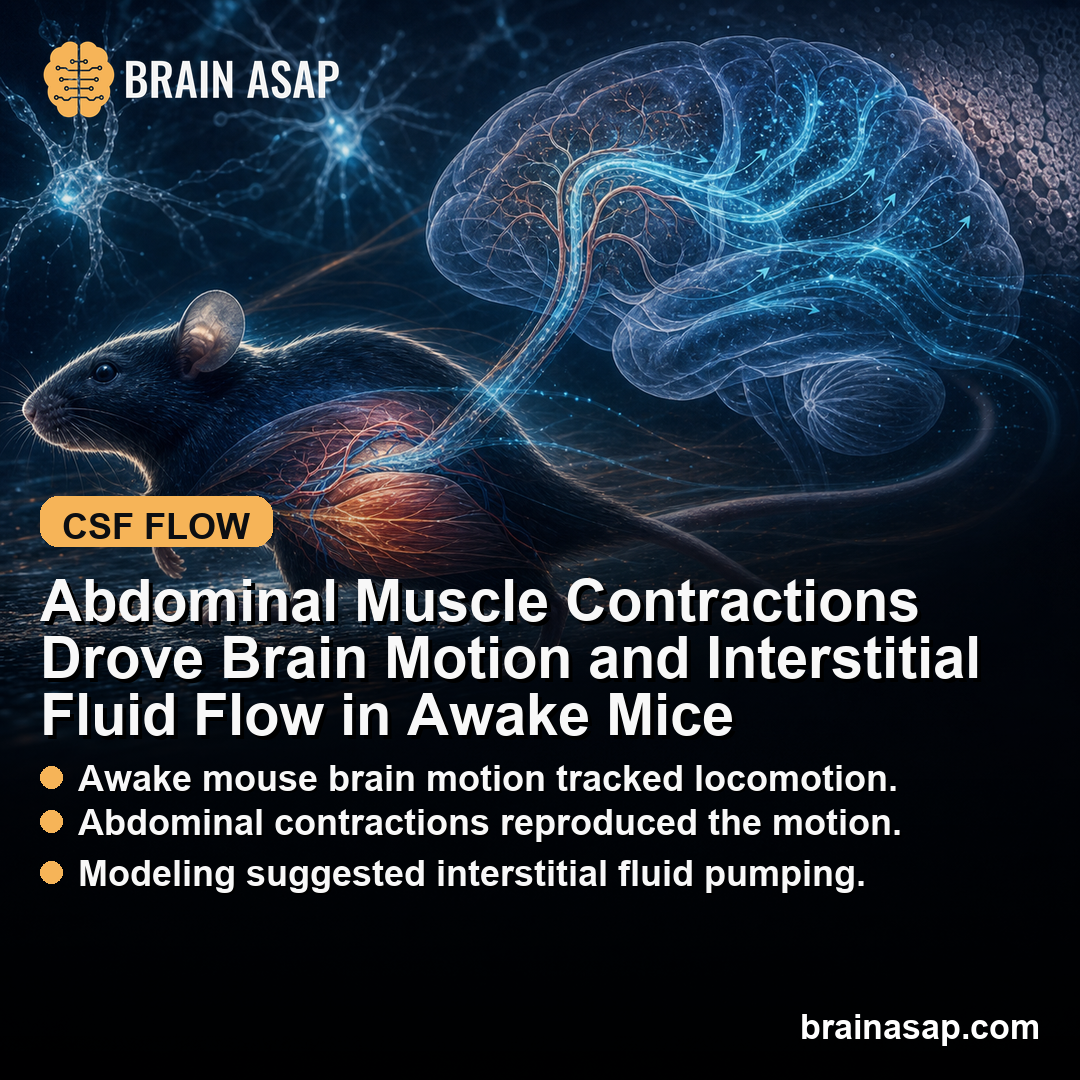
TL;DR: A 2026 mouse study in Nature Neuroscience found that abdominal muscle contractions during locomotion drove directed brain motion and helped move interstitial fluid through brain tissue during wakefulness.
Key Findings
- Brain motion was tightly coupled to locomotion, not heartbeat or breathing: Two-photon imaging in awake head-fixed mice showed dorsal cortex shifted relative to skull — and the motion correlated with locomotion much more strongly than with cardiac or respiratory cycles.
- Abdominal muscles drove the motion through a hydraulic vascular link: Abdominal muscle contractions during locomotion, transmitted via a vascular hydraulic-like connection between the abdominal cavity and the central nervous system, produced the brain motion. Direct pressure applied to the mouse’s abdomen reproduced the same brain motion in the absence of locomotion.
- Direction was rostral and lateral: The brain didn’t move randomly — motion was directed primarily forward (rostral) and sideways (lateral), suggesting a structured biomechanical pathway rather than random jiggling.
- Modeling suggests fluid is being pumped through the brain: Computational simulations suggest brain motion drives interstitial fluid through brain tissue and out into the subarachnoid space — in the opposite direction of fluid flow during sleep.
- Possible wakefulness counterpart to glymphatic clearance: If sleep clears waste through one fluid-flow direction, this awake-locomotion-driven motion appears to serve as a different waste-clearance mode operating during active behavior.
- Brain mechanically linked to abdominal compartment: The CNS is hydraulically continuous with the abdominal cavity through vascular structures, making body movement a direct mechanical input to brain physiology.
Source: Nature Neuroscience (2026) | Garborg et al.
The standard mental model of brain mechanics is that the brain sits cushioned in cerebrospinal fluid (CSF) inside a rigid skull, with motion driven by heartbeat-related vascular pulsation and breath-related intracranial pressure changes.
The Garborg study revised that model by identifying a stronger mechanical driver in the abdomen.
The Question That Started This: Why Does the Brain Move at All?
The brain is anchored inside the skull but not rigidly fixed. It floats in CSF, suspended by the meninges, and small relative motions occur during ordinary activities.
Most prior accounts have attributed this motion to:
- Cardiac pulsation — each heartbeat sends a pressure wave through cerebral vessels.
- Respiratory cycles — breathing changes intracranial pressure rhythmically.
- Posture and gravity — head position shifts gross brain location within the skull.
The Garborg team built a setup to test which of these drove brain motion in awake, behaving mice — and found a different answer than standard accounts predict.
The High-Speed Two-Photon Setup That Made the Measurement Possible
Measuring small brain motions in awake animals is technically demanding. The team used multiplane two-photon microscopy, with enough speed to separate locomotion, cardiac, and respiratory cycles.
Researchers then tracked motion of the dorsal cortex relative to the skull in awake head-fixed mice during running and rest.
Direction of motion turned out to be primarily rostral (forward) and lateral (sideways) — not random. The structured directionality immediately suggested the motion isn’t passive jiggling but follows specific biomechanical pathways.
Why “Abdominal Muscles, Not Heart or Lungs” Was the Surprise
When the team correlated brain motion with cardiac, respiratory, and locomotor signals, the locomotor correlation dominated.
Heart-related and breath-related motion was real but small. The dominant driver was something tied to body movement itself.
To isolate the mechanism, the team applied direct pressure to the mouse’s abdomen in the absence of locomotion.
The same brain motion appeared.
The abdominal compartment was the mechanical input — not as an indirect consequence of running, but directly, through pressure transmission.
The route is anatomical: a hydraulic-like vascular connection between the abdominal cavity and the central nervous system. Abdominal muscle contractions during locomotion (or external pressure mimicking them) compress this vascular pathway, sending pressure waves up to the brain that produce the directed rostral-lateral motion.
Locomotion May Move Brain Fluid During Wakefulness
Glymphatic clearance — the brain’s waste-removal system that uses CSF flow to flush metabolic byproducts — is known to operate predominantly during sleep. The flow direction during glymphatic clearance is one specific way: CSF flowing through perivascular spaces, through interstitial brain tissue, and out.
The Garborg team’s modeling suggests the motion driven by abdominal muscles during locomotion drives interstitial fluid through and out of brain tissue into the subarachnoid space — in the opposite direction from sleep-time glymphatic flow.
That symmetry is striking.
It would mean:
- Sleep clears the brain through one mechanism in one direction.
- Active wakefulness appears to clear the brain through a different mechanism in the opposite direction.
- Movement can be functionally important for brain physiology beyond cardiovascular benefit.
- Sedentary lifestyle can compromise a brain-clearance mode that normally happens during walking, running, and routine activity.
This is hypothesis-grade — modeling rather than direct fluid-flow measurement during locomotion — but the mechanistic story is internally consistent and testable.
What Mechanical Coupling to the Abdomen Means for Brain Function
The deeper conceptual reframe is that the brain is not isolated from the body’s mechanical activity, even though the blood-brain barrier can make it seem separate.
The CNS is hydraulically continuous with the abdominal compartment through vascular structures, and ordinary body movement directly shapes brain physiology through fluid mechanics.
That has implications for several research domains:
- Exercise neuroscience: Beyond cardiovascular and growth-factor effects, movement can drive brain fluid dynamics in ways relevant to cognitive function and waste clearance.
- Spaceflight neuroscience: Microgravity changes abdominal mechanics; this mechanism can help explain some brain-related findings in long-duration spaceflight.
- Disorders of CSF and intracranial pressure: Conditions like idiopathic intracranial hypertension or normal pressure hydrocephalus have an underexplored abdominal-compartment dimension.
- Sedentary lifestyle and dementia risk: If movement-driven brain clearance is a real wakefulness function, prolonged sedentary states can compromise more than cardiovascular health.
The Honest Limits of This Mouse Study
- Mouse anatomy isn’t human anatomy. The hydraulic vascular link between abdominal cavity and CNS can exist in different proportions or routes in humans. Translation needs human imaging studies.
- Modeling doesn’t equal measurement. The interstitial-fluid flow direction during locomotion comes from computational simulation, not direct measurement. Direct in vivo flow imaging during movement is the next experiment.
- Head-fixed running isn’t normal locomotion. The setup constrains some kinds of body movement; whether the same mechanism scales to free-moving behavior needs validation.
- Functional consequences are hypothesized, not demonstrated. The paper proposes brain clearance as a function for the observed motion, but doesn’t directly show that interstitial fluid clearance changes with locomotion in ways that affect tissue health.
Practical implication: the discovery that brain motion is driven by abdominal muscles fits a broader pattern in modern neuroscience: the brain is far more mechanically and physiologically continuous with the rest of the body than the older brain-as-isolated-organ model suggested.
Movement, gut function, breathing, posture, and abdominal mechanics all participate in brain physiology in ways neuroscience is only beginning to map.
The Garborg study adds one specific mechanism: abdominal muscle contractions driving rostral-lateral brain motion through a hydraulic vascular link.
The implications for how exercise, sedentary behavior, and physical therapy connect to brain health are likely larger than current research practice reflects.
Citation: DOI: 10.1038/s41593-026-02279-z. Garborg et al. Brain motion is driven by mechanical coupling with the abdomen. Nature Neuroscience. 2026.
Study Design: High-speed multiplane two-photon microscopy in awake head-fixed mice tracked dorsal cortex motion relative to skull during locomotion and rest; correlated motion with cardiac, respiratory, and locomotor signals; tested abdominal pressure as a direct mechanical input; used computational simulation to model interstitial fluid flow consequences.
Sample/Model: Awake head-fixed mice — see full publication for sample sizes.
Key Statistic: Brain motion is primarily directed rostrally and laterally during locomotion, driven by abdominal muscle contractions transmitted via a hydraulic-like vascular connection between the abdominal cavity and CNS rather than by cardiac or respiratory cycles; modeling suggests this motion drives interstitial fluid clearance in the opposite direction from sleep-time glymphatic flow.
Caveat: Mouse model with head-fixed setup; interstitial fluid flow direction is from computational simulation rather than direct in vivo measurement; functional consequences of the motion-driven clearance are proposed but not demonstrated; human translation requires anatomical and imaging studies.