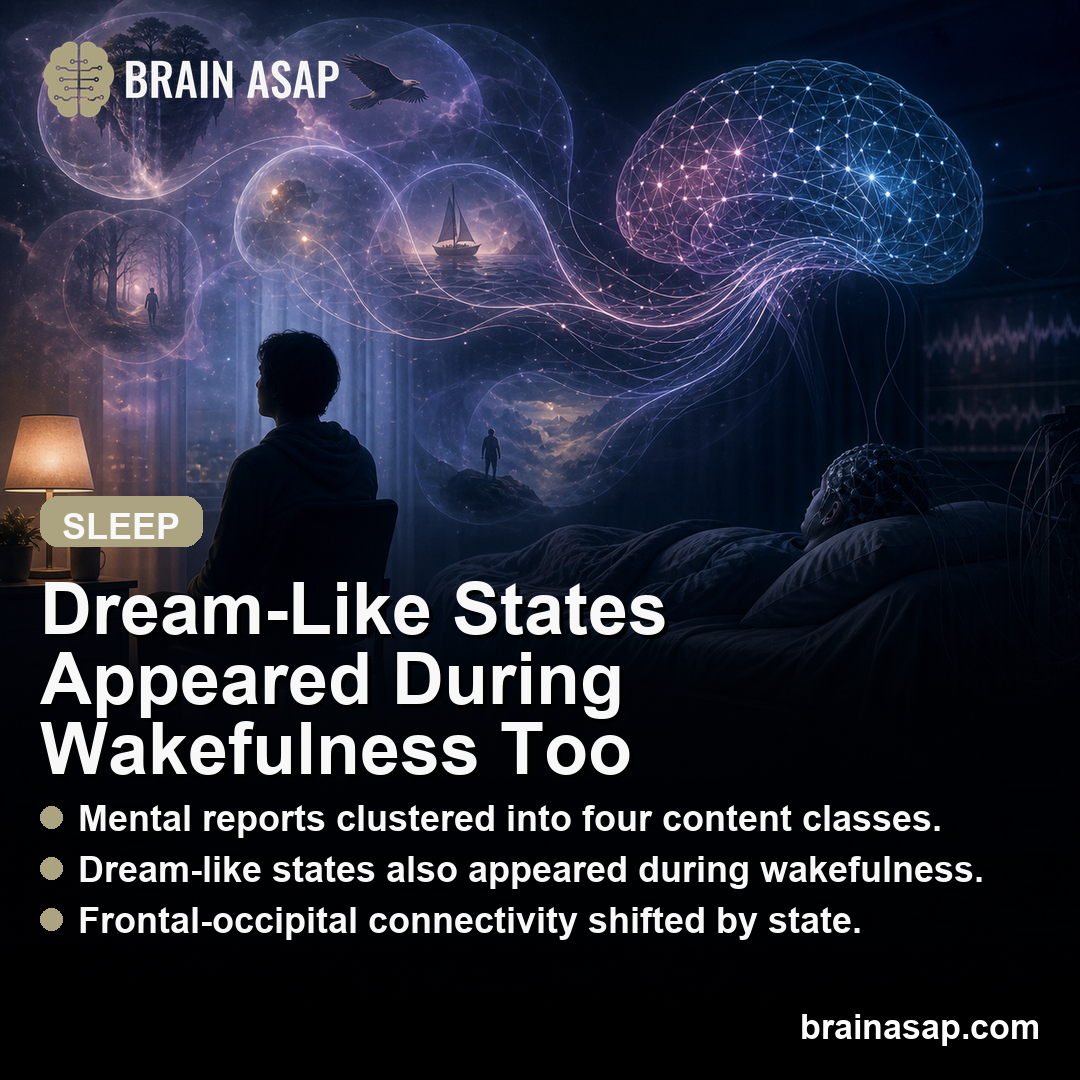
TL;DR: A 2026 study in Cell Reports used electroencephalography (EEG), a brain-wave recording method, in 92 nappers to identify four mental states across wakefulness, sleep onset, and light sleep, including a bizarre dream-like state with reduced frontal-occipital connectivity.
Key Findings
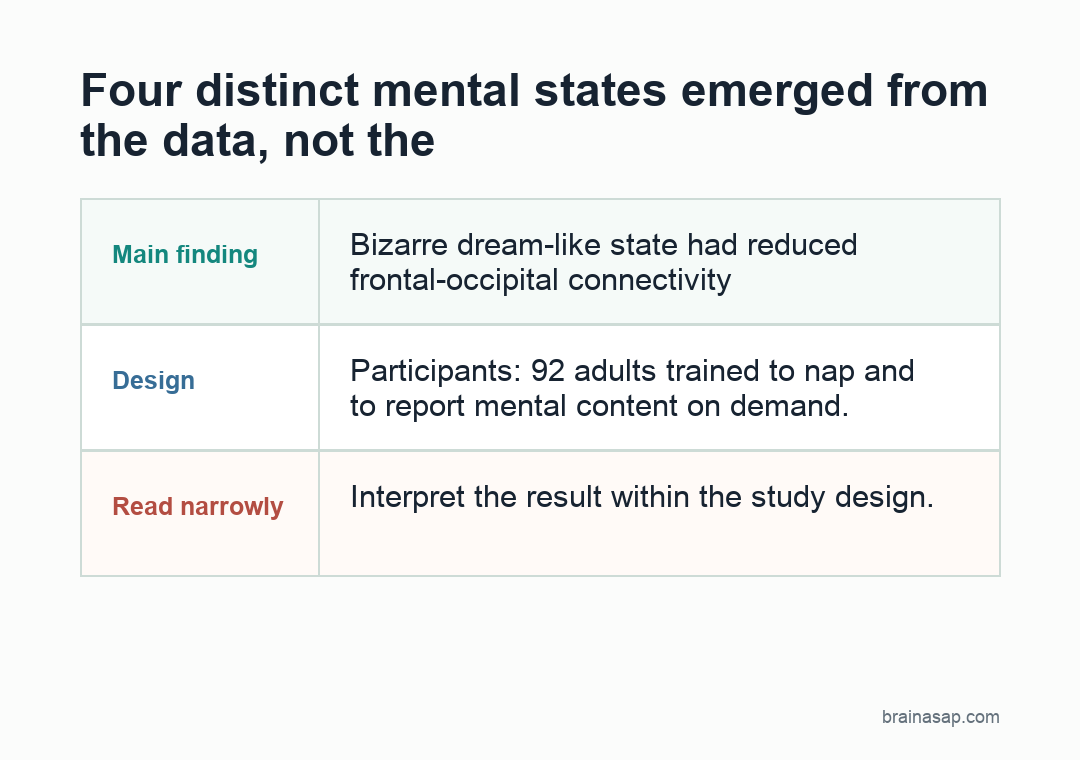
- Four distinct mental states emerged from the data, not the expected two: A clustering algorithm with no preconceived categories found four classes: fleeting recollections, environment-connected awareness, bizarre dream-like content, and high-control task-related thinking.
- All four states occurred across all three vigilance levels: The same mental-content classes appeared in wakefulness, sleep onset, and light sleep — meaning thought content does not respect the wake/sleep boundary.
- Bizarre “C3” content has a specific brain signature: Reduced long-range connectivity between frontal and occipital regions characterized the dream-like state, regardless of whether the participant was awake or asleep.
- 92 trained nappers, EEG-monitored, with Edison-inspired interruption: Participants napped while holding a bottle (or with an alarm); when interrupted, they reported the prior 10 seconds of mental content and rated bizarreness, fluidity, spontaneity, and perceived wakefulness.
- Memory bias explains why we think dreams are sleep-only: Researchers note people remember emotionally charged or meaningful dreams better, and tend to dismiss daytime dream-like flashes as mind-wandering — producing a false impression that bizarre mental content belongs to sleep.
Source: Cell Reports (2026) | Decat et al.
The conventional view treats wakefulness and sleep as physiologically distinct states with separable mental content — rational thought during the day, dreams at night.
Recent work has shown a continuum between wakefulness and sleep, with intermediate states like mind-wandering and mind-blanking. What remained open was whether the content of thought followed the same continuum or jumped discretely between waking-thought and dream categories.
This Paris Brain Institute study used a clever sleep-onset paradigm to test that question directly.
Edison-Inspired Drop-the-Bottle Setup With 92 Nappers and EEG
The Paris Brain Institute team focused on sleep onset, the transitional stage between wakefulness and sleep, because it compresses many vigilance fluctuations into a short time window.
The experimental setup borrowed from Thomas Edison’s reported habit of falling asleep in his armchair while holding a heavy object — the falling object woke him at the threshold of sleep, when his mind was full of creative ideas.
The Decat team’s modern version:
- Participants: 92 adults trained to nap and to report mental content on demand.
- Interruption mechanism: A held bottle that dropped, or an alarm.
- Self-report after each interruption: Description of the prior 10 seconds of mental experience plus four ratings — bizarreness, fluidity, spontaneity, perceived wakefulness.
- Continuous EEG: Brain activity recorded throughout, capturing complexity, spectral power, and functional connectivity.
- Analysis: Data-driven clustering with no preconceived state categories.
The data-driven choice mattered because researchers do not fully agree on how to define hypnagogic experiences. Starting with clusters reduced the risk of forcing reports into wake/sleep categories too early.
Four Mental States, Not Two
The clustering algorithm produced four classes rather than the expected wake/sleep division.
The four states:
- C1 — Fleeting recollections: “An image of my dad crossed my mind.” Brief, episodic memory-like content.
- C2 — Environment-connected: “I was listening to the street sounds.” High awareness of surrounding sensory input.
- C3 — Bizarre, dream-like: “I saw images of small aliens.” Vivid, surreal sensory imagery characteristic of dreams.
- C4 — High-control task-related: “I was thinking about what I would do tomorrow.” Voluntary, goal-directed thinking.
The four-state structure better matches the actual diversity of mental experience than the binary wake/dream model and is what made the cross-vigilance finding visible.
All Four States Appeared in All Three Vigilance Stages
The signature finding from the cross-tabulation:
- C1, C2, C3, and C4: Each appeared across wakefulness, sleep onset, and light sleep.
- Implication: Mental content does not follow the wake/sleep boundary — the type of thought one is having is independent of the vigilance state of the brain.
- Examples reported by participants: One reported seeing ants crawling on her body against a backdrop of crossword puzzles — while awake. Another mentally went through tomorrow’s schedule — while fully asleep.
The result reframes a long-standing assumption. Dream-like content is not what makes us asleep; it is one of the modes the brain can occupy regardless of vigilance level.
The Bizarre State Has a Specific Brain Signature
The team analyzed EEG complexity, spectral power, and functional connectivity to look for state-specific neurophysiological markers.
The bizarre C3 state stood out:
- Reduced long-range connectivity: Specifically between frontal and occipital regions of the brain.
- Functional interpretation: Frontal regions support lucid reasoning and executive control; occipital regions handle visual processing. Reduced communication between them can release vivid sensory imagery from the constraints of rational interpretation.
- Same signature across vigilance states: The frontal-occipital disconnection appeared whenever C3 content was reported, regardless of whether the participant was awake or in light sleep.
The interpretation is that lucid reasoning may weaken while vivid sensory imagery becomes more dominant, creating the subjective feel of a dream-like state.
Memory Bias Explains the Sleep-Only Dream Illusion
If dream-like content occurs across waking life too, why are people convinced dreams belong to night?
The team’s explanation centers on selective remembering:
- Emotionally charged dreams stick: The dreams people remember and report are usually emotionally intense or personally meaningful, biasing the cultural sample of “what a dream is.”
- Mundane dreams are forgotten: Dreaming you are at work tomorrow leaves no memory trace because it does not surprise you.
- Daytime dream-like flashes get dismissed: Quick fanciful images during waking hours are typically labeled mind-wandering or distraction and filtered out, even when they would qualify as dream-like under the C3 definition.
Together, these biases produce a false impression that bizarre mental content is sleep-specific when the data show it is not.
Small sample, self-report, and single-session design limit generalization.
- 92 participants: Reasonable for a sleep-onset experiment but not large for population-level inference.
- Trained nappers: Participants were accustomed to napping and to mental-content reporting. People who do not nap regularly or who struggle to report mental content can show different patterns.
- Self-reported mental content: The four-state taxonomy depends on participants accurately describing their own thought content, which is itself a limited cognitive task.
- Sleep-onset window only: The vigilance fluctuations were captured in the transition from wakefulness to light sleep. Whether the four-state structure extends to deeper sleep stages or to fully alert daytime activity is not directly tested here.
- Single-night design: Whether individual participants show stable mental-content patterns across multiple sessions is not addressed.
Mental-Content-Based Sleep Assessment Can Better Match Patient Experience in Insomnia
The clinical implication is concrete and immediate:
- Paradoxical insomnia is the obvious application: Patients who report unrefreshing sleep or whole-night wakefulness despite polysomnography showing apparent sleep can spend unusually long stretches in the alert hyperconnected C2 state, or unusually short stretches in the C3 dream-like state.
- Standard sleep-stage scoring can be the wrong yardstick: Conventional sleep stages are defined by EEG patterns. Mental-content scoring captures something the standard categories miss and can align better with patient experience.
- Diagnostic potential: Identifying specific mental-content distributions in patients could provide objective markers of insomnia subtypes that current scoring does not detect.
- Reframing the wake/sleep boundary: Researchers need to treat mental content as a separate axis from vigilance, rather than assuming the two co-vary.
The clinical possibility is that mental-content reports could help identify objective markers of insomnia instead of treating patient reports as secondary to standard sleep-stage labels.
Citation: DOI: 10.1016/j.celrep.2026.117237. Decat N, Oudiette D et al. Dream-like mental states can occur during wakefulness. Cell Reports. 2026.
Study Design: Sleep-onset experimental paradigm with Edison-inspired drop-the-bottle interruption; continuous EEG; data-driven clustering of self-reported mental content.
Sample Size: 92 adult participants trained to nap and to report mental content on demand.
Key Statistic: Four distinct mental-content classes emerged from clustering: fleeting recollections, environment-connected, bizarre dream-like, and high-control task-related. All four appeared across wakefulness, sleep onset, and light sleep. The bizarre dream-like state had a specific reduced frontal-occipital connectivity signature.
Caveat: Modest sample size; trained-napper participants; self-reported mental content; sleep-onset window only; single-session design limits inference about across-night stability or deeper sleep stages.