TL;DR: A 2026 study in Journal of Pain Research found dialysis headache in 50.6% of 79 adults receiving maintenance hemodialysis, with prior recurrent headaches and female sex independently linked to higher odds of developing headaches during dialysis.
Key Findings
- 79 hemodialysis patients: Researchers interviewed adults with end-stage renal disease who had been on regular hemodialysis for at least 6 months at one Saudi hospital.
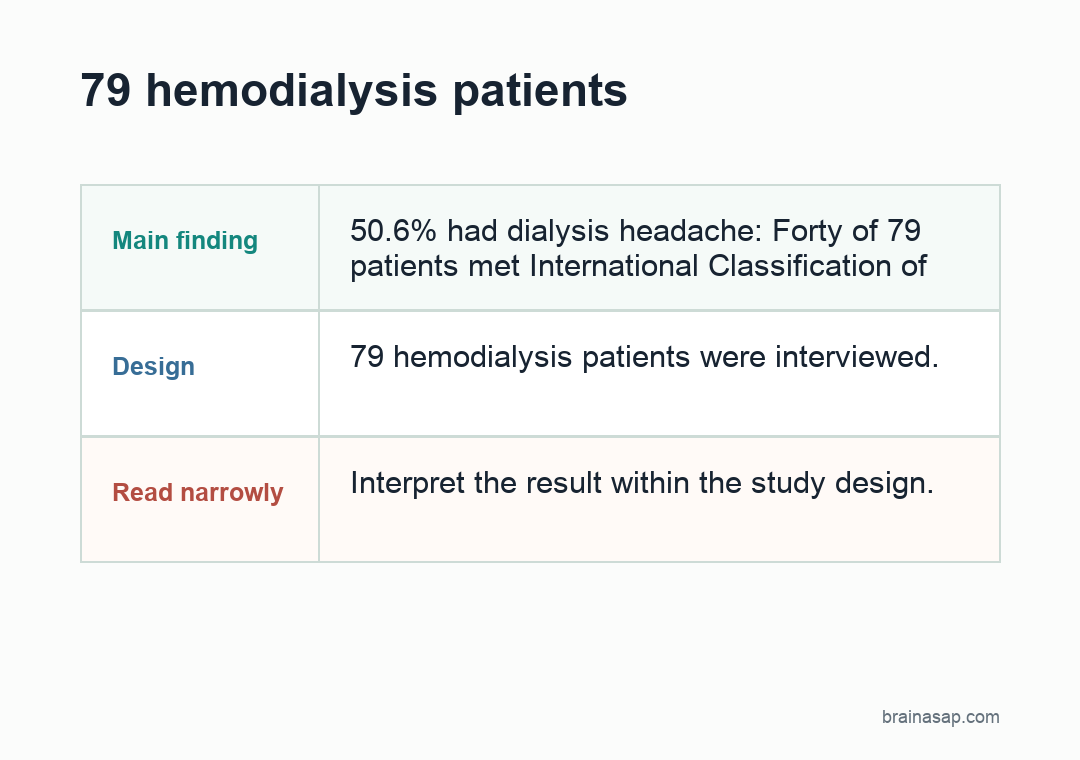
- 50.6% had dialysis headache: Forty of 79 patients met International Classification of Headache Disorders criteria for headache that developed or worsened during hemodialysis and resolved after treatment.
- Prior headache history was higher: Recurrent headaches before dialysis were reported by 65.0% of patients with dialysis headache versus 33.3% of those without dialysis headache.
- Prior headaches quadrupled odds: In multivariable analysis, prior headache history was associated with higher odds of dialysis headache (OR = 4.08, 95% CI 1.42-11.75).
- Other risk signals appeared: Female sex independently increased dialysis-headache odds (OR = 3.25), and mean diastolic blood pressure was lower in the headache group than the non-headache group (61.1 vs 68.7 mmHg).
Source: Journal of Pain Research (2026) | Albilali et al.
Dialysis Headache Was Common in End-Stage Renal Disease
Dialysis headache is a secondary headache diagnosis tied to the hemodialysis session itself.
Under ICHD-3 criteria, the headache starts or worsens during hemodialysis and resolves after the session, usually within a defined post-dialysis window.
Three clinical details anchor the dialysis-headache result:
- High frequency: 50.6% of interviewed maintenance-hemodialysis patients met dialysis-headache criteria.
- Prior history: recurrent headaches before dialysis were more common in the dialysis-headache group.
- Independent predictors: prior headache history, female sex, and lower diastolic blood pressure remained linked after adjustment.
A practical session screen can stay simple:
- Timing: ask whether pain begins or worsens during dialysis.
- Resolution: ask whether pain fades after the session ends.
- History: document recurrent headaches before maintenance hemodialysis began.
Hemodialysis can stress the nervous system through fluid shifts, blood pressure changes, uremic toxin removal, electrolyte changes, and vascular effects.
Headache is one of the neurological complications patients can experience, along with more severe dialysis-related problems such as disequilibrium syndrome, hypertensive encephalopathy, stroke, and dialysis dementia.
The Saudi study focused on a practical clinical issue: patients who already had recurrent headaches before dialysis can become more vulnerable to dialysis headache after they start maintenance treatment.
That history is clinically useful because it is easy to ask about during dialysis intake. It does not require imaging, specialized testing, or a biomarker panel.
If the association holds in larger studies, headache history can help clinicians identify patients who need closer symptom tracking during treatment sessions.
Researchers Interviewed 79 Adults on Maintenance Hemodialysis
Researchers conducted a cross-sectional study at the hemodialysis unit of King Khalid University Hospital.
Eligible patients were adults with end-stage renal disease who had been receiving maintenance hemodialysis for at least 6 months and can answer symptom items about headache timing and features.
The final analysis included 79 patients.
Each patient completed a structured questionnaire covering demographics, clinical history, dialysis variables, blood pressure measurements, and headache features.
Some interviews were completed during dialysis sessions, while others were completed by phone because of scheduling or patient preference.
Dialysis headache classification depended on the reported timing of headache symptoms.
Patients were considered to have dialysis headache if they had at least three headache episodes that developed or worsened during hemodialysis and resolved within 72 hours after the session ended.
Researchers also asked whether patients had recurrent headache attacks before starting the hemodialysis program.
That distinction is important because it separates a long-standing headache susceptibility from headaches that appeared only after dialysis began.
Half of Hemodialysis Patients Reported Dialysis Headache
Dialysis headache was common in this cohort.
Forty of 79 patients, or 50.6%, met criteria for dialysis headache.
That frequency sits within the broad range reported in earlier dialysis studies, where estimates have varied from about 28% to 73%.
The headache pattern was fairly consistent.
Moderate intensity was most common, reported by 21 of the 40 patients with dialysis headache.
Pain was usually dull, throbbing, or a mixed pattern, and it most often appeared in the temporal or frontotemporal regions.
Timing also fit the dialysis-linked diagnosis.
Most headaches began during the second half of the hemodialysis session, and all resolved within 72 hours.
The average reported duration was 5.2 hours, although the standard deviation was wide, showing that symptom duration varied across patients.
Associated symptoms were present but not dominant.
Photophobia was reported by 15.0% of patients with dialysis headache, and nausea by 12.5%.
Those symptoms overlap with migraine biology, but the study did not formally diagnose pre-dialysis migraine or tension-type headache using standardized headache criteria.
Prior Recurrent Headaches Predicted Dialysis Headache Risk
The clearest patient-history result involved prior headaches.
Among patients with dialysis headache, 26 of 40 had a recurrent headache history before starting hemodialysis. Among patients without dialysis headache, 13 of 39 reported that history.
Put another way, prior headaches were present in 65.0% of the dialysis-headache group compared with 33.3% of the non-headache group.
In the multivariable model, prior headache history was associated with about fourfold higher odds of dialysis headache.
The proposed explanation is neurobiological susceptibility.
Patients with pre-existing primary headache disorders can have altered pain processing, central sensitization, or a more responsive trigeminovascular system.
Dialysis-related shifts in blood pressure, osmolality, or vasoactive peptides can then trigger headache more readily.
That mechanism remains plausible rather than proven.
The study did not measure calcitonin gene-related peptide, substance P, cerebral blood flow, serum osmolality, or dialysis-to-dialysis biological changes.
It also did not classify earlier headaches as migraine, tension-type headache, or another primary headache disorder. Female sex was another independent factor.
Women made up 50.0% of the dialysis-headache group but only 23.1% of the non-headache group. After adjustment, female sex was associated with higher odds of dialysis headache.
Blood pressure pointed to a possible dialysis-session trigger. Mean diastolic pressure during hemodialysis was lower in patients with dialysis headache than those without it, 61.1 vs 68.7 mmHg.
Systolic pressure values were also numerically lower during dialysis in the headache group, although that comparison did not reach statistical significance.
A lower intradialytic diastolic pressure can contribute through transient cerebral hypoperfusion or impaired autoregulation in susceptible patients.
Earlier studies have not been fully consistent, with some pointing toward higher blood pressure or blood pressure variability instead.
Hemodynamic change during dialysis can be one contributor, not the single cause.
Diabetes mellitus showed an inverse association.
Diabetes was more common in the non-headache group, and in the regression model it was associated with lower odds of dialysis headache.
The paper treats that finding cautiously because residual confounding and differences in patient characteristics can explain it.
Dialysis Headache May Need Routine Screening During Sessions
Clinically, dialysis headache should be asked about directly.
Patients do not always volunteer symptoms if they assume headaches are an expected part of treatment, and clinicians may focus first on dialysis adequacy, fluid status, blood pressure, and vascular access.
A simple screening approach could include three items:
- Timing: Does the headache begin or worsen during hemodialysis, especially in the second half of the session?
- Recovery: Does it resolve after dialysis, and how long does recovery usually take?
- History: Did recurrent headaches exist before dialysis began?
Those items would not diagnose every cause of headache. A new severe headache, focal neurological symptoms, hypertensive emergency, infection concern, or unusual post-dialysis course still requires medical evaluation.
The point is to make the dialysis-linked pattern visible instead of treating it as a vague discomfort.
For patients with a prior headache history, clinicians can also track to track blood pressure during the session, symptom timing, ultrafiltration patterns, caffeine withdrawal, and coexisting migraine features.
The current study does not test a prevention strategy, so it should not be used to recommend a specific medication or dialysis adjustment by itself.
Small Cross-Sectional Design Limits Causal Claims
The main limitation is design.
A cross-sectional study can identify associations, but it cannot prove that prior headache history causes dialysis headache.
It also cannot show whether blood pressure changes precede headache onset or simply occur in the same dialysis sessions.
Sample size was another constraint. The cohort included 79 patients, with 40 dialysis-headache cases. With several predictors in the multivariable model, estimates can be unstable, and the confidence intervals were wide.
The study also came from a single center in Saudi Arabia, which limits generalizability.
Dialysis protocols, patient comorbidities, headache reporting, caffeine habits, and access to headache care may differ across centers and countries.
Headache history was self-reported rather than formally diagnosed by primary headache subtype.
That leaves open an important next step: prospective multicenter studies that classify migraine, tension-type headache, medication overuse, blood pressure patterns, dialysis parameters, and biological markers before and during dialysis.
Even with those limits, the study gives clinicians a concrete starting point. In this cohort, dialysis headache affected about half of hemodialysis patients, and prior recurrent headaches marked a substantially higher-risk group.
The most careful interpretation is not that dialysis headache has one cause.
The findings support a mixed model: baseline headache susceptibility can interact with dialysis-session physiology, including hemodynamic shifts, vascular signaling, and pain-processing pathways.
Citation: DOI: 10.2147/JPR.S594581. Albilali et al. Dialysis headache in hemodialysis patients: Is a history of recurrent headaches prior to hemodialysis a risk factor? Journal of Pain Research. 2026;19:5945-5953.
Study Design: Cross-sectional questionnaire and clinical analysis in maintenance-hemodialysis patients.
Sample/Model: 79 adults with end-stage renal disease receiving regular hemodialysis at one Saudi hospital.
Key Statistic: Prior recurrent headache history was associated with dialysis headache odds of 4.08 (95% CI 1.42-11.75).
Caveat: Single-center cross-sectional data cannot prove dialysis physiology caused the headaches.