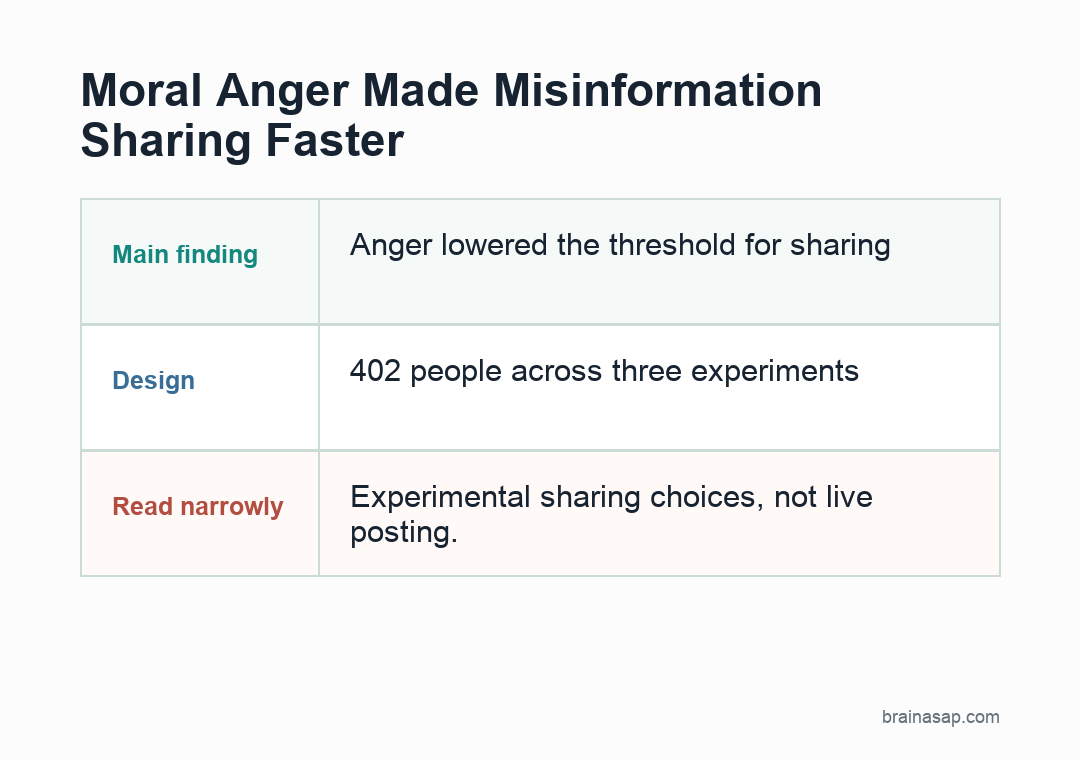
TL;DR: A 2026 study in Cognition & Emotion found that moral anger did not improve falsehood detection; it lowered the evidence threshold for sharing, making the choice faster and less dependent on source credibility.
Key Findings
- Severe moral violations made false headlines more shareable: In a 223-person online experiment, people were more willing to share misinformation when the headline described a stronger moral transgression.
- Credibility usually helped, but anger weakened the brake: Across studies, high-credibility sources increased sharing, yet moral anger made low-credibility false headlines easier to pass along.
- Anger beat disgust: In 116 university students, moral anger increased willingness to share low-credibility false headlines, while moral disgust did not show the same push.
- The model pointed to less caution: In a 63-student decision-modeling experiment, anger lowered the evidence threshold needed before choosing to share.
- Truth discrimination did not improve: Anger sped the choice without making participants better at separating true from false headlines.
Source: Cognition & Emotion (2026) | Jiang et al.
A false post does not need to persuade someone calmly if it can first make them furious.
This study argues that moral anger is dangerous online because it changes the decision process before truth checking has finished doing its job.
Outrage Was Too Blunt a Label
Online misinformation is often explained as a truth problem: people believe the wrong thing, so they share the wrong thing.
That explanation is partly right, but it misses a faster route.
Some posts are built to make the sharing impulse arrive before careful evaluation does.
Decision details:
- Severe moral violations: made false headlines more shareable in the first experiment.
- Credibility warnings: still helped, but anger weakened the brake.
- Anger versus disgust: anger increased low-credibility false-headline sharing more clearly than disgust.
- Decision modeling: anger lowered the evidence threshold needed before choosing to share.
The new paper focused on that route by separating moral outrage into different emotions. Anger and disgust can both seem moral reactions, but they point the body in different directions.
Anger is approach-oriented: it prepares people to confront, condemn, and act. Disgust more often pushes withdrawal.
On social feeds, the distinction is not academic. Sharing is an action.
If anger is the part of outrage that moves people toward expression, a false headline wrapped in moral violation does not need deep belief to travel.
It only needs to lower the barrier to action.
A 223-Person Headline Test Made Morality Compete With Credibility
The first experiment recruited 223 participants in China through an online platform.
They read 24 false news headlines that varied in two ways: how severe the moral violation seemed and how credible the source label appeared, from very low to very high.
Before rating willingness to share, participants were nudged toward one of three mental frames.
Some judged accuracy, some judged morality, and some received no special focus.
That setup let the researchers ask whether attention to the headline’s moral content changed how much people relied on source credibility.
The pattern was not that people ignored credibility altogether.
They were generally more willing to share headlines from higher-credibility sources.
But severe moral transgressions increased willingness to share, especially when participants had been prompted to think about the moral meaning of the headline.
The important twist is that both accuracy and morality prompts reduced reliance on the external credibility label.
Once people were pulled into evaluating the message content itself, the source cue became less dominant.
In real feeds, where credibility labels are often weak, ambiguous, or absent, that shift is plausibly enough to matter.
Anger, Not Disgust, Pushed Low-Credibility Headlines
The second experiment narrowed the test. It used 116 university students and compared moral anger with moral disgust while participants evaluated 18 false headlines about minor or severe moral violations.
Each headline came with either a high-credibility or low-credibility source. Participants were prompted to attend to their anger, their disgust, or neutral details before rating whether they would share the item.
Anger did something disgust did not. The anger prompt increased willingness to share false headlines from low-credibility sources compared with the disgust and control prompts. Disgust did not produce the same increase.
That difference gives the study its main behavioral claim: moral anger can override a credibility warning more than moral disgust does.
The false headline does not become more trustworthy.
The reader becomes more ready to act on it anyway.
For platforms, that is a harder problem than simple gullibility. A label that says “low credibility” can still be seen, understood, and partially discounted if the emotional state creates urgency around sharing.
A 63-Student Decision Model Tracked How Anger Changed Sharing
The third experiment asked whether anger changed the machinery of the decision itself.
Sixty-three university students first completed an anger induction by writing about a personal memory that made them intensely angry.
Then they judged 36 true and false headlines paired with low, ambiguous, or high source-credibility labels.
The researchers used hierarchical drift-diffusion modeling, a framework for separating different parts of a choice.
Put simply, it asks whether a person is gathering evidence carefully, whether the evidence favors one response, and how much evidence they require before committing.
Two people can make the same choice for different reasons. One person may share because the headline looks true. Another may share because the threshold for action has dropped.
The model pointed to the second route.
Anger lowered the decision threshold for sharing, meaning participants needed less accumulated evidence before choosing to pass along a headline.
The share decision became faster and less cautious . Just as important, anger did not appear to improve truth discrimination.
The emotion did not make participants better at telling true headlines from false ones. It changed the amount of caution they brought to the decision.
Many misinformation interventions try to improve accuracy attention.
That is sensible, and the first experiment supports the idea that people can be directed toward evaluating content.
But the broader result says the emotional state is part of the bottleneck.
A user can understand source credibility and still share too quickly when a post creates moral urgency. That creates a different intervention target: the moment between emotional arousal and public action.
The study points toward several intervention ideas:
- Friction at the hot moment: A short pause before sharing outrage-heavy content can help because the risky step is not only belief, but speed.
- Emotion-aware prompts: Warnings that name anger or arousal is plausibly more relevant than generic accuracy reminders for content designed to provoke condemnation.
- Credibility cues with timing: Source labels may work better when they appear before the user is already emotionally committed to reacting.
- Share-flow design: Platforms could treat forwarding, reposting, and quote-posting as behavioral decisions that deserve their own safeguards.
None of that requires treating users as irrational.
The point is subtler: emotion changes the decision environment.
Anger can make expression seem the correct next move before the slower parts of judgment have caught up.
Why Sharing Intent Is Not the Same as Posting
The limits are clear. These were controlled experiments, not live-platform field trials. The outcome was willingness to share, not actual posting behavior with followers, reputation, comments, algorithmic rewards, or social consequences attached.
The samples were also from China, and two of the experiments used university students.
Cultural norms around emotion, trust, confrontation, and public sharing could shape how broadly the findings generalize across countries and platforms.
The full paper would also be needed for exact model coefficients and a deeper look at the drift-diffusion estimates.
The supported claim is narrow: anger lowered modeled caution and increased sharing willingness, especially where credibility should have restrained people.
Still, the mechanism is valuable because it separates two ideas that often get blurred.
People may share misinformation because they believe it, but they may also share because anger lowers the threshold for acting before checking.
A Share Button Turns Anger Into a Behavioral Choice
The practical advice is simple: if a post makes you instantly angry, that is the moment to pause before liking, commenting, or sharing.
That advice sounds obvious until you remember that the study’s point is precisely how anger compresses that pause.
The share button is not only a measure of belief.
It is a behavioral test of timing, credibility, identity, and emotion.
A post that turns moral anger into speed can spread even when the reader has not become more accurate, more informed, or more certain.
That is why this paper is helpful.
It moves the misinformation conversation away from a flat test of whether people can detect falsehoods and toward a more realistic test: what makes a person act before detection has a chance to matter?
Citation: DOI: 10.1080/02699931.2026.2647351. Jiang et al. Moral anger accelerates misinformation sharing: evidence from experimental manipulations and hierarchical drift-diffusion modelling. Cognition & Emotion. 2026
Study Design: Three experimental studies manipulating moral violation severity, source credibility, attention prompts, moral anger/disgust, and anger induction, with hierarchical drift-diffusion modeling in the third experiment.
Sample/Model: Experiment 1: 223 online participants; Experiment 2: 116 university students; Experiment 3: 63 university students.
Key Statistic: Anger lowered modeled decision thresholds for sharing while leaving truth discrimination unchanged; exact model coefficients should be checked against the full paper before publication.
Caveat: The finding is about sharing decisions under experimental conditions, not a claim that anger always causes misinformation belief.