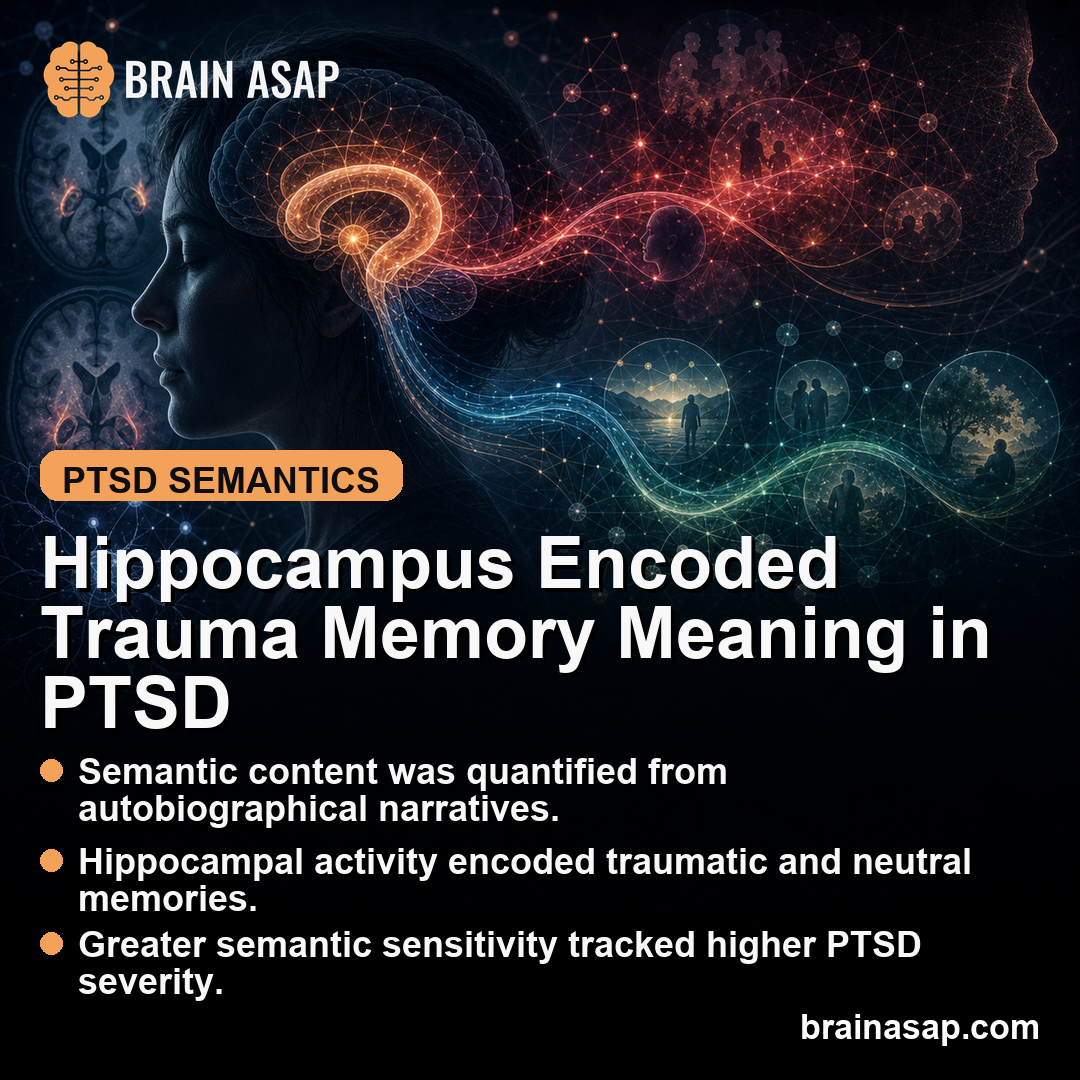
TL;DR: A 2026 PTSD neuroimaging and language-analysis study in Neuropsychopharmacology found that hippocampal activity encoded specific semantic content of traumatic and neutral autobiographical memories, while greater hippocampal sensitivity to autobiographical semantic content related to higher PTSD symptom severity.
Key Findings
- Study type: a study combining natural-language semantic quantification with brain activity during traumatic and neutral autobiographical narratives.
- Participant context: Individuals with PTSD completed autobiographical memory recall in a registered clinical study context.
- Main result: Hippocampal activity encoded specific semantic content of traumatic and neutral autobiographical memories.
- Second result: Greater hippocampal sensitivity to autobiographical semantic content related to higher PTSD symptom severity.
- Caution: The study does not show that trauma memories are biologically identical to ordinary memories in every respect.
Source: Neuropsychopharmacology (2026) | Cisler et al.
PTSD models often emphasize traumatic memory recall, but the brain mechanisms that encode the meaning of autobiographical trauma narratives remain difficult to measure.
The study used natural language processing and large language model methods to quantify semantic content, then linked that content to brain activity during memory recall.
The key result is about meaning, not just memory intensity: hippocampal activity encoded semantic content during traumatic and neutral autobiographical recall. That brings language-model measures into a PTSD brain-imaging question.
Trauma Narratives Were Quantified With Language Models
Design: a study combining natural-language semantic quantification with brain activity during traumatic and neutral autobiographical narratives. Sample: individuals with PTSD completing autobiographical memory recall in a registered clinical study context.
The study quantified narrative meaning and linked it to brain activity while participants recalled autobiographical memories. That design asks what the memory is about, not only how emotional it feels.
- Narratives: Participants recalled traumatic and neutral autobiographical memories.
- Semantics: Language methods quantified the content of what was recalled.
- Brain activity: The analysis tested which circuits encoded that semantic content.
- Symptoms: PTSD severity was related to hippocampal semantic sensitivity.
Hippocampus Encoded Semantic Content During Recall
Main finding: hippocampal activity tracked semantic content. That places the hippocampus in the meaning structure of recalled memories, including trauma narratives.
Higher PTSD symptom severity related to greater hippocampal sensitivity to autobiographical semantic content. This keeps the result relevant to symptoms without reducing PTSD to one brain region.
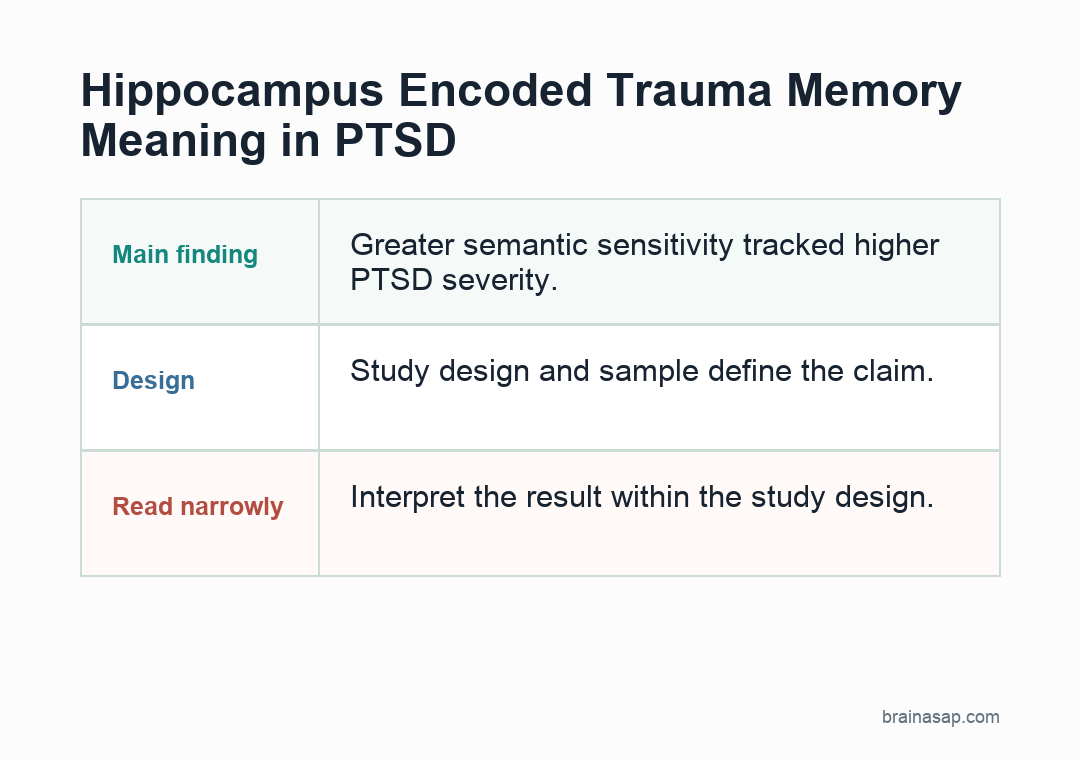
Measurement detail: Semantic quantification is powerful, but it depends on language models, narrative tasks, and imaging choices.
- Participant context: Individuals with PTSD completed autobiographical memory recall in a registered clinical study context.
- Design: Natural-language semantic quantification was paired with brain activity during traumatic and neutral autobiographical narratives.
- Primary anchor: Hippocampal activity encoded specific semantic content of traumatic and neutral autobiographical memories.
- Second layer: Greater hippocampal sensitivity to autobiographical semantic content related to higher PTSD symptom severity.
- Boundary: The study does not show that trauma memories are biologically identical to ordinary memories in every respect.
Interpretation: PTSD-related memory biology may include how meaning is represented during recall. The study does not say traumatic and neutral memories are identical.
Follow-up studies should test whether semantic-hippocampal sensitivity changes with symptom improvement or trauma-focused therapy.
The finding gives researchers a more specific way to measure memory content, not a complete theory of PTSD.
PTSD Severity Related to Hippocampal Semantic Sensitivity
Semantic quantification is powerful, but it depends on language models, narrative tasks, and imaging choices. The finding should be read through that method stack.
The cleaner read is that PTSD-related memory biology may include how meaning is represented during recall. The study does not say traumatic and neutral memories are identical.
The neutral-memory comparison is important because it suggests the hippocampus was not simply responding to trauma labels alone.
The study also helps separate semantic content from emotional intensity. A traumatic memory can be highly distressing, but the semantic analysis asks what concepts and relationships appear in the narrative.
That approach gives researchers a bridge between language and brain activity. It can test whether hippocampal activity follows the meaning structure of the story rather than only the presence of a trauma cue.
Clinical interpretation should stay narrow. The finding should not be read as saying PTSD is only a hippocampal disorder, and it does not show that changing narrative content would change symptoms.
It does suggest that future treatment studies could measure whether trauma-focused therapy changes semantic-hippocampal coupling as symptoms improve.
The method is also notable because trauma narratives are not simple laboratory stimuli. People recall events with personal meaning, fragmented details, emotional shifts, and changing context.
Language-based semantic measures give researchers a way to quantify that content without reducing the memory to a single fear rating or image category.
Replication across trauma types and narrative prompts is therefore especially important.
Autobiographical Memory Tasks Still Have Limits
Main limitation: the study does not show that trauma memories are biologically identical to ordinary memories in every respect.
- Sample context: The work came from a PTSD clinical study setting.
- Memory type: Autobiographical recall differs from laboratory picture memory.
- Interpretation: Encoding semantic content does not erase trauma-specific clinical features.
- Methods: Language-model measures depend on analytic choices.
Autobiographical recall is personal, variable, and difficult to standardize. Replication should test whether the semantic signal holds across different trauma histories and narrative prompts.
Trauma Memory Biology Needs Meaning-Level Measures
Practical takeaway: PTSD memory research may need meaning-level measures, not only fear or arousal measures.
- Best use: Use the result to connect semantic content with hippocampal activity during recall.
- Do not overread: Do not claim the study fully explains traumatic memory or validates a treatment target.
- Next question: Test whether semantic-hippocampal sensitivity changes with symptom improvement or trauma-focused therapy.
That keeps the result grounded: a more specific way to measure memory content, not a complete theory of PTSD.
Citation: DOI: 10.1038/s41386-026-02402-5; Cisler et al.; Semantic encoding of trauma memories in the hippocampus among individuals with PTSD; Neuropsychopharmacology; 2026.
Study Design: A study combining natural-language semantic quantification with brain activity during traumatic and neutral autobiographical narratives.
Sample Size: Individuals with PTSD completing autobiographical memory recall in a registered clinical study context.
Key Statistic: Hippocampal activity encoded specific semantic content of traumatic and neutral autobiographical memories.
Caveat: The study does not show that semantic-hippocampal coupling changes with treatment or explains all PTSD memory symptoms.