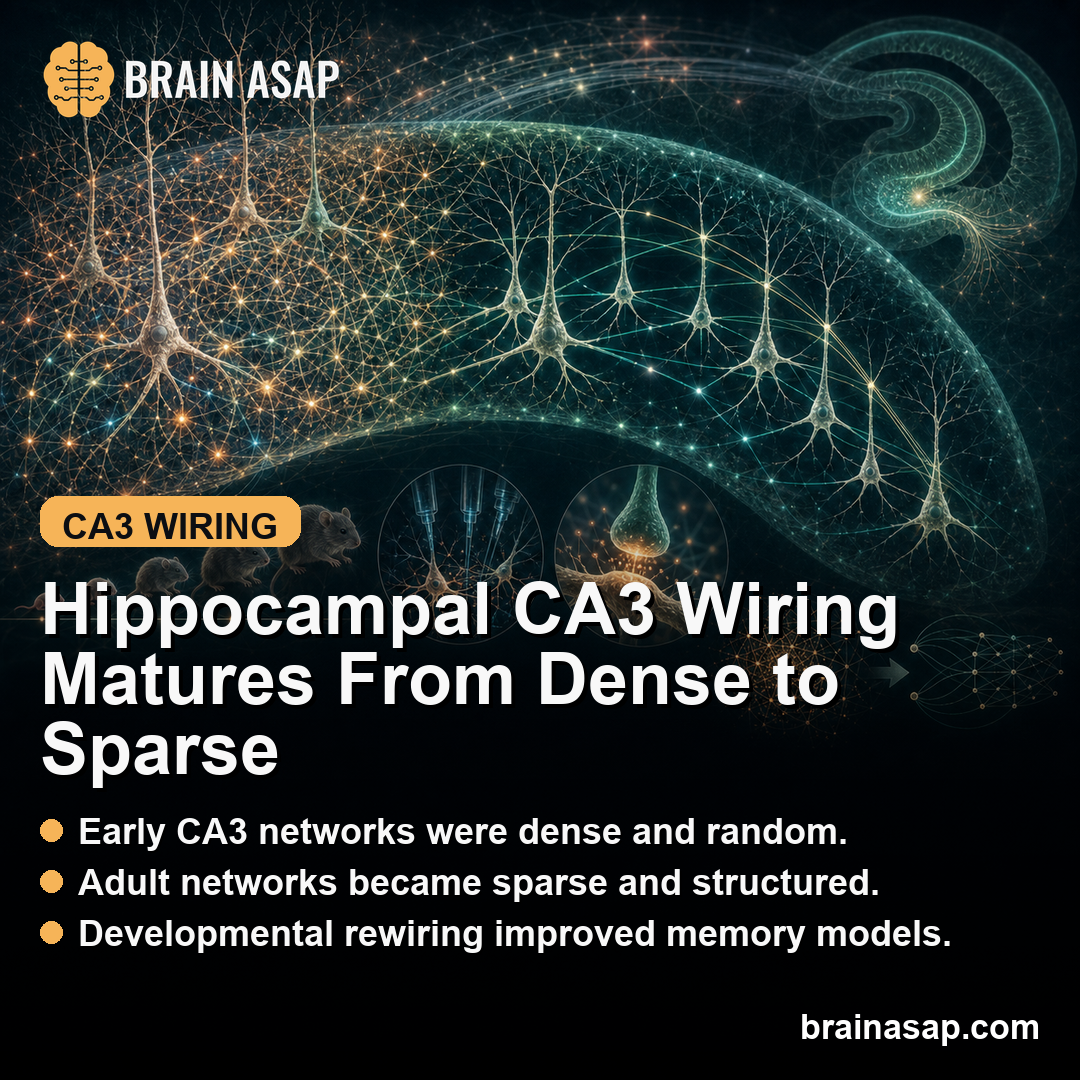
TL;DR: A 2026 Nature Communications study found that mouse hippocampal CA3 connectivity shifts from dense-random early wiring to sparse-structured adult wiring, with weaker single synapses that make memory-network output depend on coordinated input rather than one strong connection.
Key Findings
- CA3 connectivity transforms from random to structured during postnatal development: Early in life (P7-8 mice) the network is locally connected, densely wired, and randomly organized. By adulthood (P45-50) it is distributed, sparsely connected, and structured.
- Single synapses are downregulated across development: Early synapses are strong enough that single events can trigger postsynaptic spiking. By later development, multiple inputs must summate to drive output — supporting more selective firing.
- Multicellular patch-clamp circuit mapping captured up to 8 CA3 neurons simultaneously: Direct measurement of synaptic connections between specific CA3 pyramidal neurons across developmental time points.
- Sparse, structured connectivity emerges through experience-dependent mechanisms: The shift from random-dense to structured-sparse fits Hebbian learning rules — connections strengthen between co-active neurons and weaken between uncorrelated ones, leaving a structured residue.
- Memory coding matured with the wiring: Biologically inspired models showed that developmental connectivity and synaptic-strength changes improved memory storage and pattern-completion-based retrieval.
Source: Nature Communications (2026) | Vargas-Barroso et al.
The CA3 region is the workhorse of hippocampal memory.
Its recurrent connectivity — neurons connecting back to other CA3 neurons in dense loops — makes it an autoassociative network capable of pattern completion, the ability to retrieve a complete memory from a fragmentary cue.
The Vargas-Barroso paper asks the developmental question: is this connectivity born ready, or built?
CA3 Recurrent Connectivity Sets Up Pattern Completion
The hippocampal CA3 region holds a unique place in memory neuroscience.
Its dense recurrent connectivity — pyramidal neurons connecting onto other pyramidal neurons in the same region — implements a computational architecture called an autoassociative network.
The defining feature is pattern completion: given a fragment of a previously encoded memory, the network can retrieve the full pattern.
Theoretical neuroscience has worked out how autoassociative networks should be wired to function well:
- Sparse connectivity reduces interference between stored memories.
- Distributed connectivity increases storage capacity.
- Structured connectivity enables specific patterns to be retrieved without crosstalk.
- Synapses tuned for selective summation ensure that memory retrieval requires the right combination of inputs.
Adult CA3 has all of these features.
Whether young CA3 already has them — or whether they emerge through development — has been an open question.
The Vargas-Barroso team built the experimental setup to answer it.
Multicellular Patch-Clamp Mapped CA3 Synapses Directly
To map connectivity between specific CA3 pyramidal neurons, the team simultaneously recorded from up to 8 cells at once using multicellular patch-clamp electrophysiology.
This is technically demanding — eight glass electrodes, eight intact neurons, all recorded simultaneously — but it allows direct testing of which neuron is connected to which, with what synaptic strength, in real tissue.
They did this across three developmental time points in mouse hippocampus:
- P7-8 — early postnatal, before complex experience and learning have shaped circuits.
- P18-25 — late postnatal/juvenile, after weaning, during a major learning-active period.
- P45-50 — young adult, after the major developmental rewiring window has closed.
For each pair of recorded neurons, they could test directly whether a connection existed and how strong it was. Across hundreds of such tests across three ages, the developmental trajectory came into clear focus.
The Two Big Developmental Shifts and What Each Means
Two parallel developmental transformations emerged:
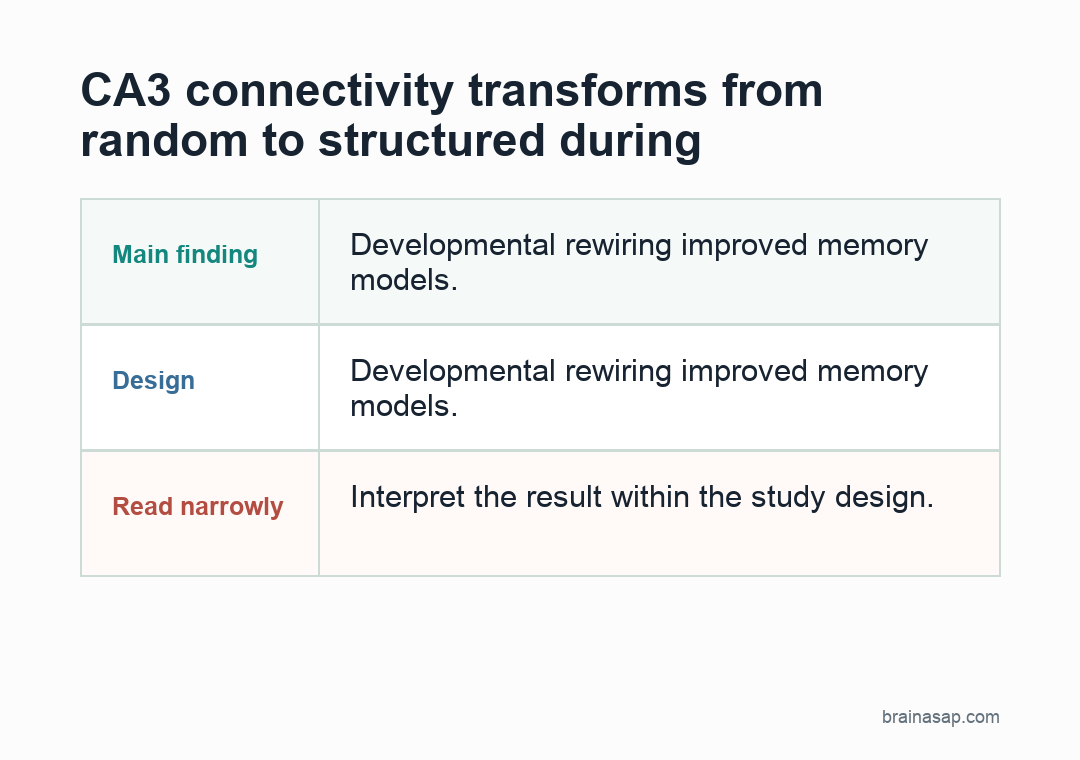
1. Connectivity transformed from random-dense to structured-sparse.
- Early life: many local connections, randomly organized between nearby neurons.
- Adulthood: fewer connections overall, more distributed across the network, with specific structured patterns.
2. Single-synapse strength was downregulated.
- Early synapses: a single synaptic event was often enough to trigger a postsynaptic spike — the network was effectively “loud” at the synapse level.
- Later synapses: multiple inputs needed to summate spatially or temporally to drive postsynaptic firing — the network became “quiet” enough that selective input combinations matter.
These two shifts together — sparser, more distributed, more structured connectivity combined with weaker individual synapses requiring summation — are exactly the configuration theoretical models predict for high-capacity, low-interference autoassociative memory.
Experience-Dependent Activity May Shape CA3 Wiring
The transformation from random-dense to structured-sparse connectivity is not what genetic preprogramming alone would produce.
Hebbian learning rules predict it: connections between neurons that fire together get strengthened (or maintained); connections between uncorrelated neurons get pruned away.
Apply this rule across years of experience, and a random-dense network becomes structured-sparse.
The Vargas-Barroso paper doesn’t directly test which experiences drive the transformation, but the timing is suggestive. The window between P7-8 and P45-50 in mice covers the period when:
- Sensory environments are rapidly being categorized.
- Spatial navigation is being learned — the place-cell system in CA3 is forming functional maps.
- Episodic-like memory formation begins.
- Social experiences accumulate — interactions with mother, littermates, and environment.
Each of these experience streams provides exactly the kind of correlated activity Hebbian learning would use to sculpt the random-dense baseline into structured-sparse mature connectivity.
Why This Connects to Critical-Period Theory and Memory Disorders
If experience-dependent rewiring builds the adult CA3 memory network, then disruption of normal experience during critical developmental periods should leave specific traces in adult memory function. Several conditions fit that developmental-risk framework:
- Early-life stress — chronic adverse experience during developmental windows is associated with adult hippocampal differences and memory vulnerabilities.
- Sensory deprivation — animals raised in impoverished environments show different hippocampal connectivity patterns.
- Autism and other neurodevelopmental conditions — connectivity differences in hippocampal circuits may reflect altered developmental rewiring.
- Schizophrenia developmental hypotheses — abnormal sparsening or pruning during adolescent development has been proposed as a contributor.
The Vargas-Barroso paper provides the basic developmental architecture against which these abnormalities can now be more precisely characterized.
The Honest Limits of Mouse Patch-Clamp Connectivity Maps
- Mouse hippocampus is not human hippocampus. Conserved features apply, but human developmental timing, network scale, and experience are different.
- In vitro slice recording isolates tissue from intact behavior. The connectivity measurements are direct, but the functional consequences for living memory are inferred from biological models, not directly tested.
- Sample sizes per developmental age are limited by the difficulty of multicellular patch-clamp. Up to 8-cell recordings are technical achievements, but the statistical power per developmental window depends on how many such recordings the team accumulated.
- The Hebbian-experience explanation is plausible but not directly demonstrated. The paper shows the developmental endpoint; whether specific experiences during the developmental window produce the transformation requires manipulation experiments.
Memory-development implication: The conventional framing for childhood memory development is that “memory just gets better with age” — a vague capacity that grows with neural maturation.
The Vargas-Barroso paper makes the developmental mechanism specific: memory storage capacity, retrieval specificity, and pattern-completion ability all depend on a structural transformation of the CA3 network that takes years of experience to complete.
The implications cascade:
- Young children’s memory isn’t a weaker version of adult memory — it’s running on different network architecture.
- Adolescent memory development includes a structural rewiring window that’s still active well into the second decade of life.
- Disrupting normal experience during developmental windows leaves architectural consequences, not just functional ones.
- Adult memory disorders may have developmental origins that no amount of adult-onset intervention can fully address.
The hippocampus you carry as an adult was built by your childhood. The Vargas-Barroso paper makes that statement quantitative for the first time.
Citation: DOI: 10.1038/s41467-026-71914-x. Vargas-Barroso et al. Developmental emergence of sparse and structured synaptic connectivity in the hippocampal CA3 memory circuit. Nature Communications. 2026.
Study Design: Multicellular patch-clamp electrophysiology recording up to 8 CA3 pyramidal neurons simultaneously in mouse hippocampus across three postnatal developmental ages (P7-8, P18-25, P45-50); biologically inspired computational modeling of memory storage and pattern-completion retrieval to test functional consequences of the developmental connectivity changes.
Sample/Model: Mouse hippocampal slices at three developmental time points — see full publication for sample sizes per age.
Key Statistic: CA3 network underwent a transformation from local, dense, and random connectivity early in life to distributed, sparse, and structured connectivity by adulthood, accompanied by single-synapse downregulation requiring spatial summation for postsynaptic firing in mature networks; modeling showed these changes specifically improved memory storage and pattern-completion retrieval.
Caveat: Mouse model; in vitro slice recording; functional consequences for memory inferred from biological models rather than directly demonstrated; Hebbian-experience hypothesis suggested by timing but requires experience-manipulation experiments to confirm causation.