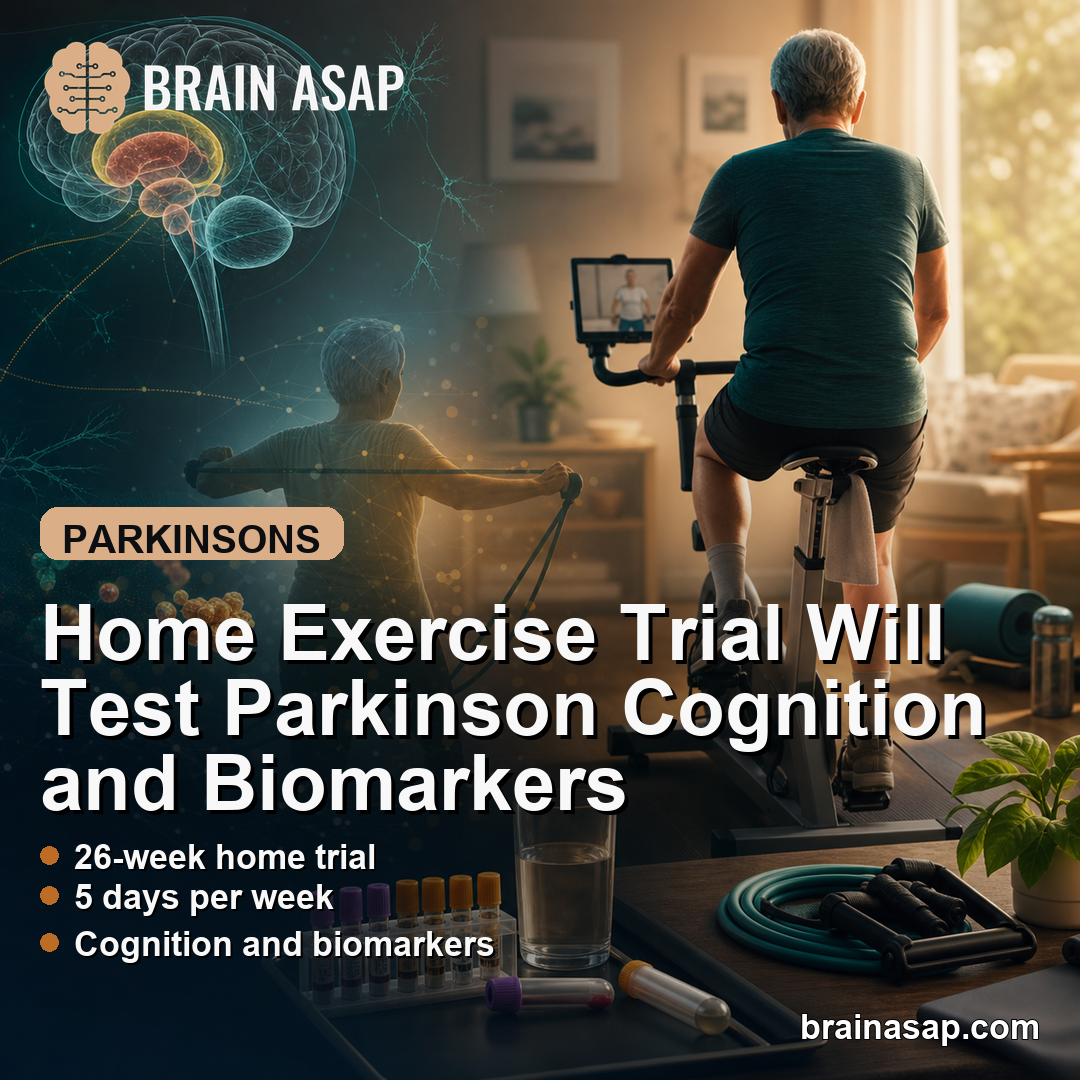
TL;DR: A 2026 protocol in JMIR Research Protocols describes EXCEL-PD, a randomized trial testing whether 26 weeks of virtually supervised home endurance and resistance exercise is feasible, safe, and biologically informative for people with Parkinson disease.
Key Findings
- Home trial design: EXCEL-PD randomizes 31 planned participants with Parkinson disease to home-based exercise or waitlist usual care.
- 26-week intervention: The active arm combines treadmill endurance training and free-weight resistance training at home.
- 5 days per week: By week 6, the target schedule is 3 endurance days and 2 resistance days weekly.
- 80%-85% HRmax: Endurance training ramps toward 30 minutes at high-intensity target heart rate within 40-minute sessions.
- Biomarker sampling: Researchers plan blood, saliva, and cerebrospinal fluid measures alongside cognition and motor outcomes.
Source: JMIR Research Protocols (2026) | Mehta et al.
Parkinson disease is often discussed as a movement disorder, but cognitive decline is one of its major long-term burdens. The EXCEL-PD protocol asks whether a structured exercise program can be delivered at home while still collecting the clinical and biological data needed for a stronger trial.
The source is a protocol, not a completed results paper. Its value is in the trial design: who is eligible, what exercise dose is planned, which outcomes are measured, and how safety and adherence will be tracked.
EXCEL-PD Tests Home Exercise for Parkinson Cognition and Motor Progression
The Exercise for Cognitive Excellence in Parkinson’s Disease trial is a single-site randomized controlled study at the University of California, San Francisco. Researchers planned to enroll 31 people with Parkinson disease.
Participants must be 40 to 80 years old, have idiopathic Parkinson disease, and have a modified Hoehn and Yahr stage below 4. If they use Parkinson medications, doses must be stable before baseline.
- Primary trial aim: Can the home program be delivered with acceptable feasibility, adherence, and safety?
- Secondary clinical aim: The trial measures global cognition and motor symptom progression over 26 weeks.
- Biological aim: Blood, saliva, and cerebrospinal fluid biomarkers are measured before and after the intervention.
- Comparator group: Waitlist usual care continues baseline activity and is offered the program after randomization ends.
The protocol is built around a practical problem. Exercise may help Parkinson outcomes, but clinic-based programs can be hard to scale for people with mobility limits, travel barriers, or limited access to specialized centers.
Virtual Supervision Ramps Down as Safety Skills Improve
The exercise arm receives 26 weeks of home-based combined training. Participants are given a treadmill, free weights, an exercise bench, and a mat so the prescribed program can happen at home.
Virtual sessions are delivered by neuro exercise specialists over Zoom. During weeks 1 and 2, all sessions are supervised so participants can learn safe treadmill use, handrail use, weightlifting form, and fall-risk precautions.
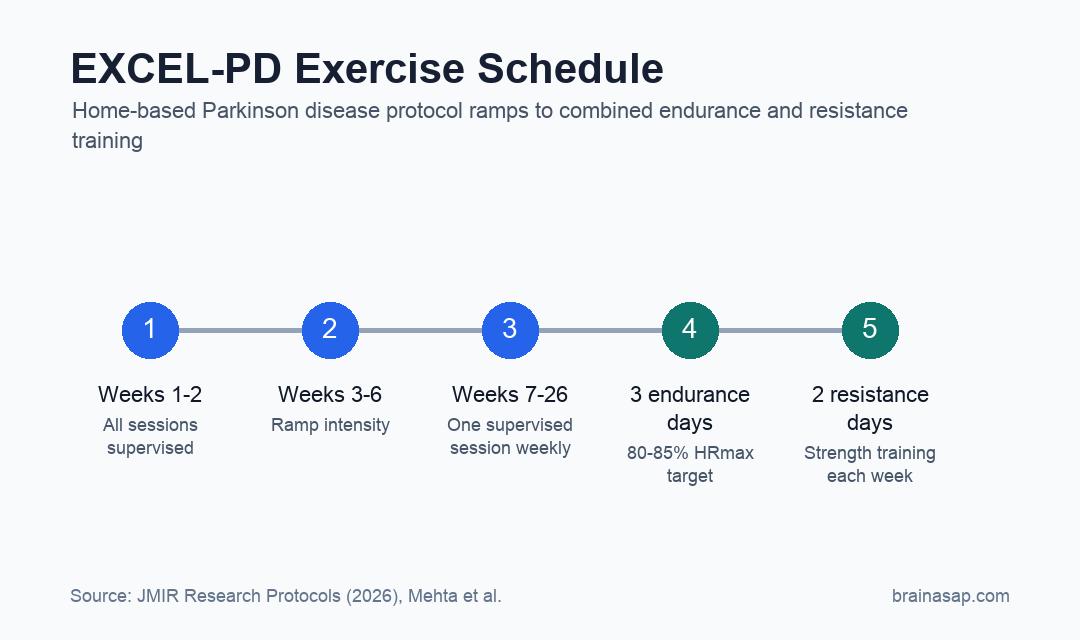
During weeks 3 to 6, the program includes 10 supervised sessions while exercise intensity increases. By the end of week 6, the target is 5 exercise days per week: three treadmill endurance sessions and two resistance sessions.
- Early familiarization: Trainers confirm participants can use equipment safely before supervision is reduced.
- Gradual intensity ramp: Heart-rate and resistance targets increase over the first 6 weeks.
- Maintenance phase: Weeks 7 to 26 include one supervised session per week plus independent home sessions.
This design does not assume home exercise is automatically safe. It builds safety checks into the transition from supervised to independent training.
Endurance and Resistance Training Have Separate Dose Targets
The endurance prescription is specific. Participants perform treadmill training 3 times per week, aiming for 80%-85% of maximum heart rate. Each endurance session lasts 40 minutes, including warm-up and cool-down, with 30 minutes at target intensity.
Resistance training occurs 2 times per week, separated by 48 hours. The program starts at 60% of estimated one-repetition maximum and uses free-weight exercises for strength and muscle mass plus an isometric core exercise.
- Monitoring tool: A Polar H10 heart-rate monitor records endurance intensity and session duration.
- Adherence records: Participants upload heart-rate data and keep an exercise diary.
- Weekly review: Study staff review average heart rate, session duration, and exercise days.
- Adaptive support: Trainers can add calls, supervised sessions, or in-person help if targets are not being met.
The resistance plan also changes after 13 weeks to keep challenging participants while targeting similar muscle groups. A static home routine can become too easy or too repetitive over a half-year trial.
MoCA, MDS-UPDRS, and Fluid Biomarkers Track More Than Attendance
EXCEL-PD does not only count workouts. Secondary outcomes include the Montreal Cognitive Assessment, a brief global cognitive screen, and the MDS-UPDRS part III, a motor examination used in Parkinson disease research.
The biomarker plan is broader than many exercise protocols. Researchers will measure peripheral biomarkers in blood and saliva, plus brain-related markers from cerebrospinal fluid collected before and after the intervention.
- Feasibility: Average heart-rate percentage and resistance training load during weeks 7 to 26.
- Adherence: Number of exercise days per week and duration at target intensity.
- Safety: Adverse events and serious adverse events throughout the trial.
- Clinical outcomes: Cognition, motor scores, and participant-reported outcomes at baseline and 26 weeks.
Those measures make the study useful even if it remains a pilot. A future larger trial would need to know whether participants can reach the intended exercise dose, whether safety issues are manageable, and which biomarkers are worth carrying forward.
The Protocol Sets Up a Results Trial but Does Not Prove Benefit Yet
Recruitment began in July 2023 and ended in November 2025. The protocol states that the last participant was expected to complete data collection in May 2026, with analyses beginning in June 2026 and results expected later in 2026 or early 2027.
That timeline keeps the interpretation clear. The protocol does not show that home exercise improved cognition, slowed Parkinson motor progression, or changed biomarkers. It shows how researchers plan to test those claims.
The strongest near-term use is methodological. If EXCEL-PD shows good adherence and safety, it could support larger home-based Parkinson exercise trials that include both clinical outcomes and biological mechanisms.
Citation: DOI: 10.2196/97507. Mehta et al. Home-Based, Virtually Supervised Combined Exercise Intervention in People With Parkinson Disease: Protocol for a Randomized Controlled Trial. JMIR Research Protocols. 2026;15:e97507.
Study Design: Randomized controlled trial protocol for a home-based exercise intervention.
Sample Size: 31 planned participants with Parkinson disease.
Key Statistic: The intervention targets 26 weeks of training, with 3 endurance sessions and 2 resistance sessions weekly by week 6.
Caveat: This is a protocol article, so efficacy results were not yet available in the source.