TL;DR: A 2026 human microbiome and intervention study in Nature Communications found that coffee drinkers showed distinct gut microbiome composition and lower several microbial metabolites, while caffeinated and decaffeinated coffee shifted stress and mood measures in the intervention phase.
Key Findings
- Study type: a study of habitual coffee intake, caffeinated and decaffeinated coffee, gut microbes, metabolites, stress, mood, and cognition.
- Participant groups: The study compared healthy coffee drinkers and non-coffee drinkers in observational and coffee-intervention arms.
- Main result: Coffee drinkers showed distinct gut microbiome composition and lower several microbial metabolites including GABA and indole-related compounds.
- Second result: Caffeinated coffee reduced anxiety and psychological distress, while both coffee types improved perceived stress and depression scores in the intervention phase.
- Caution: The study does not reduce coffee effects to caffeine alone, and behavior changes should not be treated as treatment effects.
Source: Nature Communications (2026) | Boscaini et al.
Coffee is usually discussed as caffeine, but coffee contains many compounds that can interact with gut microbes, inflammation, stress physiology, and cognition.
This Nature Communications study examined the microbiota-gut-brain axis by comparing habitual coffee drinkers with non-drinkers and by testing caffeinated and decaffeinated coffee exposure.
Core result: this is not simply a coffee-had-effects finding. Coffee drinkers had different gut microbiome composition and lower several microbial metabolites, including GABA and indole-related compounds, while the intervention phase linked coffee intake with stress and mood measures.
Coffee Was Studied Through the Microbiota-Gut-Brain Axis
Design: a study of habitual coffee intake, caffeinated and decaffeinated coffee, gut microbes, metabolites, stress, mood, and cognition. Sample: healthy coffee drinkers and non-coffee drinkers in observational and coffee-intervention arms.
The study combined habitual intake, microbiome profiling, metabolomics, and a coffee intervention. That mix helps connect coffee exposure with gut-brain markers, but it also means the evidence spans several measurement layers.
- Microbes: Coffee drinkers had higher Cryptobacterium and Eggerthella species.
- Metabolites: Indole-3-propionic acid, indole-3-carboxyaldehyde, and GABA were lower.
- Behavior: Coffee drinkers showed differences in impulsivity and emotional reactivity.
- Intervention: Both caffeinated and decaffeinated coffee shifted some stress and mood measures.
Coffee Drinkers Had Different Gut Microbes and Metabolites
The microbiome result is the anchor: coffee drinkers showed distinct gut microbes and lower microbial metabolites. That keeps the discussion focused on a gut-brain pathway rather than a generic coffee-is-good claim.
The intervention result adds behavior-level context: caffeinated coffee reduced anxiety and psychological distress, while both caffeinated and decaffeinated coffee improved perceived stress and depression scores.
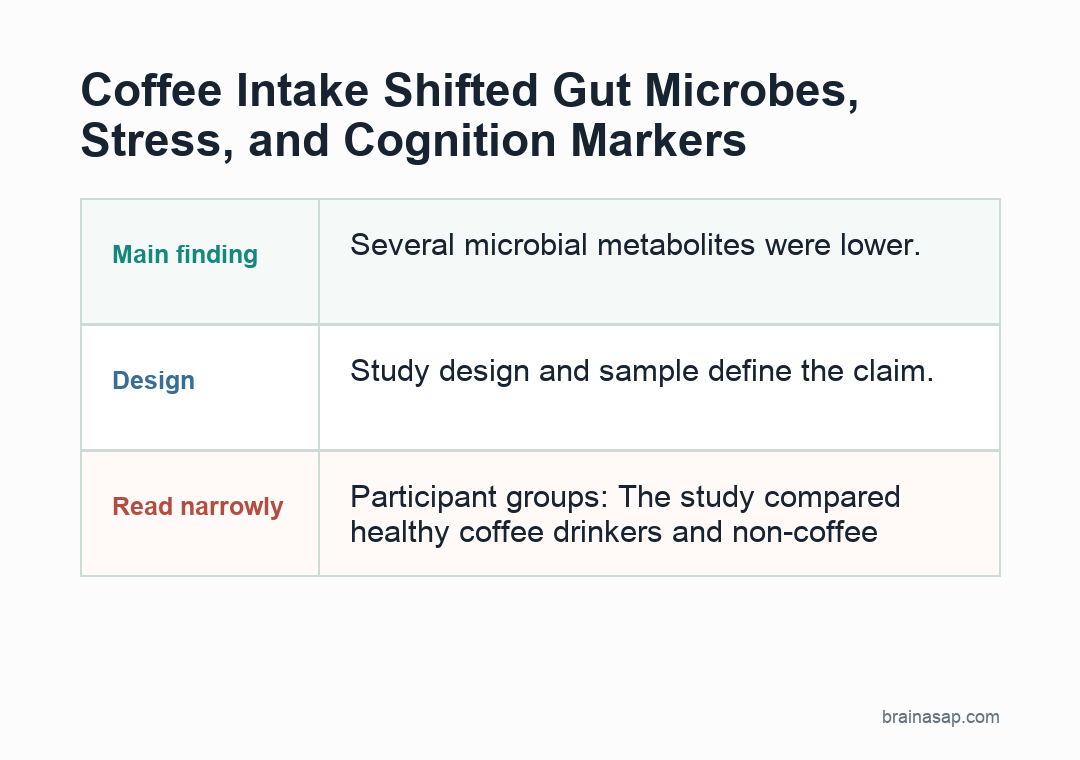
Measurement detail: A microbiome-metabolite result and a short behavioral intervention should not be collapsed into one treatment claim.
- Population: Healthy coffee drinkers and non-coffee drinkers in observational and coffee-intervention arms.
- Design: Habitual coffee intake, caffeinated and decaffeinated coffee, gut microbes, metabolites, stress, mood, and cognition.
- Primary anchor: Coffee drinkers showed distinct gut microbiome composition and lower several microbial metabolites including GABA and indole-related compounds.
- Second layer: Caffeinated coffee reduced anxiety and psychological distress, while both coffee types improved perceived stress and depression scores in the intervention phase.
- Boundary: The study does not reduce coffee effects to caffeine alone, and behavior changes should not be treated as treatment effects.
Interpretation: Coffee intake was linked with gut microbial changes and some stress-related measures. The study does not prove coffee is a mental-health therapy.
Follow-up work should test which coffee compounds, doses, and baseline microbiome profiles drive the observed changes.
That keeps the finding specific: gut microbes, microbial metabolites, and stress-related measures moved together, without turning coffee into a treatment recommendation.
Caffeinated Coffee Reduced Anxiety and Psychological Distress
A microbiome-metabolite result and a short behavioral intervention should not be collapsed into one treatment claim. They answer related but different questions.
The cleaner read is that coffee intake was linked with gut microbial changes and some stress-related measures. The study does not prove coffee is a mental-health therapy.
The decaffeinated comparison matters because it suggests some effects may involve coffee components beyond caffeine.
That distinction is important for the gut-brain interpretation. Coffee contains polyphenols, fiber-like compounds, and other molecules that can be transformed by gut microbes before they affect host physiology.
The metabolite findings also cut against a simple stimulant story. Lower GABA and indole-related compounds point to microbial and host-metabolic pathways that do not map cleanly onto caffeine alone.
Behavioral changes should still be read cautiously. Short-term questionnaire shifts can reflect expectancy, sleep, baseline mood, diet changes, or the experience of joining an intervention.
The strongest next test would separate coffee compounds rather than treating coffee as one exposure. Caffeine, chlorogenic acids, roasting products, and habitual diet could each shape the microbiome differently.
Cognition and Stress Effects Were Not Caffeine-Only
Main limitation: the study does not reduce coffee effects to caffeine alone, and behavior changes should not be treated as treatment effects.
- Healthy adults: The findings do not test psychiatric or cognitive treatment.
- Multiple pathways: Caffeine, polyphenols, metabolites, and habits can all contribute.
- Behavior measures: Questionnaire shifts are not clinical diagnoses.
- Microbiome complexity: Observed taxa may be markers rather than direct mechanisms.
Diet, sleep, baseline health, and expectancy can all shape coffee studies. Those factors make replication and controlled intervention work important.
Coffee Biology Should Not Be Oversold as Treatment
The practical takeaway is to keep the coffee result specific: gut microbes, metabolites, and stress-related measures moved together.
- Best use: Use it as microbiota-gut-brain evidence around coffee exposure.
- Do not overread: Do not turn the result into advice to use coffee as treatment for anxiety or depression.
- Next question: Test which coffee compounds, doses, and baseline microbiome profiles drive the observed changes.
That gives readers a specific result without overselling a familiar beverage.
Citation: DOI: 10.1038/s41467-026-71264-8; Boscaini et al.; Habitual coffee intake shapes the gut microbiome and modifies host physiology and cognition; Nature Communications; 2026.
Study Design: A study of habitual coffee intake, caffeinated and decaffeinated coffee, gut microbes, metabolites, stress, mood, and cognition.
Sample Size: Healthy coffee drinkers and non-coffee drinkers in observational and coffee-intervention arms.
Key Statistic: Coffee drinkers showed distinct gut microbiome composition and lower several microbial metabolites including GABA and indole-related compounds.
Caveat: The behavioral findings should not be treated as evidence that coffee is a mental-health or cognitive treatment.