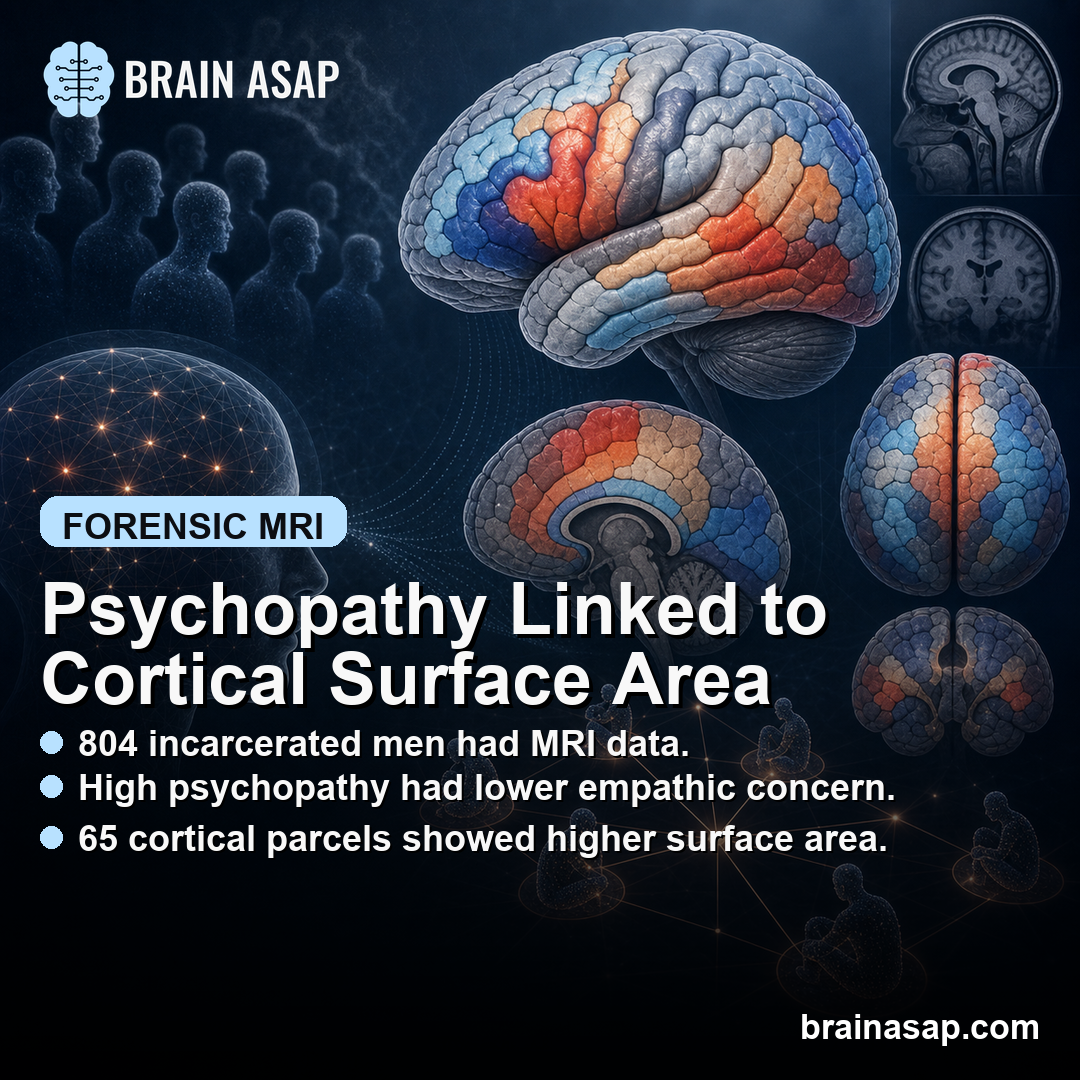
TL;DR: A 2026 study in Biological Psychiatry: Global Open Science linked higher psychopathy in MRI data from 804 incarcerated men to lower empathic concern and broader cortical surface area, while empathy scores themselves were not directly tied to cortical thickness or surface area.
Key Findings
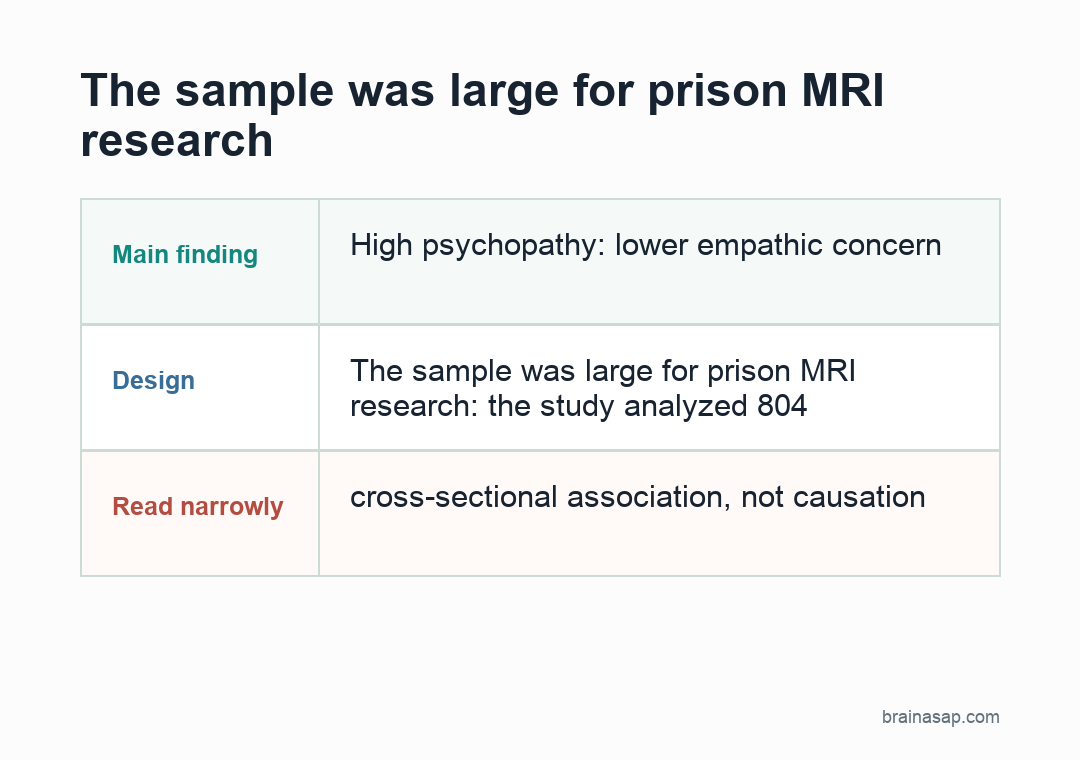
- The sample was large for prison MRI research: the study analyzed 804 incarcerated adult men, including 178 classified as high psychopathy and 289 classified as low psychopathy.
- Empathic concern was lower in high psychopathy: the high-psychopathy group had lower affective empathy on the Interpersonal Reactivity Index.
- Empathy scores did not map directly onto cortical structure: cortical thickness and surface area were not significantly related to the empathy subscales.
- Cortical surface area was larger in the high-psychopathy group: 65 cortical parcels showed larger surface area after correction for multiple comparisons.
- The design cannot prove cause: the data show associations in incarcerated men, not whether cortical structure causes psychopathy or results from development, environment, behavior, or other factors.
Source: Biological Psychiatry: Global Open Science (2026) | Radecki et al.
A large MRI study of incarcerated men found that psychopathy was linked to both lower empathy and measurable differences in cortical organization, but the two findings did not collapse into one simple brain-empathy explanation.
The study separated three readouts:
- Psychopathy ratings: PCL-R total and factor scores.
- Empathy ratings: cognitive perspective taking and affective empathic concern.
- MRI structure: cortical thickness, cortical surface area, and structural-covariance gradients.
The study analyzed 804 adult men in prison settings.
Researchers measured psychopathy with the Psychopathy Checklist-Revised, empathy with the Interpersonal Reactivity Index, and brain structure with T1-weighted MRI.
Main result: men with high psychopathy showed lower empathic concern and broader cortical surface area, while empathy scores themselves were not significantly associated with cortical thickness or surface area.
Interpretation: An MRI scan did not identify empathy. In this sample, psychopathy and cortical structure were related in ways that remained visible after accounting for age, IQ, and total intracranial volume.
High Psychopathy Was Linked to Lower Empathic Concern
The researchers divided participants into high- and low-psychopathy groups using standard Psychopathy Checklist-Revised thresholds.
The high-psychopathy group had scores of 30 or higher, while the low-psychopathy group had scores of 20 or lower.
In the full sample, the average PCL-R total score was 22.85.
Empathy was measured with two Interpersonal Reactivity Index subscales. Perspective Taking captures a cognitive ability to consider another person’s point of view.
Empathic Concern captures affective concern for another person’s distress. These are related but not identical, which is important because psychopathy is often discussed as though empathy were one single trait.
The strongest behavioral contrast was in affective empathy.
Men in the high-psychopathy group had lower empathic concern than men in the low-psychopathy group.
In factor-level models, the interpersonal-affective psychopathy factor was uniquely negatively related to empathic concern, while the lifestyle-antisocial factor was uniquely negatively related to perspective taking.
A practical way to read that split is:
- Factor 1: more tied to reduced emotional concern for others.
- Factor 2: more tied to reduced cognitive perspective taking.
- Total score: helpful for group comparisons, but less precise than the factor-level pattern.
Empathy Scores Did Not Track Cortical Thickness or Surface Area
The MRI analysis separated cortical thickness from cortical surface area.
The distinction is important because these measures are developmentally and biologically distinct.
A cortex can be thicker without having a larger surface area, and a larger surface area does not automatically mean more tissue is working better.
When the researchers tested whether empathy scores were related to cortical thickness or surface area, they did not find significant associations.
That is one of the most helpful guardrails in the study.
The study found empathy differences and brain-structure differences, but it did not show that the measured empathy scores were directly explained by the same cortical measures.
This keeps the interpretation narrower and more accurate.
Lower empathy was not directly visible in the scans.
The actual result is more specific: psychopathy related to cortical structure, and psychopathy also related to empathy, but the empathy subscales did not map cleanly onto the cortical structure metrics.
High Psychopathy Showed Larger Cortical Surface Area
The clearest imaging result involved cortical surface area.
Compared with the low-psychopathy group, the high-psychopathy group showed larger surface area across 65 cortical parcels after false-discovery-rate correction.
Total cortical surface area was also larger in the high-psychopathy group after controlling for age, IQ, and total intracranial volume.
The reported total-surface-area association was a group-level, statistically reliable estimate: standardized beta 0.25, 95% confidence interval 0.14 to 0.36, p = 9 x 10^-6.
The group difference corresponded to Cohen’s d of 0.39.
That estimate is not large enough to diagnose an individual person, but it still helps characterize the cohort-level neuroscience pattern.
The largest cortical effect sizes appeared in paralimbic areas and the somatomotor network.
Those regions are relevant because prior psychopathy research has often focused on social-affective, emotional, and action-related systems.
The new paper adds scale: rather than reporting a small regional result, it shows a broad surface-area pattern across a large incarcerated cohort.
Cortical Thickness Organization Was More Compressed
The study also looked beyond regional size measures by using structural-covariance gradients.
In plain terms, this method asks how patterns of cortical structure vary across the cortex and whether the overall organization looks expanded, compressed, or shifted across groups.
For cortical thickness, high psychopathy was associated with a compressed structural-covariance gradient.
Surface-area gradients did not show the same compression.
That difference reinforces the idea that cortical thickness and surface area should not be treated as interchangeable MRI outcomes.
The gradient result is more abstract than the surface-area result, but it fits the broader theme of the study.
Psychopathy was not linked to one isolated spot.
It was associated with distributed cortical structure, including large-scale organization of thickness patterns.
Causality Remains Unresolved in One Male Prison Sample
This study is not evidence that cortical surface area causes psychopathy.
It is also not evidence that prison behavior, early adversity, genetic liability, substance use, head injury, or other developmental factors produced the cortical differences.
The design was cross-sectional, so it can describe associations but not sequence.
The sample is both a strength and a limit.
A cohort of 804 incarcerated men is unusually large for this kind of MRI work, and about 90% of participants reported a violent offense.
But the findings may not generalize to women, non-incarcerated populations, adolescents, or people with lower psychopathy scores outside prison settings.
There are also measurement limits.
PCL-R ratings and self-reported empathy scales are helpful, established tools, but neither is a direct measure of moral behavior in everyday life.
MRI measures such as cortical thickness and surface area are structural summaries, not readouts of what a person is thinking or feeling.
The cleanest interpretation is that this study strengthens the link between psychopathy and distributed cortical structure in a large incarcerated sample.
It also keeps a clear boundary around the claim: the brain findings were related to psychopathy, not a simple MRI signature of empathy.
Citation: DOI: 10.1016/j.bpsgos.2026.100695. Radecki et al. Cortical Structure in Relation to Empathy and Psychopathy in 800 Incarcerated Men. Biological Psychiatry: Global Open Science. 2026;100695.
Study Design: Cross-sectional MRI and behavioral study of incarcerated adult men, using PCL-R psychopathy ratings, Interpersonal Reactivity Index empathy measures, cortical thickness, cortical surface area, and structural-covariance gradients.
Sample Size: 804 incarcerated adult men; 178 high-psychopathy participants and 289 low-psychopathy participants in the primary group comparison.
Key Statistic: High psychopathy was associated with larger total cortical surface area after adjustment for age, IQ, and total intracranial volume; 65 parcels showed larger surface area after correction.
Caveat: Cross-sectional male incarcerated sample; the findings are group-level associations, not a diagnostic MRI signature or causal test.