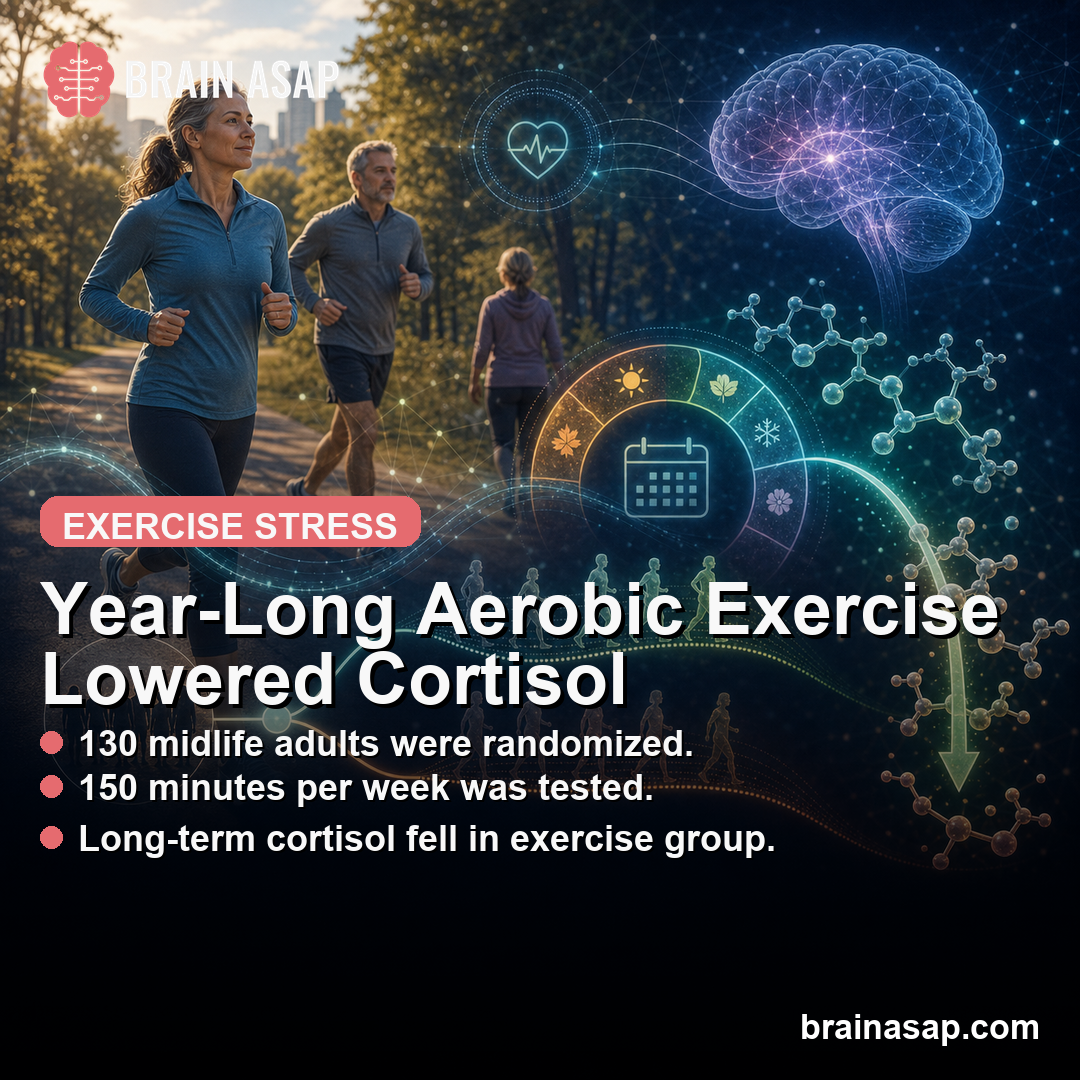
TL;DR: A 2026 randomized clinical trial in the Journal of Sport and Health Science assigned 130 midlife adults to 150 minutes/week aerobic exercise or no-exercise control for 1 year and found sustained lower long-term cortisol in the exercise group.
Key Findings
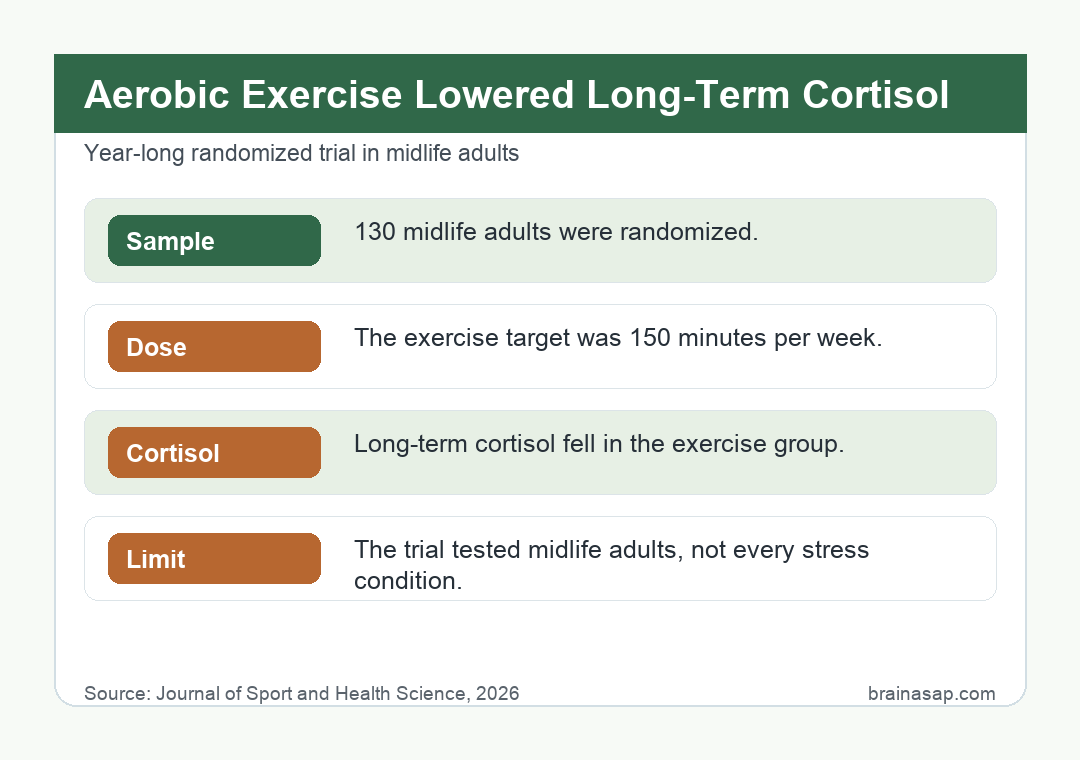
- Year-long randomized trial in 130 midlife adults: Participants aged 26 to 58 were randomly assigned to either 150 minutes of moderate-to-vigorous aerobic activity per week or a control condition that received general health information without an exercise prescription.
- Significant reduction in long-term cortisol in the exercise group: Researchers found a sustained drop in cortisol — the body’s primary stress hormone — in the exercise condition, meaningful enough to call out as the standout finding of the trial.
- Cause-and-effect mapping of exercise to long-term stress biology: Most prior evidence is correlational. This randomized trial tracked exercise effects on cortisol and related stress markers continuously across 1 full year.
- The dose was the standard public-health guideline: 150 minutes per week is roughly 30 minutes a day, 5 days a week — the American Heart Association recommendation. The result implies that meeting the guideline, not exceeding it, was enough to lower long-term cortisol.
- Brain imaging plus neuroendocrine markers: The team tracked cardiorespiratory fitness, cortisol, and additional stress and emotion measures using brain imaging and other neuroendocrine techniques across the year.
Source: Journal of Sport and Health Science (2026) | Gianaros et al.
Cortisol is the body’s main stress hormone, released by the adrenal glands and active in metabolism, immune function, sleep, memory, and mood regulation.
Chronically elevated cortisol has been linked to cardiovascular disease, metabolic disorders, and several mental health conditions, which makes the test of whether ordinary lifestyle behaviors lower it medically relevant.
Most prior evidence linking exercise to cortisol has been correlational. This randomized clinical trial tested the causal version of that relationship.
130 Midlife Adults Randomized to Aerobic Exercise vs Control for a Full Year
Researchers led by Peter Gianaros at the University of Pittsburgh and Kirk Erickson at the AdventHealth Research Institute enrolled 130 adults aged 26 to 58.
The trial design:
- Exercise arm: 150 minutes per week of moderate-to-vigorous aerobic activity for 1 year — the standard American Heart Association recommendation.
- Control arm: Received general information about health habits without changing physical activity levels.
- Duration: 12 months — long enough to capture sustained, not transient, biological change.
- Outcome tracking: Cardiorespiratory fitness, cortisol, brain imaging, and other neuroendocrine and emotional measures across the year.
The randomized design lets the trial estimate cause-and-effect rather than describe an association, which is the gap that distinguishes this work from the bulk of the prior literature.
The Standout Result Was a Significant Drop in Long-Term Cortisol
Across the year, participants in the exercise condition showed a meaningful reduction in long-term cortisol levels.
That result gives one plausible biological route for exercise benefits: lowering longer-term cortisol exposure may help connect regular aerobic activity to lower risk across stress-related physical and mental health outcomes.
The implications follow directly from cortisol’s known biology:
- Lower long-term cortisol may mean lower cardiovascular load: Chronically elevated cortisol is part of the pathway connecting psychological stress to cardiovascular disease.
- Lower cortisol may mean better sleep, memory, and mood: Cortisol disrupts each of these when chronically elevated, so reductions over time could feed forward into other quality-of-life endpoints.
- The effect is exercise-driven, not just fitness-driven: Cortisol changes were tracked alongside cardiorespiratory fitness changes, supporting a behavior-to-biology causal pathway.
150 Minutes a Week Was the Tested Exercise Dose
The dose tested in this trial is not heroic. It is the standard guideline most public-health bodies have endorsed for years.
That choice has practical weight:
- 30 minutes, 5 days a week: The 150-minute weekly target translates to a manageable daily routine for most adults.
- Moderate-to-vigorous, not maximal: The intervention did not require high-intensity interval training or competitive athletic effort.
- Achievable without specialized equipment: Walking briskly, cycling, swimming, or moderate-effort group exercise all qualify under the prescription.
The trial does not show that more is better, since only the 150-minute condition was tested. But it does show that meeting the guideline produces a measurable cortisol benefit at 1 year.
Brain Imaging Showed a Companion Slowing of Brain Aging
A prior publication from the same trial cohort reported a different but related finding using brain imaging.
Participants in the exercise arm showed a slower pace of brain aging, measured through structural and functional imaging metrics that track typical age-related decline.
The two findings sit naturally together. Chronically elevated cortisol has been linked to accelerated brain aging in observational work, and lowering long-term cortisol is one plausible mechanism connecting aerobic exercise to slower brain-aging trajectories.
The trial cannot prove that the cortisol drop caused the brain-aging change, since both were measured in the same participants. But the pattern fits a model in which long-term exercise reduces stress-hormone load and, downstream, supports brain-tissue maintenance.
Single Dose, One-Year Window, and Aerobic-Only Design Limit the Conclusions
- Single dose tested: The trial compared 150 minutes per week against no-exercise control. Whether more (or less) exercise produces proportionally larger or smaller cortisol reductions is not established.
- 1-year window: The duration is long compared with most exercise studies but still short relative to a lifespan. Whether cortisol stays lower over 5 to 10 years of continued exercise is unknown.
- Midlife adult cohort only: Participants were aged 26 to 58. Older adults, adolescents, and people with chronic stress or psychiatric conditions may respond differently.
- Resistance and other modalities not tested: The trial used aerobic exercise only. Whether resistance training or mixed modalities produce comparable cortisol benefits remains a separate issue.
- Adherence and dropout were not described in detail in the press release: The eventual functional dose received by exercise-arm participants depends on how closely they hit the 150-minute target, which is a standard adherence question for any year-long behavioral trial.
Guideline-Level Aerobic Exercise Engages the Cortisol Pathway, Not Just the Cardiovascular One
Practical implications follow from the dose-tested-and-found-effective design:
- The guideline-level dose is not just heart-protective: The same 150-minute target most cardiology bodies recommend now has direct evidence for lowering long-term cortisol, broadening the rationale beyond cardiovascular endpoints.
- Mental-resilience framing fits the data: Lower cortisol is biologically consistent with better stress regulation, sleep, and mood — outcomes that aerobic exercise is widely recommended to support, now backed by causal trial-level evidence.
- Exercise prescription as preventive psychiatry: The cortisol pathway is mechanistically central to several mental health conditions. Year-long aerobic exercise is a behaviorally simple intervention that directly engages this pathway.
- Companion finding strengthens the case: The slower brain-aging finding from the same cohort makes the case for guideline-level aerobic exercise as a brain-health intervention, not only a cardiovascular one.
Citation: DOI: 10.1016/j.jshs.2026.101135. Gianaros PJ, Erickson KI et al. Effects of a year-long aerobic exercise intervention on neuroendocrine, autonomic, and neural correlates of stress, emotion, and cardiovascular disease risk in midlife adults. Journal of Sport and Health Science. 2026.
Study Design: Randomized clinical trial; 12-month aerobic exercise intervention vs no-exercise control, with neuroendocrine, autonomic, and brain-imaging outcome assessment.
Sample Size: 130 midlife adults aged 26 to 58 years.
Key Statistic: Significant reduction in long-term cortisol in the exercise condition; companion finding from the same cohort showed slower brain-aging pace in exercise-arm participants.
Caveat: Single dose (150 min/week) tested against no-exercise control; 1-year duration; midlife adults only; aerobic exercise modality only; long-term durability beyond 1 year and effects in older adults or specific clinical populations remain to be tested.