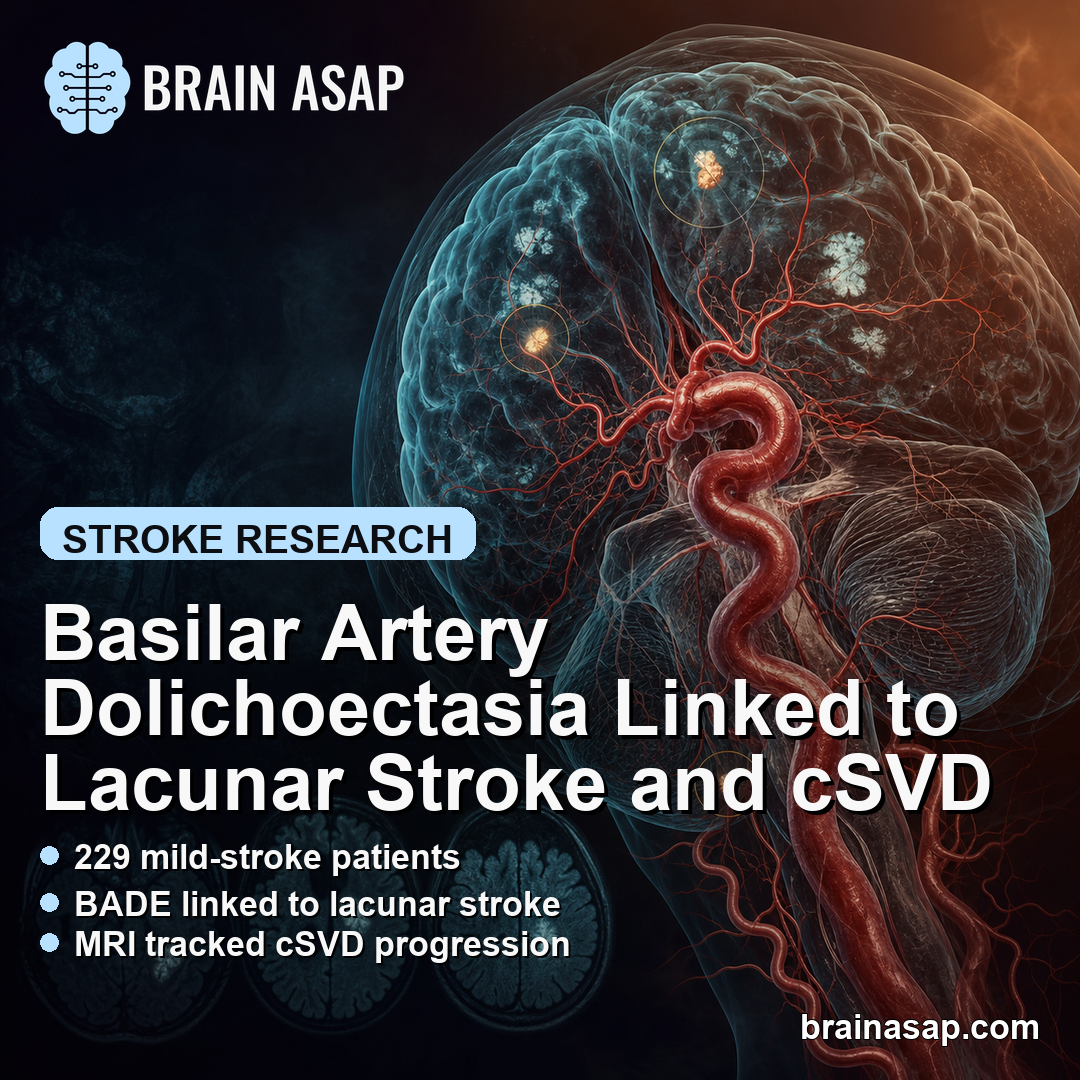
TL;DR: A 2026 prospective mild-stroke cohort study in Circulation linked basilar artery dolichoectasia and wider cranial arteries to lacunar stroke and cerebral small-vessel disease, while large-artery stenosis did not show the same association.
Key Findings
- 229 mild-stroke patients: The Mild Stroke Study 3 cohort included lacunar and mild nonlacunar ischemic stroke patients followed with MRI and clinical assessments.
- 57.2% lacunar stroke: 131 of 229 patients had lacunar stroke, a stroke subtype often tied to cerebral small-vessel disease.
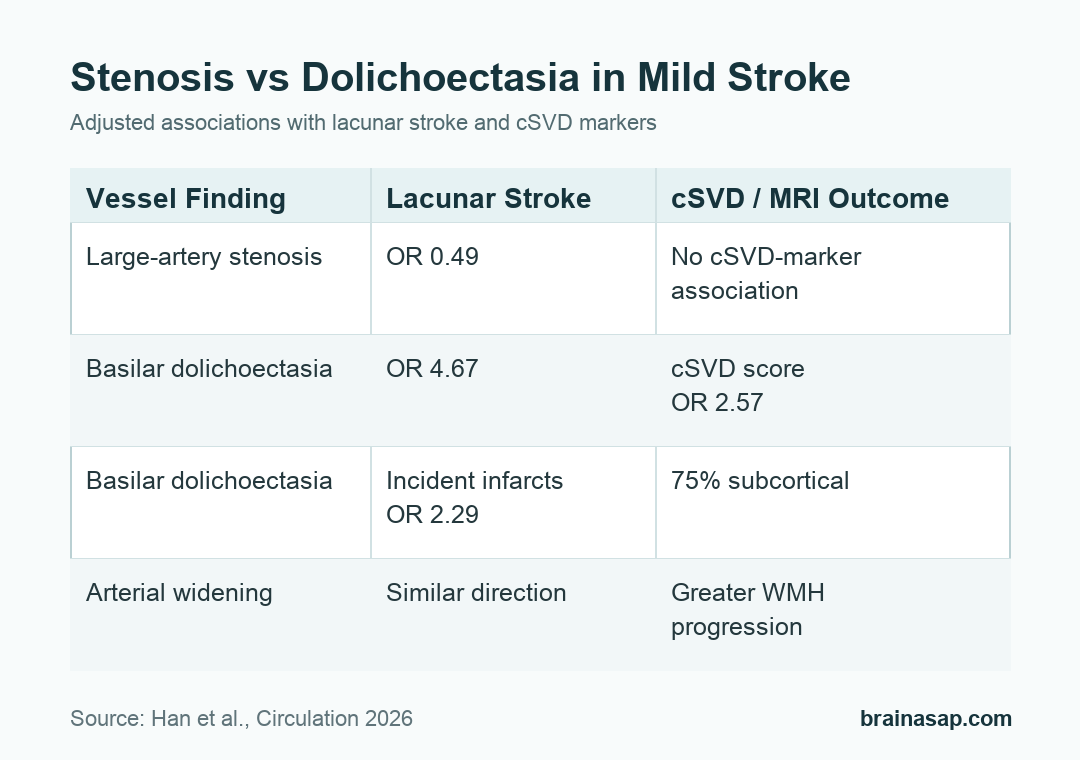
- LAS odds ratio 0.49: Large-artery stenosis was associated with lower odds of lacunar versus nonlacunar stroke, not higher odds.
- BADE odds ratio 4.67: Basilar artery dolichoectasia was associated with higher odds of lacunar stroke after adjustment.
- WMH progression: Basilar artery dolichoectasia was also associated with greater 1-year white-matter hyperintensity progression.
Source: Circulation (2026) | Han et al.
Cerebral small-vessel disease (cSVD) is a brain-vessel disorder linked to lacunar stroke, white-matter injury, small infarcts, cognitive decline, and gait problems. The question in this study was whether cSVD tracked more with narrowed large arteries or widened, tortuous arteries.
The answer mattered because the 2 artery phenotypes imply different mechanisms. Stenosis points toward atherosclerotic narrowing; dolichoectasia points toward arterial widening and structural vessel-wall abnormality.
Large-Artery Stenosis Did Not Explain Lacunar Stroke in This Cohort
Large-artery stenosis (LAS) was defined as at least 50% intracranial or cervical artery narrowing. If lacunar stroke were mainly caused by large-artery atheroma in this cohort, LAS should have been more common in lacunar stroke or tied to cSVD markers.
That was not what the adjusted models showed. LAS was associated with lower odds of lacunar versus nonlacunar stroke, with an odds ratio of 0.49 and 95% confidence interval of 0.23 to 0.99.
- LAS prevalence: Large-artery stenosis was present in 20.5% of the 229-patient cohort.
- Stroke subtype: LAS did not point toward lacunar stroke as the likely subtype.
- cSVD markers: LAS was not associated with cerebral small-vessel disease markers or incident infarcts.
The direction matters for interpretation. The paper does not say large-artery stenosis increased lacunar-stroke odds; it reported the opposite direction after adjustment.
Basilar Artery Dolichoectasia Tracked Lacunar Stroke and cSVD
Basilar artery dolichoectasia (BADE) was defined from basilar artery diameter, bifurcation height, and lateral displacement. It reflects widening and tortuosity rather than focal narrowing.
BADE was present in 15.7% of patients and was strongly associated with lacunar stroke. The adjusted odds ratio was 4.67, with 95% confidence interval of 1.87 to 13.14.
- Lacunar stroke: BADE was associated with higher odds of lacunar stroke.
- cSVD burden: BADE was associated with higher cerebral small-vessel disease scores.
- Incident infarcts: BADE was associated with new infarcts during follow-up.
The cSVD score association had an odds ratio of 2.57, with 95% confidence interval of 1.28 to 5.25. Incident infarcts had an odds ratio of 2.29, with 95% confidence interval of 1.01 to 5.14.
The systematic review supported the cohort finding. Across 27 studies with 9,515 patients with lacunar stroke, the pooled prevalence of ipsilateral large-artery stenosis was 11%, and studies comparing ipsilateral with contralateral stenosis found little evidence for a causal side-specific relationship.
White-Matter Hyperintensity Progression Favored the Arterial-Widening Mechanism
White-matter hyperintensities, or WMH, are MRI-visible white-matter injury markers often used in cSVD research. In this cohort, BADE was associated with greater WMH progression over 1 year.
The reported coefficient was beta = 0.15, with 95% confidence interval of 0.01 to 0.29, per log10-transformed WMH volume. Wider intracranial arteries showed similar associations.
- WMH progression: BADE tracked worsening white-matter injury over follow-up.
- Subcortical infarcts: Among incident infarcts, 75% were subcortical.
- Wider arteries: Continuous arterial-diameter analyses supported the same arterial-widening interpretation.
Taken together, those results fit a nonatheromatous small-vessel mechanism more than a simple plaque-narrowing mechanism.
Clinical Outcomes Did Not Shift Clearly by LAS or BADE
The study also evaluated functional status, cognition, and mobility. Cognition included the Montreal Cognitive Assessment (MoCA), a brief cognitive screening test, and Trail Making Test B/A ratio. Mobility used Timed Up-and-Go.
Neither LAS nor BADE showed clear associations with baseline or 1-year clinical outcomes in the reported table. For example, 1-year MoCA estimates were close to null for both LAS and BADE.
- Function: Modified Rankin Scale scores did not show a clear LAS or BADE association.
- Cognition: MoCA and Trail Making Test B/A did not show clear associations.
- Mobility: Timed Up-and-Go did not show a clear association.
That does not erase the imaging findings. It means this sample and follow-up period detected stronger vascular/MRI associations than clinical disability associations.
Single-Center Mild-Stroke Data Limit the Mechanism Claim
The study was prospective and MRI-rich, but it was still a single-center cohort from Edinburgh stroke services. Larger multicenter studies are needed before the mechanism can be treated as settled across populations.
The paper also notes that magnetic resonance angiography was not routinely performed and that the lack of vessel-wall imaging limited direct visualization of plaque at perforator origins.
- Single center: Generalizability needs confirmation outside this cohort.
- Imaging limit: Vessel-wall imaging was not available for direct plaque assessment at small perforator origins.
- Observational design: Associations cannot prove that arterial widening caused lacunar stroke or cSVD progression.
In this mild-stroke cohort, cSVD aligned more with dolichoectasia and arterial widening than with large-artery stenosis.
Citation: DOI: 10.1161/CIRCULATIONAHA.126.079493. Han et al. Implications of cranial arterial stenosis and dolichoectasia for cerebral small-vessel disease etiopathogenesis: findings from a prospective mild stroke cohort. Circulation. 2026;153:1813-1826.
Study Design: Prospective mild-stroke cohort with baseline and 1-year clinical and MRI assessments plus systematic literature review.
Sample Size: 229 patients with lacunar or mild nonlacunar ischemic stroke; 131 had lacunar stroke.
Key Statistic: BADE was associated with lacunar stroke (OR 4.67), higher cSVD score (OR 2.57), incident infarcts (OR 2.29), and greater WMH progression.
Caveat: The single-center observational design and limited vessel-wall imaging prevent definitive causal claims about the mechanism.