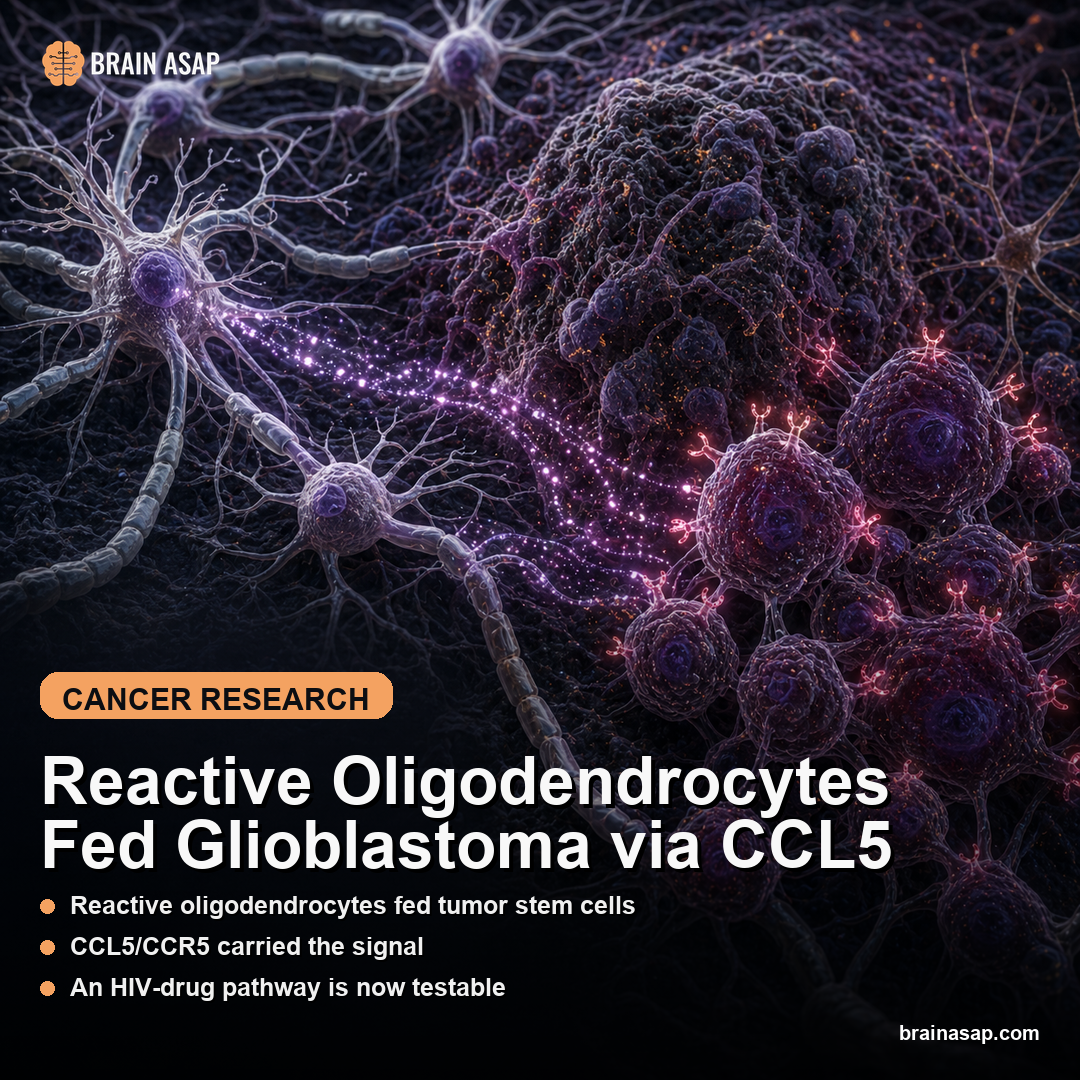
TL;DR: A 2026 study in Neuron found that glioblastoma was not growing alone: reactive oligodendrocytes helped maintain glioma stem cells through CCL5/CCR5 signaling, and blocking that conversation slowed tumor growth in models.
Key Findings
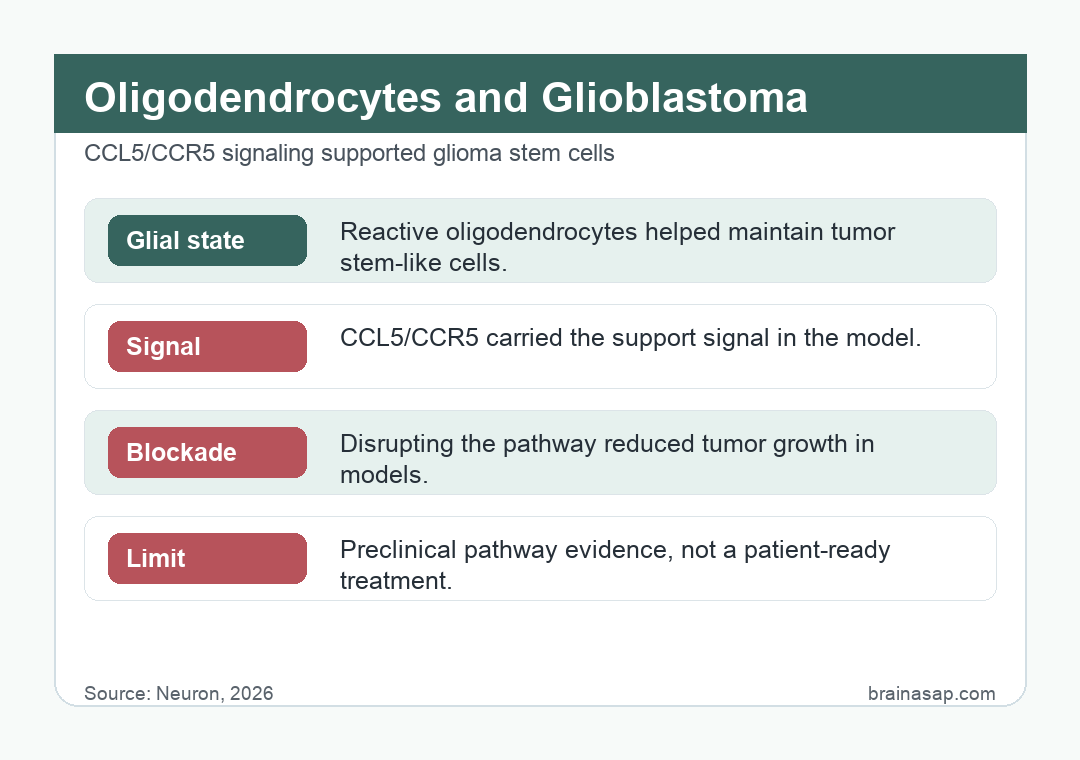
- CCL5/CCR5 showed the association: Reactive oligodendrocytes promoted glioma stem cell maintenance through a chemokine pathway better known from immune biology.
- Stem-like tumor cells gained support: The key target was not only bulk tumor mass but the self-renewing glioma stem cell compartment that helps recurrence.
- Blocking communication slowed growth: Interfering with the CCL5/CCR5 axis reduced tumor growth in laboratory models.
- A CCR5 drug class became relevant: Because CCR5 is already druggable, the pathway gives researchers a concrete repurposing experiment rather than a vague tumor-niche idea.
- The niche, not just the clone: The paper strengthens the view that glioblastoma progression depends on non-malignant brain-cell partners.
Source: Neuron (2026) | Mikolajewicz et al.
Glioblastoma is often described as a tumor that invades the brain.
This Neuron paper makes the brain side of that sentence more credible: support cells built for myelin maintenance can be pushed into a reactive state that helps the cancer preserve its stem-like engine.
Oligodendrocytes Became Tumor Accomplices, Not Bystanders
Oligodendrocytes usually earn their reputation by insulating axons with myelin. In a glioblastoma ecosystem, however, the same lineage can become reactive and start sending readouts that tumor cells know how to use.
Study details:
- Reactive oligodendrocytes: supplied CCL5 inside the tumor environment.
- Glioma stem cells: used CCR5 to respond to that chemokine cue.
- Pathway blockade: reduced tumor growth in laboratory models.
- Druggability: made CCR5 a concrete repurposing target rather than a vague niche marker.
That is the unsettling part of this study.
A support cell that normally helps neural circuits run cleanly became part of the malignant neighborhood, helping preserve the cells most responsible for persistence and relapse.
Glioblastoma recurrence is not driven only by the cells visible in the main tumor mass.
Stem-like glioma cells can resist stress, survive treatment pressure, and rebuild growth after therapy.
A niche readout that helps maintain that compartment is therefore more dangerous than a simple growth-factor footnote.
CCL5 and CCR5 Turned a Glial readout Into Stem-Cell Support
The named mechanism is the CCL5/CCR5 pathway. CCL5 is a chemokine, a signaling molecule cells use to recruit or instruct other cells; CCR5 is one of its receptors.
In this context, the pathway linked reactive oligodendrocytes to glioma stem cell maintenance.
The reason is glioma stem cells are not just another subpopulation.
They are the tumor’s durable seed bank, the cells that can survive stress and rebuild the disease.
- Readout source: reactive oligodendrocytes released CCL5 in the tumor environment.
- Tumor receptor: CCR5 let glioma stem cells respond to that chemokine cue.
- Disease effect: the pathway supported the stem-like compartment that helps glioblastoma persist.
- Intervention test: blocking the pathway reduced tumor growth in models, supporting a functional role rather than a descriptive marker.
The point is not that oligodendrocytes become cancer cells. It is that non-malignant brain cells can be recruited into a tumor-supporting state, changing the local chemistry around glioma stem cells.
Treatment design has to separate two problems: killing tumor cells and changing the niche. A therapy may shrink a mass while leaving behind environmental readouts that help the next wave of growth.
Blocking the Chemokine Conversation Cut Tumor Growth
The intervention result gives the paper its translational edge. When the researchers disrupted this oligodendrocyte-to-tumor communication in models, tumor growth dropped.
A CCR5-targeting drug class already exists because CCR5 has long been studied in HIV and immune signaling.
That does not make CCR5 blockade a glioblastoma treatment yet, but it moves the idea from abstract pathway biology toward a druggable experiment.
Repurposing logic is strongest when the target, disease mechanism, and delivery problem all line up.
Here, the target is plausible, the disease mechanism is model-based, and the hard tests are whether enough drug reaches the tumor niche and whether CCR5 blockade weakens the stem-cell compartment without unacceptable immune or neural effects.
The brain-delivery test is especially important.
A CCR5 blocker may look strong in a dish or a mouse model and still fail if it cannot reach the relevant tumor regions at the right concentration, or if glioblastoma bypasses the pathway through other niche readouts.
Timing also changes the experiment.
A pathway that maintains glioma stem cells may need to be blocked during the window when radiation or chemotherapy is creating selection pressure, because surviving stem-like cells are exactly the population that can rebuild the tumor.
Why a Brain Tumor’s Neighborhood May Be Its Weak Spot
Glioblastoma has repeatedly taught oncology that killing cancer cells is not enough. The tumor remodels vessels, immune cells, neurons, and glia, turning the surrounding brain into a protective terrain.
This study adds oligodendrocyte-lineage signaling to that list. Tumor progression can be a conversation, and some conversations are easier to interrupt than the cancer genome itself.
The niche framing also changes how recurrence is understood.
If glioma stem cells rely partly on nearby reactive brain cells, then therapy aimed only at tumor-intrinsic mutations can leave a support system intact.
The environment may keep feeding the cells that survive.
That is especially relevant in the brain, where glial cells are not passive scaffolding.
Oligodendrocytes, astrocytes, microglia, neurons, and vascular cells all send survival, inflammatory, electrical, or metabolic readouts that a tumor can exploit.
The oligodendrocyte finding also fits the broader shift in glioblastoma biology away from tumor-only thinking.
The disease behaves less like a sealed mass and more like a malignant ecosystem embedded in living neural tissue.
That ecosystem framing also explains why glioblastoma is so hard to treat surgically.
Even after the visible tumor is removed, infiltrating cells remain inside brain regions that cannot simply be cut away, and those cells continue interacting with local glia and circuits.
CCL5/CCR5 gives that ecosystem a named molecular route.
Instead of treating the tumor neighborhood as a vague collection of supportive cells, the paper identifies a readout source, a receptor, a stem-cell phenotype, and an intervention point.
What CCL5/CCR5 Still Cannot Promise Patients
The evidence is model-based, not a patient trial.
The big clinical tests remain dose, brain penetration, timing, patient selection, and whether blocking CCR5 would weaken the tumor without creating unacceptable immune or neural side effects.
Glioblastoma is also biologically heterogeneous. A CCR5 strategy may matter most in tumors with a strong reactive-oligodendrocyte signature, high CCL5/CCR5 activity, or a stem-cell state that depends on this niche readout.
For a disease where survival is often measured in months, a repurposable pathway is worth testing carefully.
The study makes the case that reactive oligodendrocytes are not scenery.
They are part of the machinery glioblastoma uses to keep moving.
The next step is not simply adding a CCR5 blocker to every glioblastoma regimen.
It is to test pathway activity, tumor penetration, combination timing with radiation or chemotherapy, and whether stem-like tumor cells lose self-renewal when the oligodendrocyte readout is interrupted.
A strong clinical translation would likely require biomarker selection. Patients whose tumors show high CCL5/CCR5 activity or a reactive-oligodendrocyte-rich niche may be the most rational group for early testing.
Combination strategy is another open test.
CCR5 blockade might need to be paired with radiation, temozolomide, immune therapy, or stem-cell-directed approaches if the goal is to weaken both the tumor cells and the niche that protects them.
The cleanest patient-facing version would not be “CCR5 for glioblastoma” in general.
It would be a trial that first proves the pathway is active in a tumor, verifies drug exposure in the tumor region, and then measures whether the stem-like compartment weakens after blockade.
Citation: DOI: 10.1016/j.neuron.2025.12.012. Mikolajewicz et al. Reactive oligodendrocytes promote glioblastoma progression through CCL5/CCR5-mediated glioma stem cell maintenance. Neuron. 2026;114(2):237-249.e10
Study Design: Mechanistic cancer-neuroscience study using glioblastoma models, cell-state analysis, and pathway blockade.
Sample/Model: Laboratory glioblastoma models and human tumor-context analyses.
Key Statistic: Blocking CCL5/CCR5-mediated oligodendrocyte-tumor signaling reduced tumor growth in models.
Caveat: Single-study evidence; interpret with the source design and sample.