TL;DR: A 2026 systematic review and meta-analysis in Neurological Sciences found that ketogenic diet (KD), a very-low-carbohydrate diet designed to raise ketone fuel use, looked feasible and generally safe as an add-on strategy in glioblastoma (GBM), but the survival signal still needs phase III randomized proof.
Key Findings
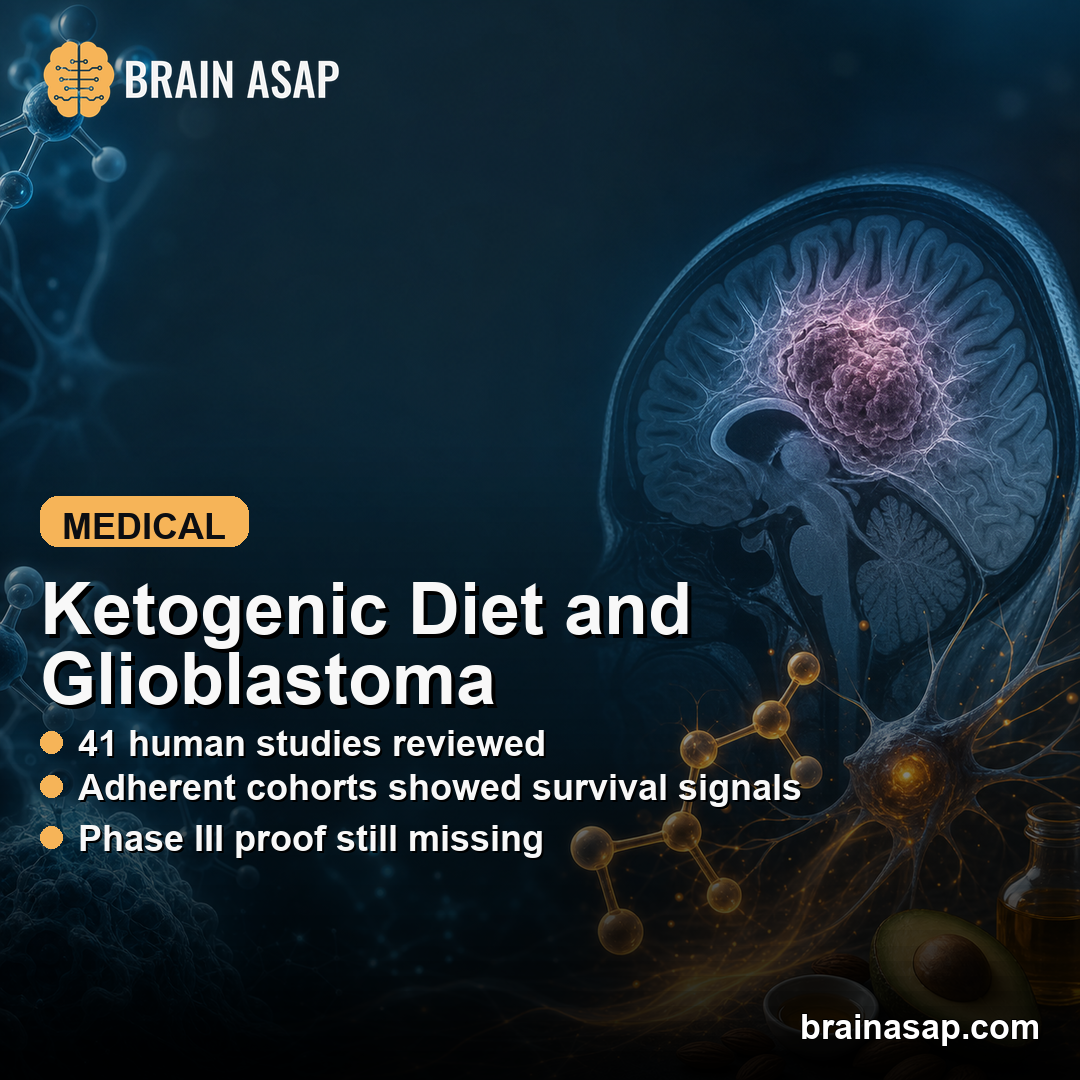
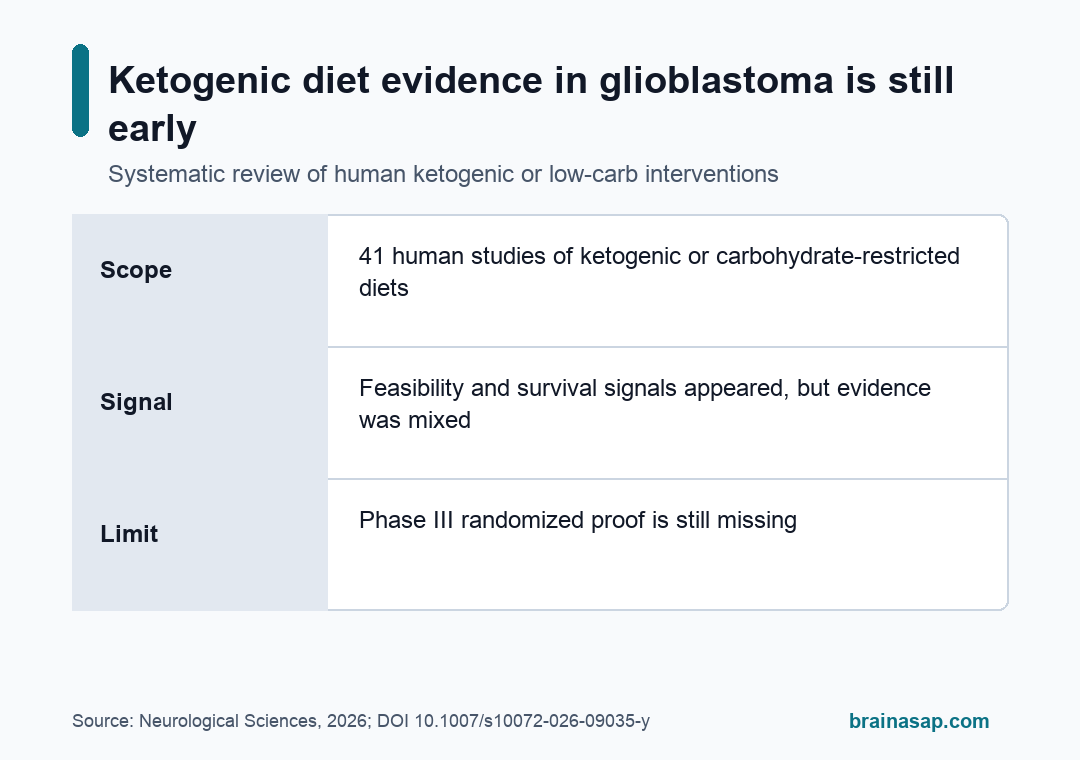
- The review included 41 human studies of ketogenic or carbohydrate-restricted dietary interventions in glioblastoma or high-grade glioma.
- Across included reports, more than 75% of patients reportedly maintained nutritional ketosis when adherence was measured.
- Some adherent cohorts reported median overall survival near 29.4 months, compared with a standard-care historical benchmark of 14.6 months.
- Safety: Reported diet-related side effects were usually mild, most often gastrointestinal symptoms, weight loss, fatigue, or transient metabolic issues.
- Caveat: The evidence remains limited by small cohorts, mixed diet protocols, variable outcome reporting, and no completed phase III trial proving clinical benefit.
Source: Firdous et al. Neurological Sciences. 2026.
Glioblastoma is a fast-growing brain cancer with poor survival even after maximal surgery, radiotherapy, and temozolomide chemotherapy. The review focused on whether ketogenic metabolic therapy could exploit a basic tumor feature: many GBM cells rely heavily on glucose-driven energy metabolism.
The clinical idea is not that diet replaces cancer treatment. Researchers reviewed whether a medically supervised ketogenic diet could sit beside standard care by lowering glucose availability, raising ketones, and changing metabolic conditions that GBM cells may be less able to use.
Ketogenic Diet Targeted the Glucose Dependency of Glioblastoma
GBM often shows the Warburg effect, meaning tumor cells favor glycolysis, a glucose-using energy pathway, even when oxygen is available. The review treated that metabolic pattern as the biological reason for studying KD in this setting.
In a ketogenic diet, carbohydrate intake is restricted enough to raise ketone bodies, including beta-hydroxybutyrate, while lowering glucose and insulin signaling. Healthy neurons can use ketones as fuel, but GBM cells may be more metabolically constrained.
The paper described several mechanisms that could matter in glioblastoma research:
- Lower glucose pressure: KD aims to reduce the glucose availability that can support glycolytic tumor growth.
- Ketosis as exposure: Nutritional ketosis was usually defined around beta-hydroxybutyrate levels of at least 0.5 mmol/L.
- Radiation sensitivity: Some studies tested KD during radiotherapy or chemoradiotherapy because metabolic stress might make tumor cells more vulnerable.
- Metabolic monitoring: Several protocols tracked glucose-to-ketone balance rather than treating diet assignment alone as the active exposure.
That mechanism is plausible, but plausibility is not the same as treatment proof. The review’s main clinical value is that it brings together feasibility, safety, and survival findings across a fragmented literature.
Forty-One Human Studies Were Included
Researchers searched PubMed, Embase, Cochrane, and Web of Science for human studies published from 2000 through September 2025. After screening, 41 studies met inclusion criteria, including randomized trials, prospective cohorts, retrospective reports, case series, case reports, and abstracts.
The included diet strategies were not identical. A strict classic KD is a different clinical exposure from a modified Atkins diet, calorie-restricted KD, medium-chain triglyceride diet, intermittent fasting protocol, or time-restricted ketogenic plan.
The review grouped the evidence across several intervention patterns:
- Classic 4:1 KD: A high-fat diet with a 4:1 ratio of fat to combined carbohydrate and protein.
- Modified Atkins diet: A less restrictive ketogenic approach used in some glioma feasibility studies.
- Calorie-restricted KD: A ketogenic diet paired with energy restriction or short fasting cycles.
- Ketogenic metabolic therapy: Broader protocols that used ketosis, glucose restriction, and glucose-to-ketone monitoring as a treatment framework.
Sample sizes were often small, ranging from single-patient reports to cohorts above 100 patients. Disease settings also varied, including newly diagnosed GBM, recurrent GBM, pediatric high-grade glioma, and mixed glioma-grade cohorts.
Survival Signals Were Strongest in Adherent Cohorts
The clearest numerical finding came from studies where patients sustained ketosis and remained adherent. The review highlighted recent data in which adherent cohorts had median overall survival of 29.4 months, against a historical standard-care benchmark of 14.6 months.
Another cited adherent subgroup reported a 66.7% three-year survival rate, against 8.3% in controls or expected comparators. Those numbers are attention-grabbing, but they should be read as findings from small and selected groups rather than proof that KD doubles survival.
Several reasons make the survival interpretation cautious:
- Selection bias: Patients who maintain a difficult diet may differ from patients who cannot, including by support, disease burden, or baseline health.
- Historical benchmark: A 14.6-month standard-care benchmark is useful context, but it is not the same as a randomized same-trial control arm.
- Molecular variation: IDH mutation and MGMT methylation status can affect glioblastoma outcomes, but many included studies did not stratify consistently by these markers.
- Protocol variation: Diet intensity, duration, monitoring, and concurrent cancer treatments differed across studies.
KD looks plausible enough to keep testing, especially when nutritional ketosis is actually achieved. The review does not show that patients should self-start a ketogenic diet outside oncology and dietitian supervision.
Safety Looked Acceptable but Monitoring Still Matters
Across the review, reported diet-related side effects were usually mild. Common events included gastrointestinal symptoms, fatigue, weight loss, constipation, hypoglycemia, lightheadedness, and other tolerability problems that can matter in already vulnerable cancer patients.
No grade 3/4 diet-related toxicities were reported across the reviewed evidence. That safety finding supports continued clinical testing, but it does not remove the need for monitoring.
Glioblastoma patients may be receiving surgery, radiation, chemotherapy, steroids, anti-seizure drugs, and other supportive treatments while trying to maintain nutritional ketosis.
A medically supervised KD program would need to track several practical issues:
- Nutrition adequacy: Weight loss may be undesirable if a patient is already losing strength during treatment.
- Metabolic labs: Glucose, ketones, electrolytes, and hydration status can shift during carbohydrate restriction.
- Medication context: Steroids, diabetes drugs, anti-seizure drugs, and chemotherapy side effects can all change diet safety.
- Quality of life: A demanding diet is only useful if the patient can sustain it without worsening daily function.
Phase III Trials Need to Separate Signal From Proof
The limitation section keeps the result grounded. Most available studies were small, non-randomized, unblinded, and heterogeneous.
Diet composition, treatment length, ketosis targets, adherence checks, and outcome endpoints varied enough that pooled interpretation remains uncertain.
Researchers pointed to ongoing or registered trials as the next necessary step. One listed study, DIET2TREAT, is a randomized phase 2 trial of ketogenic diet versus standard dietary guidance during standard-of-care glioblastoma treatment.
Other trials are testing ketogenic diet with metformin or more intensive fasting and time-restricted ketogenic programs.
For now, the conclusion is measured: ketogenic diet appears feasible, generally safe, and biologically rational as an adjunct strategy in glioblastoma care.
The next question is whether controlled trials can reproduce the survival findings without relying on historical benchmarks or highly selected adherent patients.
Citation: DOI: 10.1007/s10072-026-09035-y. Firdous et al. Efficacy and safety of ketogenic diet in glioblastoma: an updated systematic review and meta-analysis. Neurological Sciences. 2026;47:461.
Study Design: Systematic review and meta-analysis of human ketogenic-diet studies in glioblastoma and high-grade glioma.
Sample Size: 41 included studies, ranging from single-patient reports to cohorts above 100 patients.
Key Statistic: Some adherent cohorts reported median overall survival of 29.4 months versus a 14.6-month historical standard-care benchmark.
Caveat: The evidence is heterogeneous and mostly small or non-randomized, so phase III trials are still needed before KD can be treated as proven glioblastoma therapy.