TL;DR: A 2026 study in Brain, Behavior, & Immunity – Health found that whole-body hyperthermia in adults with major depressive disorder triggered a 30-minute whole-blood RNA-seq response dominated by heat-shock genes and immune pathways, including IL-6 production.
Key Findings
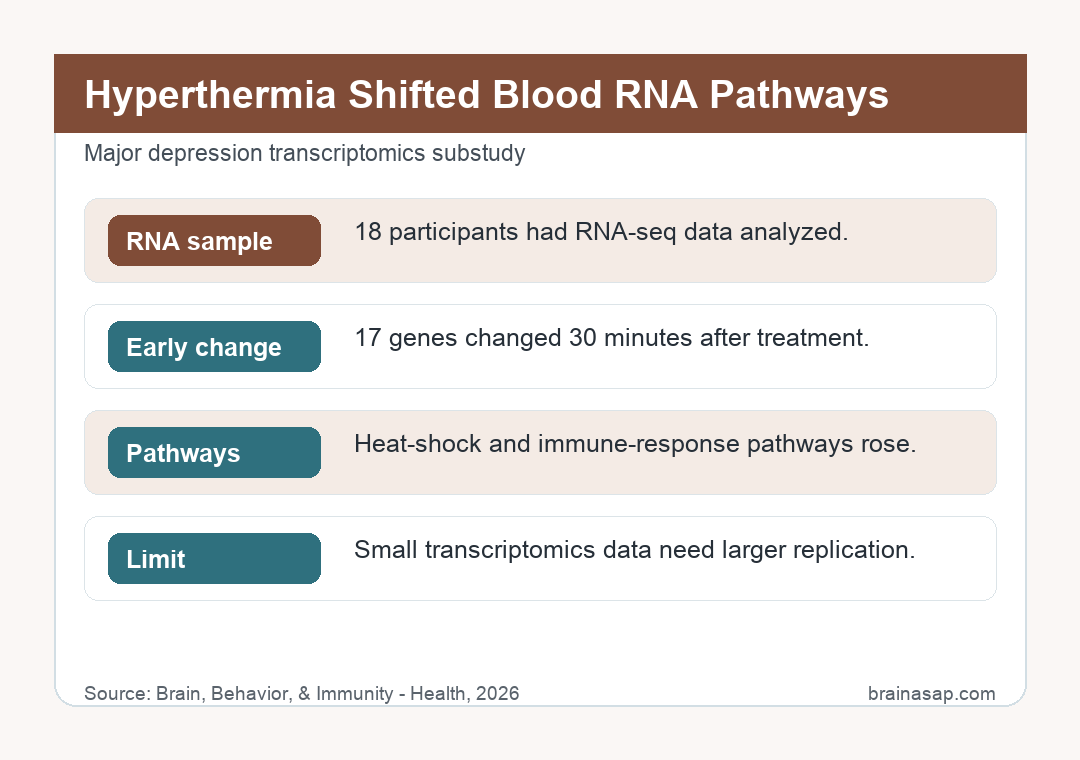
- 18 RNA-seq participants: Whole-blood RNA sequencing was available for 9 adults assigned to whole-body hyperthermia and 9 assigned to sham hyperthermia.
- 38.5 C heat target: Infrared whole-body hyperthermia was designed to raise core temperature to the lower limit of mild fever, about 38.5 C.
- 17 genes changed at 30 minutes: Differential expression analysis found 17 genes meeting the q-value < 0.01 threshold, with 14 upregulated and 3 downregulated after whole-body hyperthermia.
- Heat-shock genes dominated: Genes encoding heat-shock proteins made up 41% of the differentially expressed genes, including HSPA1A, HSPA1B, HSPH1, HSP90AB1, HSPA4, and HSP90AA1.
- 88 biological processes were enriched: Gene set enrichment analysis found 88 upregulated biological processes at FDR q < 0.05, including heat-shock and immune-response pathways.
Source: Brain, Behavior, & Immunity – Health (2026) | Akonom et al.
Whole-Body Hyperthermia Tested Heat Biology in Major Depression
Whole-body hyperthermia is being studied as a possible depression treatment because controlled heat exposure can produce biological changes that overlap with exercise, fever-like immune signaling, and stress-response pathways.
Researchers returned to blood samples from a small sham-controlled whole-body hyperthermia trial and asked a mechanistic question: what changed in the blood transcriptome half an hour after the heat session?
Major depressive disorder is usually discussed through neurotransmitters, psychotherapy, inflammation, sleep, or stress hormones. Controlled heat exposure sits at the intersection of several of those systems because it creates a short physiological challenge rather than a daily medication exposure.
In the parent trial, adults with moderate to severe major depressive disorder were randomized to whole-body hyperthermia or a sham procedure.
The intervention used infrared heat to raise core body temperature to about 38.5 C, the lower edge of mild fever.
Depression symptoms were then followed for 6 weeks.
The current paper focused on a subset of that trial.
Out of 34 enrolled participants, whole-blood RNA-seq data were available for 18 people, split evenly between whole-body hyperthermia and sham.
Blood was collected 30 minutes after the intervention, when prior analyses had already shown an immediate IL-6 protein response.
A 30-minute blood draw cannot show long-term remodeling of depression biology, but it can show the immediate molecular response to heat exposure. The study therefore works best as a mechanism paper, not as a standalone clinical-efficacy trial.
RNA Sequencing Found 17 Heat-Sensitive Blood Genes
Researchers used whole-blood RNA sequencing to compare gene expression after whole-body hyperthermia with expression after the sham condition. Biological sex was identified as a confounding variable in principal component analysis and was controlled in the differential-expression model.
The main gene-level result was concentrated rather than broad. At a false-discovery-rate adjusted threshold of q 17 genes were differentially expressed.
Fourteen were upregulated and three were downregulated in the hyperthermia group compared with sham. Heat-shock biology was the clearest pattern.
HSPA1A and HSPA1B, both members of the HSP70 family, were upregulated with log2 fold changes around 1.0.
HSPH1, HSP90AB1, HSPA4, and HSP90AA1 also appeared in the significant gene list.
Heat-shock proteins help cells manage stress-damaged or misfolded proteins. The blood transcriptome therefore showed that the body registered the heat exposure as a real physiological event, not as a mild comfort intervention.
- Heat-shock signal: HSP70-family genes were prominent in the 30-minute response.
- Immune signal: Enriched pathways included cytokine and interferon-related processes.
- Clinical boundary: The RNA-seq data explain an immediate blood response, not long-term depression remission.
Immune Pathways Rose Alongside Heat-Shock Response Genes
The analysis becomes more relevant to depression when it moves beyond classic heat-stress genes. Whole-body hyperthermia also increased markers tied to immune response, including CLEC17A, a gene encoding a surface protein thought to play a role in proliferating B cells.
Gene set enrichment analysis widened the view from individual genes to biological processes. At the FDR q 88 enriched biological processes , and none were significantly downregulated.
A stricter family-wise error correction still left 17 upregulated processes. The highest-confidence list included expected heat-response processes such as:
- Chaperone-mediated protein folding: a cellular system for stabilizing and refolding proteins under stress.
- Chaperone cofactor-dependent protein refolding: another heat-shock-linked process that helps recover protein structure.
- Cellular response to heat: the direct biological category that fits the intervention itself.
Immune processes were also present in the stricter list, including positive regulation of response to cytokine stimulus, B-cell receptor signaling, peptide antigen assembly with MHC protein complex, positive regulation of type I interferon production, and positive regulation of interferon beta production.
IL-6 Production Connected RNA-Seq to Earlier Depression Findings
Interleukin-6, or IL-6, is a cytokine involved in immune signaling.
Depression research often treats IL-6 as a marker of inflammation, but the biology is not one-directional.
Acute IL-6 changes after exercise or heat exposure may differ from chronic low-grade inflammation.
That distinction is important here because previous analyses of the same trial reported an immediate increase in plasma IL-6 after whole-body hyperthermia.
The new RNA-seq analysis did not find IL6 mRNA itself to be statistically significant after multiple-testing correction, but it did find the broader biological process called interleukin 6 production among the enriched gene sets.
The paper therefore supports a narrower claim: the blood transcriptome after heat exposure was consistent with heat-shock activation plus immune signaling that overlaps with IL-6 production. It does not prove that IL-6 alone caused the antidepressant effect.
That is still useful.
If whole-body hyperthermia improves depression for some patients, the mechanism may involve a short, coordinated stress response rather than simple relaxation or placebo expectation.
Heat-shock pathways, cytokine signaling, and immune-cell communication are plausible pieces of that response.
Depression Scores Improved at Weeks 1 and 2 in the RNA-Seq Subsample
The RNA-seq substudy was small, but it retained the early clinical pattern from the larger parent trial. Baseline Hamilton Depression Rating Scale scores were similar between groups: 20.63 in the hyperthermia group and 21.89 in the sham group.
After treatment, adjusted HDRS scores were lower in the hyperthermia group at week 1 and week 2.
At week 1, the adjusted mean was 14.68 for whole-body hyperthermia versus 20.52 for sham, with d = 1.17 and p = 0.020. At week 2, the adjusted mean was 13.25 versus 19.04, with d = 1.08 and p = 0.031.
By week 4, the group difference was no longer statistically significant, although the effect size was still medium.
By week 6, the difference was minimal.
That time course fits the study’s timing caution: the molecular readout was immediate, while the symptom effect was strongest in the first 2 weeks.
Those clinical numbers should not be overextended.
The RNA-seq group included only 17 participants with usable HDRS follow-up data for the subgroup analysis.
The study was not powered to define which patients should receive heat-based treatment.
Small-Sample Bulk RNA-Seq Limits the Depression Mechanism Claim
The strongest limitation is sample size. The mechanistic analysis compared 9 hyperthermia participants with 9 sham participants, which is enough to detect a large heat-shock response but not enough to map the full immune biology of depression treatment.
Researchers used bulk whole-blood RNA-seq, not single-cell RNA-seq. Bulk sequencing can show that a blood sample changed, but it cannot cleanly identify which immune-cell subtype drove each transcriptomic pattern.
The paper names two additional sensitivity issues.
Baseline samples were not available for this particular 30-minute comparison, and globin mRNA was not depleted before sequencing.
Both factors may have made the analysis more conservative and could have increased false negatives.
Whole-body hyperthermia produced a measurable blood response in people with major depressive disorder, and the response included both heat-defense and immune pathways. Whether those early transcriptomic changes mediate antidepressant improvement still needs larger, more cell-specific, time-resolved studies.
Sauna, hot bath, and whole-body hyperthermia studies can easily be pulled into wellness claims that run ahead of the evidence. This analysis narrows the claim to measurable transcriptomic changes after controlled heat exposure.
Heat exposure is not yet a proven stand-alone treatment for depression. In this small randomized depression sample, controlled whole-body hyperthermia activated heat-shock genes and immune biological processes within 30 minutes, while the same substudy showed early symptom improvement over the next 2 weeks.
Heat may matter because it briefly pushes the body through a coordinated stress and immune-response program. The clinical question is whether that program can be tuned, repeated, and targeted safely enough to help specific patients with major depressive disorder.
Citation: DOI: 10.1016/j.bbih.2026.101225. Akonom et al. Whole-blood transcriptomic response to whole-body hyperthermia in participants with major depressive disorder. Brain, Behavior, & Immunity – Health. 2026;54:101225.
Study Design: Mechanistic RNA-seq analysis nested within a randomized, double-blind, sham-controlled whole-body hyperthermia trial in adults with major depressive disorder.
Sample Size: 18 participants with whole-blood RNA-seq at 30 minutes after intervention, including 9 assigned to whole-body hyperthermia and 9 assigned to sham hyperthermia.
Key Statistic: Differential-expression analysis found 17 genes altered at q < 0.01, with 14 upregulated and 3 downregulated after whole-body hyperthermia.
Caveat: The RNA-seq substudy was small, used a single 30-minute post-intervention blood draw, and cannot prove that transcriptomic changes caused the later depression-score differences.